

27 May
Why Aluminum Composite Panel Curtain Walls Leak Water and How Waterproofing Systems Should Be Designed
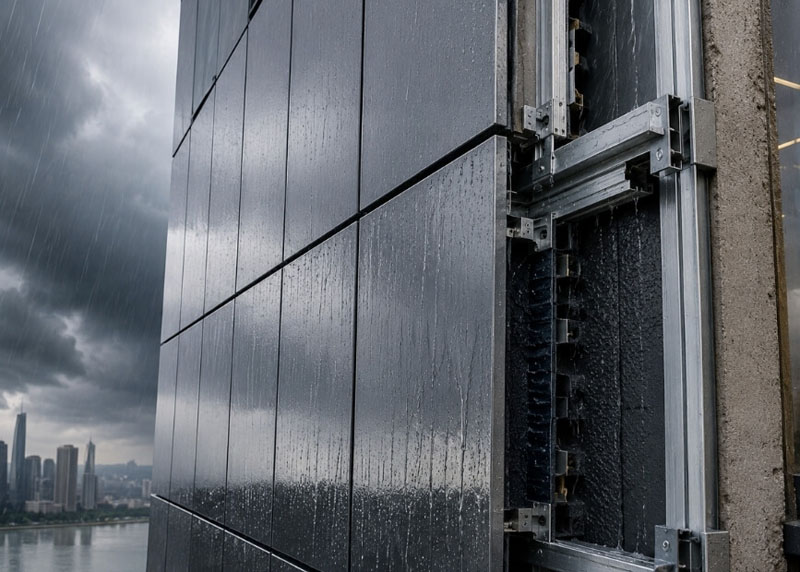
Water leakage in aluminum composite panel curtain walls is rarely caused by a single material failure. In many façade projects, infiltration problems develop gradually after thermal cycling, wind exposure, joint fatigue, drainage blockage, or installation deviations begin affecting the wall assembly over time. Even curtain walls that initially pass water penetration testing may eventually experience leakage if movement management and drainage continuity were not properly considered during design and fabrication.
Modern curtain wall waterproofing is no longer based on the assumption that the exterior façade surface will remain permanently watertight. High-performance ACM curtain wall systems are designed around pressure moderation, controlled drainage, movement accommodation, and staged sealing strategies. This approach is particularly important in high-rise buildings, coastal regions, humid climates, and projects exposed to severe wind-driven rain conditions.
Why Water Penetration Happens in ACM Curtain Wall Systems
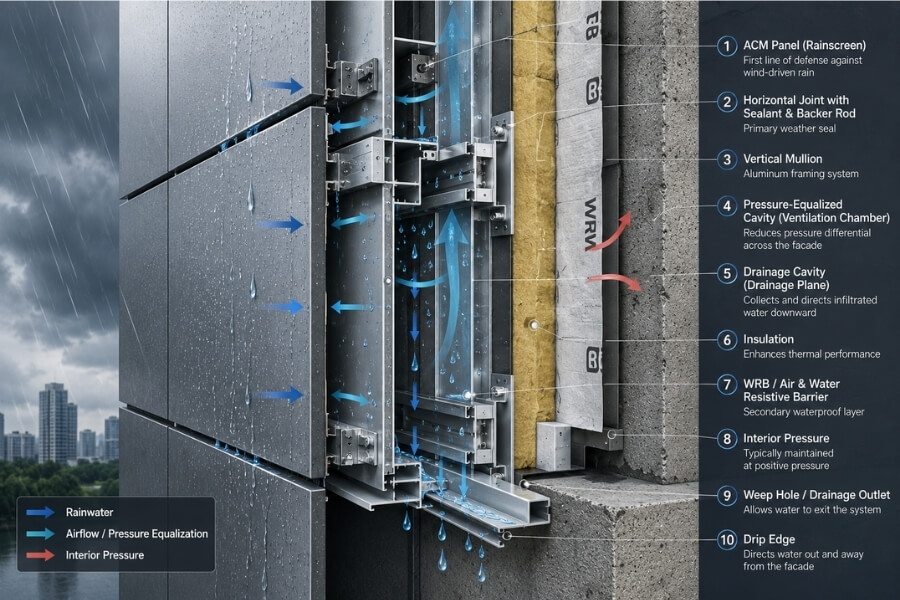
Rainwater penetration usually requires three conditions:
Openings or discontinuities within the façade assembly
Water exposure at the exterior surface
Pressure differences that force moisture inward
In real construction environments, eliminating every small opening inside a curtain wall system is unrealistic. Curtain walls consist of multiple interfaces between ACM panels, aluminum framing, glazing systems, anchors, gaskets, sealants, and movement joints. As the building responds to wind loading, temperature changes, slab deflection, and structural movement, these interfaces continuously shift under stress.
This is why modern façade engineering focuses less on absolute sealing and more on controlling how water behaves once it reaches the exterior skin.
Why Sealant Alone Cannot Fully Waterproof a Curtain Wall
One of the most common misconceptions in façade construction is that exterior silicone sealant alone can permanently stop water infiltration.
In reality, exposed sealant joints are constantly subjected to:
UV radiation
thermal expansion and contraction
cyclic joint movement
airborne contamination
moisture exposure
substrate stress
Over time, even high-quality silicone can lose elasticity or adhesion if joint geometry is poorly designed or if movement exceeds the sealant’s allowable capability.
Field inspections on aging curtain wall projects often reveal similar conditions. Exterior joints may appear visually intact, yet hidden debonding, micro-cracking, or adhesion loss has already developed behind the exposed sealant surface. Leakage frequently begins at these concealed interfaces long before visible façade damage appears.
For this reason, high-performance curtain wall systems rely on layered waterproofing strategies rather than a single exposed seal line.
The Role of Pressure Equalization in Curtain Wall Waterproofing
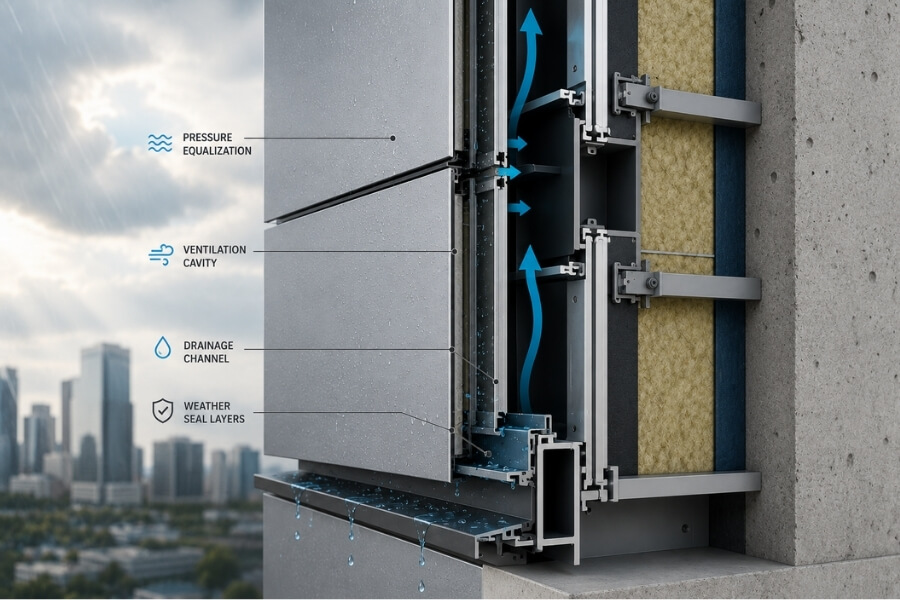
Pressure equalization is one of the most important concepts in modern rainscreen curtain wall design. Many leakage problems are not caused by large visible openings, but by wind pressure driving water through extremely small gaps within the façade assembly.
How Pressure-Equalized Rainscreen Systems Reduce Water Infiltration
Pressure-equalized curtain wall systems use drainage cavities and ventilation chambers behind the exterior ACM surface to reduce pressure differences across joints.
When wind pressure inside the cavity approaches exterior pressure conditions, rainwater becomes less likely to travel inward through joints and interfaces. Any moisture that penetrates the outer façade layer can then drain downward through controlled drainage paths before reaching sensitive interior components.
This design philosophy represents a major shift from older “barrier wall” thinking. Instead of attempting to block all water at the exterior surface, modern rainscreen systems are designed to safely manage limited water penetration under severe weather exposure.
Why Drainage Cavities and Ventilation Paths Matter
Drainage cavities are critical because curtain wall systems inevitably experience some degree of water intrusion during heavy rain events.
Without proper drainage continuity, water may remain trapped behind the ACM surface for extended periods. Over time, this trapped moisture can contribute to:
corrosion around anchors and fasteners
insulation degradation
staining at joint interfaces
freeze-thaw damage
sealant deterioration
concealed mold growth
In older curtain wall projects, drainage cavities are often partially obstructed by construction debris, displaced insulation, excess sealant residue, or improperly installed flashing components. Once drainage slows, standing water can accumulate inside the cavity after repeated storm exposure.
Ventilation openings also play an important role by allowing moisture within the cavity to evaporate more efficiently after rain events.
Key Waterproofing Components in ACM Curtain Wall Assemblies
Curtain wall waterproofing performance depends on how multiple materials function together as a coordinated system.
EPDM Gaskets and Compression Seals
EPDM gaskets are widely used in curtain wall systems because of their long-term resistance to UV exposure, ozone, humidity, and temperature fluctuations.
Unlike lower-grade sealing materials, EPDM maintains flexibility and compression recovery over extended service periods. This helps preserve sealing performance even as curtain wall framing expands and contracts under thermal loading.
In practical installation conditions, gasket compression must be carefully controlled. Excessive compression can accelerate material fatigue, while insufficient compression may create leakage pathways during pressure-driven rain exposure.
Structural Silicone vs Weather Seal Silicone
Structural silicone and weather seal silicone perform different functions inside curtain wall systems.
Structural silicone transfers loads between glazing or panel components and supporting frames. Weather seal silicone primarily protects exterior joints from environmental exposure and water penetration.
Confusion between these two materials can create major performance risks. Structural silicone applications typically require stricter environmental controls during fabrication, including substrate cleanliness verification, curing condition management, and adhesion testing.
On some projects, sealant failure is not caused by the silicone itself, but by incompatible coatings, contaminated substrates, or unstable joint dimensions created during fabrication and installation.
Backer Rods and Foam Fillers in Expansion Joints
Backer rods and polyethylene foam fillers are often treated as secondary materials, yet they strongly influence long-term joint reliability.
Properly sized backer rods help control:
sealant depth
joint geometry
movement flexibility
stress distribution
adhesion behavior
Improper backer rod sizing may create excessive sealant depth or unintended three-sided adhesion, both of which can increase stress concentration during thermal movement.
How Thermal Movement Affects Curtain Wall Waterproofing
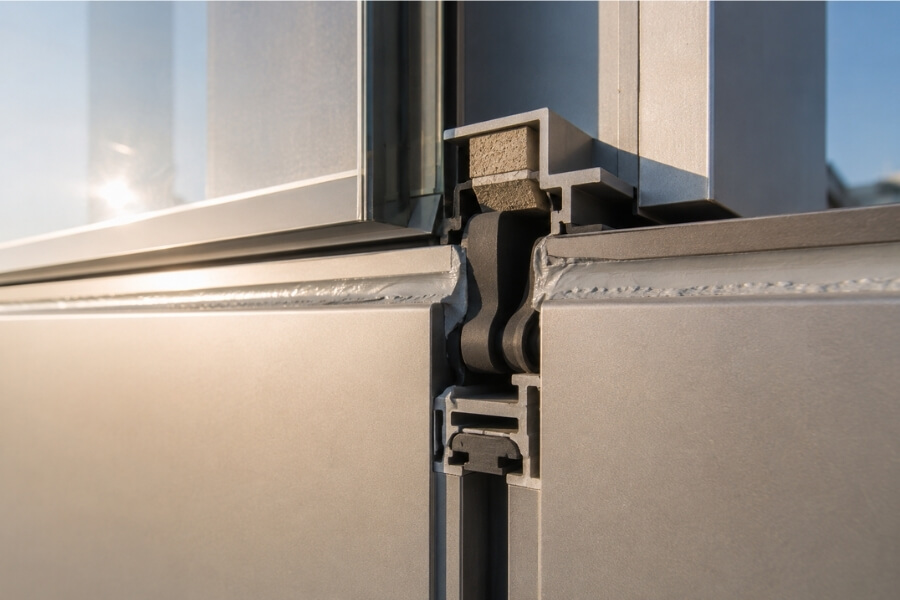
Thermal movement is one of the most underestimated causes of curtain wall leakage.
Aluminum expands and contracts significantly under temperature variation. Large ACM façade elevations exposed to direct sunlight may experience continuous dimensional movement throughout the day, particularly on dark-colored façades with high solar heat absorption.
Aluminum Expansion and Joint Fatigue
As ACM panels expand and contract, joint systems must repeatedly absorb movement without losing waterproofing integrity.
If joint spacing is too narrow, compressive stress may develop between adjacent panels. If joint width is oversized without proper sealant design, excessive movement can strain the sealant bead beyond its intended capability.
Over time, repeated thermal cycling may contribute to:
sealant cracking
edge stress concentration
gasket fatigue
panel distortion
localized water infiltration
This issue becomes more visible on long-span façades and high-rise curtain wall elevations where cumulative movement increases significantly.
How Fabrication Accuracy Influences Waterproofing Reliability
Curtain wall waterproofing performance is closely related to fabrication precision.
In ACM cassette panel systems, variations in routing depth, edge forming accuracy, panel flatness, or return dimensions can directly affect joint consistency after installation. Uneven joint widths may create localized sealant stress concentrations or inconsistent gasket compression.
Field installers sometimes compensate for fabrication deviations by overfilling sealant joints or forcing panel alignment during installation. While these adjustments may improve visual appearance temporarily, they often reduce the movement capacity originally intended within the façade design.
This is one reason why manufacturing consistency plays an important role in long-term curtain wall durability.
Movement Between the Curtain Wall and Structural Slab
Curtain wall systems must also accommodate movement between the façade frame and the building structure itself.
Movement sources may include:
slab deflection
building sway
seismic loading
creep and shrinkage
differential thermal expansion
Improperly detailed movement joints around slab edges, parapets, corners, and window interfaces are common sources of water infiltration in large commercial façades.
Common Waterproofing Failures in Aluminum Composite Panel Façades
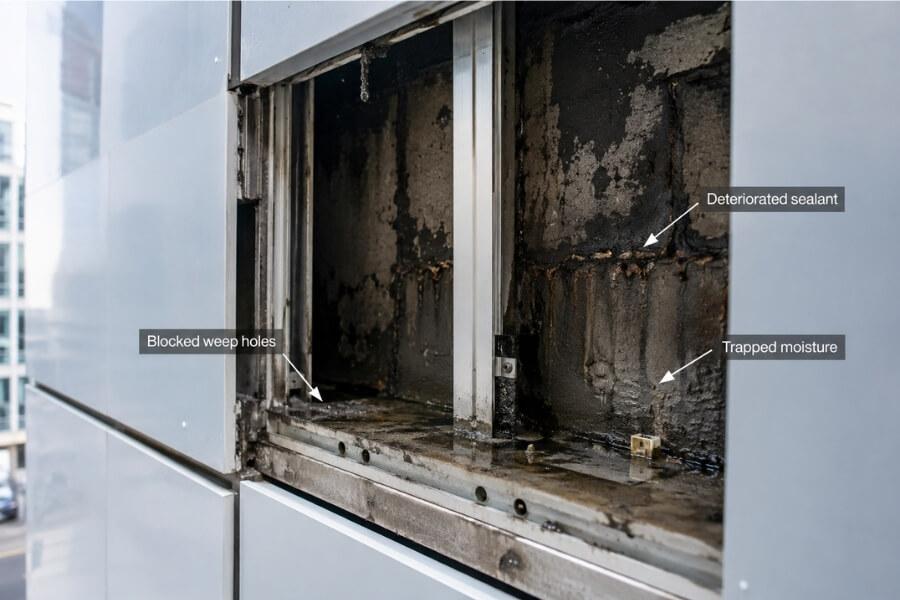
Many leakage problems originate from detailing and installation conditions rather than the ACM panels themselves.
Blocked Drainage Paths
Drainage interruption is one of the most common causes of concealed curtain wall leakage.
During construction, drainage holes and cavity pathways may become obstructed by:
excess sealant
protective film residue
insulation displacement
metal shavings
construction debris
Water may remain trapped inside the cavity long after rainfall ends. Under repeated wind pressure cycles, this moisture can migrate toward interior interfaces.
Improper Sealant Application Conditions
Sealant performance depends heavily on environmental conditions during installation.
Problems frequently occur when sealants are applied:
during rain exposure
on contaminated surfaces
under excessive humidity
outside recommended temperature ranges
before substrates are fully dry
Poor curing conditions can reduce adhesion strength and long-term elasticity even if the sealant initially appears acceptable during visual inspection.
Incompatible Sealants and Material Contamination
Compatibility issues between coatings, sealants, tapes, and substrates are another common source of façade deterioration.
Compatibility testing is especially important when combining:
PVDF-coated ACM panels
silicone sealants
EPDM gaskets
foam fillers
adhesive membranes
In some projects, visible staining or adhesion loss develops because incompatible materials were selected during procurement rather than because of installation workmanship alone.
Poorly Detailed Window and Corner Interfaces
Waterproofing failures often appear first around:
window perimeters
slab transitions
parapets
façade corners
expansion joints
These locations experience concentrated movement and more complex drainage conditions. Small discontinuities in flashing integration or air barrier continuity can create hidden water migration paths behind the curtain wall assembly.
Installation and Quality-Control Considerations for Long-Term Waterproofing
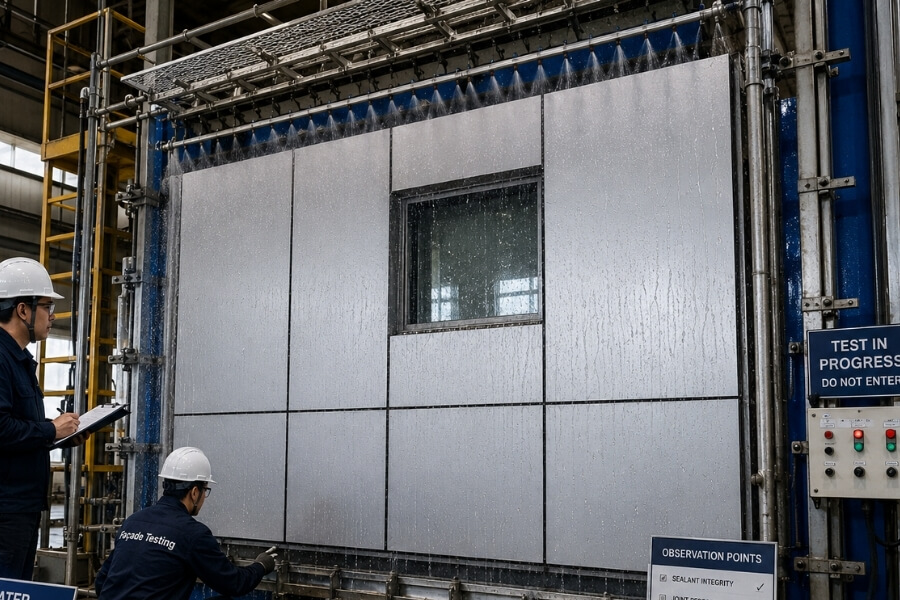
Even well-designed curtain wall systems can fail if installation quality is inconsistent.
Water Penetration Testing and Mock-Up Validation
Mock-up testing and staged water penetration testing help identify drainage and sealing weaknesses before full project completion.
These tests commonly evaluate:
joint performance
cavity drainage behavior
pressure resistance
seal continuity
interface detailing
Field testing becomes especially important for high-rise façades exposed to severe wind-driven rain conditions.
Sealant Inspection and Adhesion Verification
Long-term waterproofing reliability depends heavily on quality-control procedures during installation.
Inspection programs may include:
substrate cleanliness verification
adhesion testing
joint dimension inspection
curing condition monitoring
sealant batch traceability
Small installation inconsistencies can later become major sources of water infiltration once the façade begins experiencing long-term environmental loading.
Why Curtain Wall Maintenance Still Matters After Installation
Curtain wall waterproofing systems are not permanently maintenance-free.
Over time, routine inspections should evaluate:
aging sealants
gasket deterioration
blocked drainage cavities
panel displacement
hardware wear
flashing damage
Many large-scale façade remediation projects could have been reduced significantly if early-stage maintenance and drainage cleaning had been performed before leakage spread throughout the wall assembly.
Designing More Reliable ACM Curtain Wall Waterproofing Systems
Reliable curtain wall waterproofing depends on understanding how the entire façade assembly behaves under real environmental conditions.
High-performance ACM curtain wall systems are typically designed around several principles:
pressure moderation instead of absolute exterior sealing
controlled cavity drainage
movement accommodation
staged waterproofing protection
compatible material selection
long-term weather resistance
fabrication consistency
installation precision
Modern façade waterproofing is ultimately a system-engineering issue rather than a single-product issue.
Conclusion
Water infiltration in aluminum composite panel curtain walls is often the result of movement stress, drainage interruption, sealant fatigue, or detailing inconsistencies that gradually develop over time. Long-term waterproofing performance depends on how effectively the façade system manages pressure, moisture, ventilation, and thermal movement as a complete assembly.
As curtain wall projects continue moving toward larger panel sizes, more demanding climate exposure, and increasingly complex façade geometries, the importance of drainage-based waterproofing design continues to grow.
Aluwell® understands that reliable curtain wall performance depends on more than panel appearance alone. In modern rainscreen and curtain wall applications, fabrication precision, coating stability, dimensional consistency, and façade system compatibility all contribute to supporting long-term waterproofing reliability under real project conditions.
FAQ
Why do ACM curtain walls still leak after passing initial water testing?
Initial testing usually evaluates short-term waterproofing performance under controlled conditions. Over time, thermal cycling, sealant aging, structural movement, drainage blockage, and installation stress may gradually weaken the façade system, eventually creating concealed leakage paths behind the curtain wall assembly.
What is the difference between a barrier wall and a rainscreen curtain wall?
Barrier walls attempt to stop all water at the exterior surface, while rainscreen systems accept that limited water penetration may occur. Rainscreen curtain walls manage moisture through pressure equalization, drainage cavities, ventilation paths, and secondary waterproofing layers behind the exterior façade surface.
Why is thermal movement important in curtain wall waterproofing?
Aluminum framing and ACM panels expand and contract continuously under temperature changes. If joints cannot accommodate movement properly, sealants and gaskets may fatigue over time. This can eventually create cracking, adhesion failure, or water infiltration at façade interfaces.
Why are drainage cavities important in ACM curtain wall systems?
Drainage cavities help remove infiltrated rainwater before moisture reaches sensitive interior components. They also allow ventilation and cavity drying after rain exposure. Without proper drainage continuity, trapped water may contribute to corrosion, insulation damage, mold growth, and long-term façade deterioration.
How can fabrication quality affect waterproofing performance?
In ACM cassette systems, inaccurate routing depth, inconsistent joint spacing, poor panel flatness, or unstable edge forming may create uneven sealant stress and inconsistent gasket compression. These fabrication deviations can reduce long-term waterproofing reliability after installation.
What materials are commonly used in curtain wall sealing systems?
Typical sealing systems include structural silicone sealants, weather seal silicone, EPDM gaskets, polyethylene foam fillers, backer rods, flashing membranes, and drainage components. Material compatibility is critical because incompatible coatings or substrates may affect long-term adhesion and durability.