

26 May
ACP Panels in Modern Building Envelope Design - Performance, Fabrication, and Façade Applications
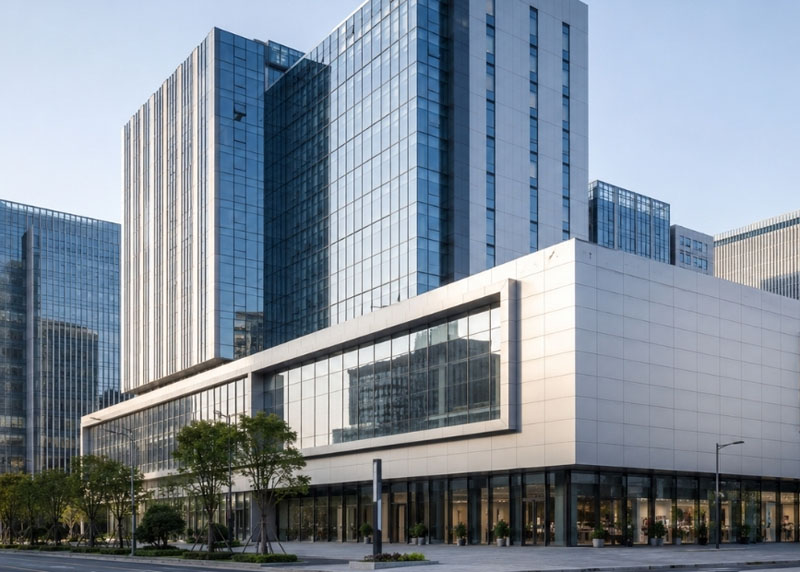
Modern façade systems are expected to perform as engineered environmental barriers rather than simple decorative surfaces. Architects and façade consultants now evaluate exterior cladding systems based on thermal movement, moisture management, installation tolerances, long-term coating stability, and lifecycle durability instead of appearance alone.
This shift is one reason ACP panels, also known as ACM panels or aluminum composite panels, became widely adopted across commercial towers, transportation hubs, retail podiums, institutional buildings, and façade retrofit projects. Their lightweight structure, fabrication flexibility, and compatibility with rainscreen assemblies allow architects to create cleaner façade geometries while reducing structural load and installation complexity.
However, ACP systems only perform reliably when fabrication quality, movement accommodation, joint detailing, and enclosure integration are properly coordinated. Many façade failures associated with aluminum composite panels are not caused by the material itself, but by drainage interruption, installation inconsistency, sealant breakdown, or inadequate thermal movement planning.
Why ACP Panels Became Widely Used in Modern Façade Systems
Modern façade engineering increasingly favors cladding systems that reduce structural dead load while maintaining large-format visual consistency. This became especially important as commercial architecture moved toward flatter curtain wall geometry, thinner façade profiles, and more visually continuous building envelopes.
Compared with precast concrete, natural stone, or thick solid aluminum plate systems, ACP panels provide a significant reduction in façade weight. Lower dead load affects more than structural efficiency. It also influences:
Anchor sizing
Secondary framing requirements
Transportation efficiency
Installation sequencing
Seismic behavior in high-rise buildings
This lightweight structure allows façade systems to span large areas without introducing the same structural burden associated with heavier cladding materials.
ACP systems also became popular because they support complex fabrication geometry with relatively efficient processing methods. Fabricators can route, fold, curve, drill, and assemble ACP cassette systems into a wide variety of architectural forms. Curved transportation terminals, folded façade fins, deep window returns, and large commercial canopies frequently rely on aluminum composite panel fabrication because the material can accommodate tighter shaping tolerances than many rigid cladding systems.
On large projects, installation speed also becomes a major factor. Prefabricated ACP cassette systems can reduce field labor requirements compared with heavier mechanically fixed façade materials. This matters in dense urban construction environments where scaffolding time, crane coordination, and site logistics directly affect project schedules.
Understanding the Structure of ACP Panels
An ACP panel is a multi-layered composite assembly engineered to balance rigidity, durability, weather resistance, and fabrication flexibility. The panel itself is only one component within a larger building enclosure system, but its layered construction strongly influences façade performance.
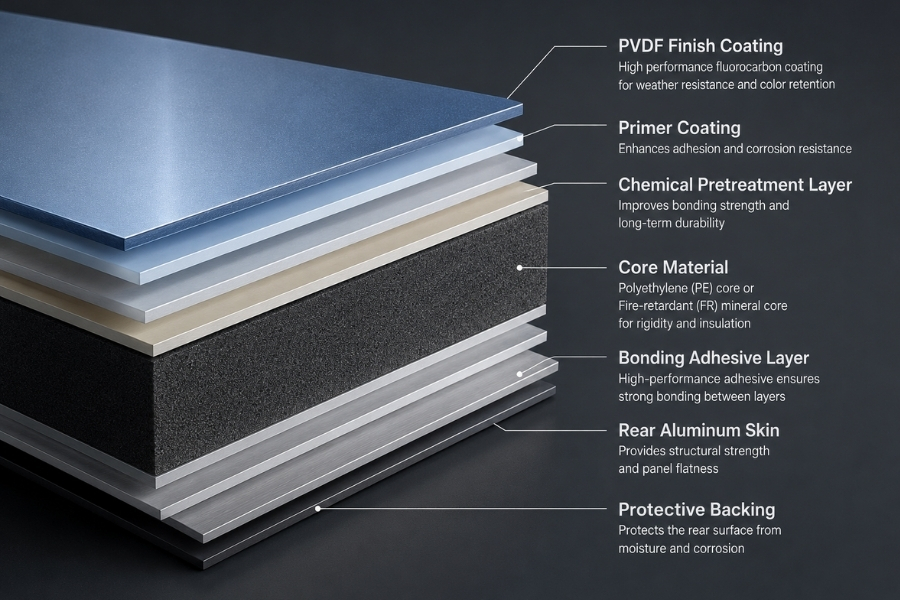
A typical architectural ACP system includes:
Exterior aluminum skin
Chemical pretreatment layer
Primer coating
PVDF or FEVE finish coating
Core material
Rear aluminum layer
Protective backing system
In many commercial façade applications, aluminum skin thickness is around 0.5 mm, although project specifications may vary depending on wind loading, panel dimensions, and fabrication requirements.
Why pretreatment quality matters
One of the least visible but most important stages of ACP manufacturing is aluminum surface pretreatment. Before coating and lamination, aluminum surfaces must be chemically cleaned and treated to improve long-term coating adhesion and corrosion resistance.
Poor pretreatment quality may not create immediate visual problems. However, long-term exposure to humidity, airborne contaminants, and thermal cycling can gradually weaken coating adhesion and accelerate surface deterioration.
This becomes especially important in:
Coastal climates with salt exposure
Tropical climates with persistent humidity
Industrial zones with airborne pollutants
Transportation hubs exposed to frequent moisture cycling
Experienced façade consultants often review not only coating specifications, but also pretreatment and coil coating consistency during supplier evaluation.
Core materials affect more than fire performance
Core selection influences several critical façade behaviors including:
Fire resistance
Thermal expansion stability
Impact resistance
Panel rigidity
Delamination resistance
Modern high-rise projects increasingly specify FR core or A2 core ACP systems due to stricter façade fire regulations and evolving building code requirements.
In many regions, fire compliance discussions now extend beyond the ACP panel itself and into broader building enclosure performance requirements including cavity barriers, ventilation design, and façade assembly testing standards such as NFPA 285.
ACP Coating Systems and Long-Term Weather Resistance
Exterior ACP durability depends heavily on coating system quality. In practice, many visible façade aging problems originate from coating degradation rather than structural failure of the panel itself.
Long-term exposure to UV radiation, airborne contaminants, thermal cycling, and moisture gradually affects surface appearance and protective performance.
Why PVDF coatings remain widely specified
PVDF coatings continue to dominate commercial ACP façade applications because of their strong resistance to weathering and UV degradation.
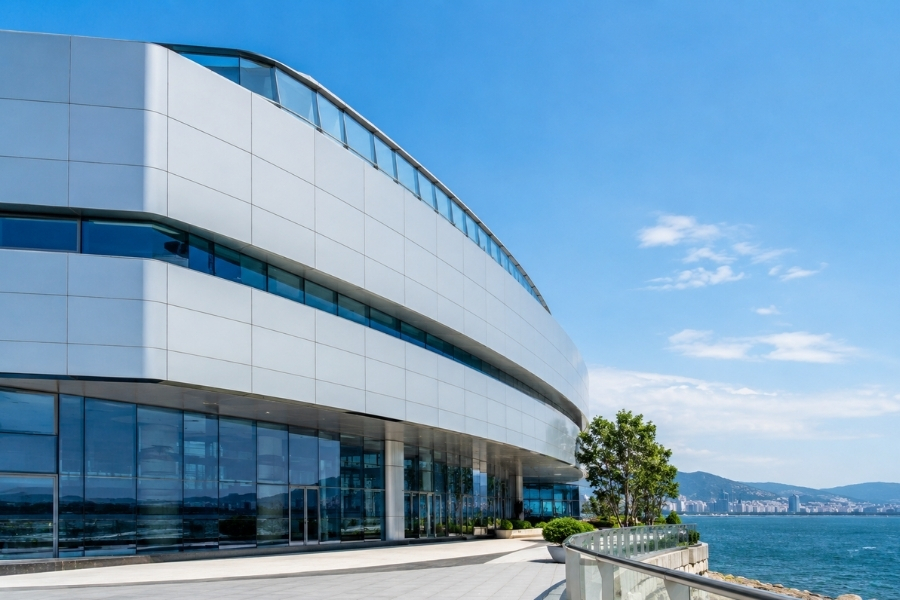
Compared with standard polyester systems, PVDF coatings generally provide:
Better color retention
Lower chalking rates
Improved gloss stability
Stronger chemical resistance
Better long-term surface durability
This becomes especially important on high-rise façades where exterior maintenance access is difficult and inconsistent weathering becomes highly visible across large elevations.
On coastal towers, façade consultants sometimes observe uneven aging patterns developing first around corners and parapet zones where salt deposition and wind-driven rain exposure are more aggressive. In these situations, coating durability becomes a long-term maintenance issue rather than only an aesthetic concern.
Color consistency matters on large façades
Color variation between ACP production batches can become surprisingly visible after installation, particularly on metallic finishes and reflective coatings.
Large commercial façades often expose small inconsistencies in:
Pigment concentration
Coil coating thickness
Curing temperature
Surface gloss
Reflectivity under daylight
Under changing sunlight conditions, slight differences between panel batches may become visible across continuous elevations. This is why many large façade projects require mock-up approval, controlled batch tracking, and Delta E color consistency review before production begins.
Coating thickness influences durability
Coating system performance depends not only on chemistry but also on coating thickness consistency.
Uneven coating thickness can contribute to:
Premature fading
Reduced corrosion resistance
Inconsistent weathering
Uneven gloss retention
This is one reason experienced ACP manufacturers invest heavily in coil coating process stability and inspection systems rather than treating coating application as a secondary manufacturing step.
ACP Fabrication and Processing Considerations
ACP systems are often selected because they support efficient fabrication and flexible geometry. However, fabrication precision directly affects long-term façade appearance and installation quality.
Large-format ACP façades may appear visually flat during shop fabrication but develop noticeable surface distortion after installation if routing depth, support spacing, or thermal movement accommodation are not properly controlled.
V-grooving and routing depth control
One of the most common ACP fabrication methods involves routing V-shaped grooves into the rear side of the panel so it can be folded into cassette assemblies.
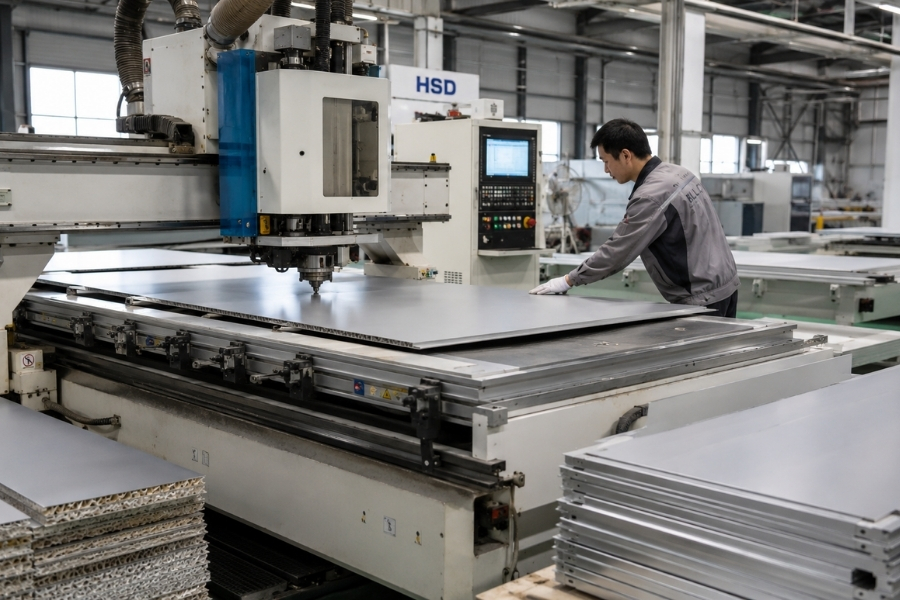
Routing depth must be carefully controlled.
If routing penetrates too deeply:
Aluminum skin strength decreases
Fold areas may crack
Surface stability weakens
Long-term fatigue resistance declines
If routing depth is insufficient:
Folding geometry becomes inconsistent
Corners may distort
Cassette alignment suffers
Experienced ACP fabricators adjust routing parameters based on:
Panel thickness
Aluminum skin thickness
Fold angle
Panel dimensions
Expected structural loading
Thermal movement affects fabrication decisions
Aluminum expands and contracts noticeably under temperature fluctuations. Dark-colored ACP façades exposed to direct solar radiation may experience significant surface temperature differences compared with shaded areas.
If thermal movement is restricted:
Oil-canning may appear
Joint alignment may shift
Fastener stress increases
Panel bowing becomes visible
On long commercial podium façades, cumulative thermal movement sometimes becomes noticeable first at corners and slab transitions where movement tolerance is more constrained.
Curved ACP façades increase fabrication complexity
Curved façade geometry requires tighter fabrication and installation coordination than flat panel systems.
Curved ACP surfaces affect:
Subframe tolerance control
Panel stress distribution
Joint spacing consistency
Sealant geometry
Visual reflection patterns
Reflective metallic finishes can make even minor fabrication deviation visible under daylight conditions.
Why Joint Design Matters in ACP Façade Systems
Many ACP façade failures originate at transitions and joints rather than within the aluminum composite panel itself.
The building enclosure must manage:
Water penetration
Thermal expansion
Air pressure differences
Drainage continuity
Sealant movement
Structural tolerance variation
Because of this, ACP façades are better understood as rainscreen assemblies rather than decorative panel systems.
ACP systems rely on moisture management logic
Modern building science generally avoids relying on “perfect barrier” façade strategies. Instead, ACP rainscreen systems are designed around moisture management principles including:
Deflection
Drainage
Pressure moderation
Ventilation
Drying potential
In properly designed ACP systems, the outer panel layer sheds most water exposure while secondary drainage layers behind the façade manage residual moisture.
This layered approach is typically more reliable than attempting to create a completely sealed façade system.
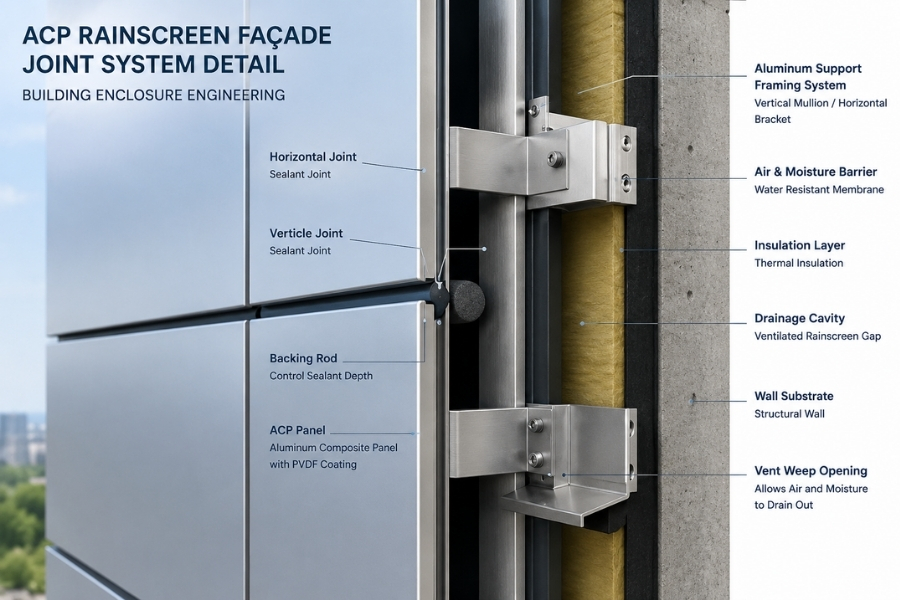
Sealant failure often begins at transitions
Water leakage problems on ACP façades frequently appear first around:
Window heads
Slab edges
Corners
Roof transitions
Mechanical penetrations
In many cases, the issue is not the ACP panel itself but interrupted drainage continuity behind the façade.
Sealants are continuously exposed to:
UV radiation
Thermal cycling
Wind loading
Structural movement
Moisture exposure
Poor joint geometry or inconsistent field installation can eventually create cracking, adhesion failure, or water intrusion.
Site installation conditions affect joint quality
Field installation rarely matches the precision shown on construction drawings. Substrate irregularity, uneven bracket alignment, weather exposure during installation, and sequencing pressure all influence final façade quality.
On some commercial projects, cumulative bracket deviation across multiple floors gradually creates uneven panel joints that become visible only after large façade areas are completed.
This is one reason experienced façade consultants emphasize buildability and installation tolerance management during early design stages rather than treating them as field issues later.
Common Failure Risks in ACP Projects
Even high-quality ACP systems can experience performance problems if enclosure coordination, fabrication quality, or installation control is inconsistent.
Oil-canning and visual waviness
Oil-canning refers to visible waviness on flat metal surfaces caused by stress imbalance, thermal movement, substrate irregularity, or fastening conditions.
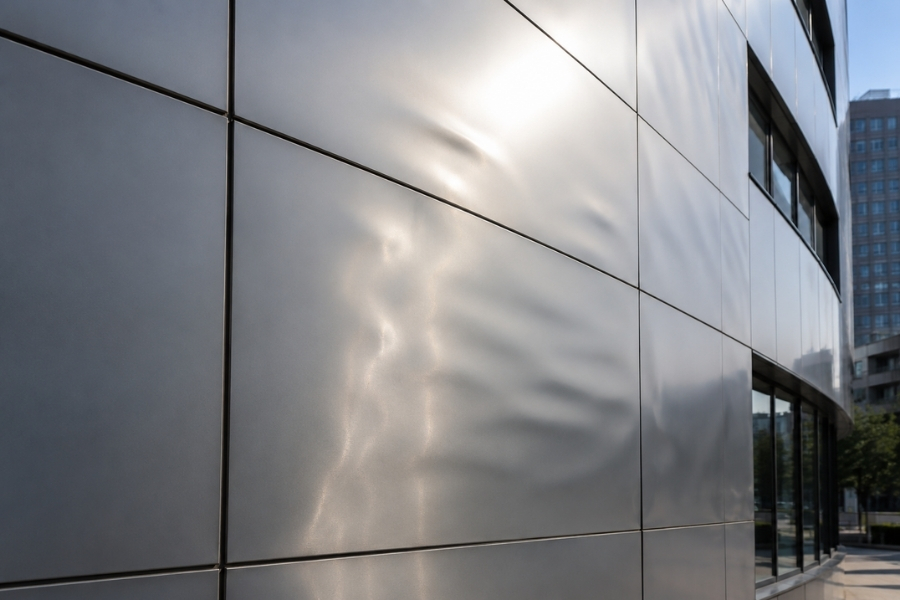
This issue becomes more noticeable on:
Dark finishes
Reflective coatings
Large-format panels
Wide unsupported spans
Thin aluminum skins
Completely eliminating oil-canning is difficult because metal surfaces naturally reflect light variation differently under changing conditions. However, proper subframe alignment and movement accommodation can reduce its visibility significantly.
Delamination
Delamination occurs when aluminum skins separate from the core material.
Potential causes include:
Poor adhesive bonding
Moisture intrusion
Inadequate pretreatment
Manufacturing inconsistency
Long-term thermal cycling
In humid climates, moisture trapped behind poorly sealed joints may gradually accelerate adhesive degradation over time.
Water infiltration
ACP façade leakage is commonly linked to:
Failed sealants
Improper flashing
Interrupted drainage paths
Poor transition detailing
Installation deviation
On high-rise projects, leakage problems often emerge first around complex interfaces rather than across large uninterrupted panel fields.
Thermal bowing
Thermal bowing occurs when temperature differences create uneven expansion across panel surfaces.
Risk increases with:
Large panel dimensions
Dark colors
High solar exposure
Restrained fixing systems
Inadequate movement spacing
South-facing façades in hot climates frequently experience stronger thermal cycling than shaded elevations, which may create uneven visual movement across the building envelope.
Surface damage during construction
ACP surfaces may also be damaged during transportation and installation.
Common field-related issues include:
Scratches from handling
Protective film residue
Edge impact damage
Contamination during sealant application
Surface staining from prolonged weather exposure before cleaning
Protective film removal timing is especially important. Leaving film exposed too long under strong UV conditions can complicate removal and affect surface appearance.
ACP Applications in Contemporary Architecture
ACP systems are now widely used across modern architectural projects because they balance appearance flexibility with manageable fabrication and installation requirements.
Commercial office towers
Large commercial towers frequently use ACP systems for podiums, crown features, soffits, and secondary façade zones where lightweight construction and visual consistency are important.
Transportation and infrastructure projects
Airports, rail stations, and transit terminals often use ACP systems because they support curved geometry, large continuous surfaces, and relatively efficient installation sequencing.
Façade retrofit projects
ACP systems are widely used in building renovation because older structures may not support heavy stone or precast cladding systems without extensive reinforcement.
Lightweight ACP façades allow architects to modernize aging buildings while reducing structural modification requirements.
Mixed-material façade systems
Modern façade design increasingly combines ACP with:
Curtain wall glazing
Terracotta cladding
Perforated metal screens
Louvers
Stone veneer systems
This layered material approach helps architects create façade rhythm, depth variation, and environmental shading without excessive structural complexity.
Key Specification Factors When Selecting ACP Panels
Selecting ACP systems requires evaluating both material performance and fabrication capability.
Important specification considerations include:
Total panel thickness
Aluminum skin thickness
Core classification
Coating type
Coating thickness
Panel flatness tolerance
Fire compliance
Fabrication precision
Climate suitability
Color consistency control
However, panel specifications alone do not guarantee façade quality.
Procurement teams should also evaluate manufacturer capabilities related to:
Coil coating consistency
CNC routing precision
Quality inspection systems
Batch traceability
Mock-up production
Technical support
Fabrication scalability
Project coordination experience
Some façade problems originate not from low-grade materials, but from inconsistent fabrication control or poor coordination between suppliers, fabricators, and installers.
Choosing ACP Systems for Long-Term Façade Performance
Successful ACP façade projects depend on more than selecting an attractive panel finish. Long-term performance is strongly influenced by the relationship between material quality, fabrication precision, climate exposure, installation execution, and enclosure detailing.
Experienced façade teams typically evaluate ACP systems through a broader building envelope perspective that includes:
Thermal movement behavior
Moisture drainage strategy
Coating durability
Fire compliance
Joint performance
Fabrication repeatability
Installation tolerance management
As commercial façade systems become larger and more visually demanding, manufacturers capable of maintaining stable coating quality, routing precision, and large-scale production consistency become increasingly important.
Aluwell® focuses on architectural ACP and ACM panel systems designed for modern building envelope applications, including commercial façades, transportation infrastructure, renovation projects, and custom architectural cladding systems. Beyond panel manufacturing itself, long-term façade reliability often depends on how well fabrication quality, coating stability, and installation coordination are managed throughout the project lifecycle.
FAQ
What is the difference between ACP and ACM panels?
ACP and ACM are often used interchangeably in the façade industry. Both refer to aluminum composite panels made from aluminum skins bonded to a core material. In North America and façade engineering projects, ACM is more commonly used, while ACP remains widely used in Asia and global construction markets.
Why are PVDF coatings preferred for exterior ACP façades?
PVDF coatings provide strong UV resistance, long-term color stability, and lower chalking rates compared with standard polyester coatings. They are commonly specified for high-rise buildings, coastal projects, and large commercial façades where long-term weather resistance and reduced maintenance are important.
What causes oil-canning in ACP panels?
Oil-canning is usually caused by stress imbalance, thermal expansion, substrate irregularity, or improper installation tolerances. Large reflective panels and dark-colored ACP systems tend to make surface waviness more visible under changing daylight conditions.
Why do ACP façade leaks often occur around joints?
Most ACP water infiltration problems originate at transitions such as window heads, slab edges, corners, and penetrations rather than through the panel itself. Poor drainage continuity, failed sealants, or improper flashing details are common causes of façade leakage.
What is the purpose of routing and V-grooving in ACP fabrication?
Routing and V-grooving allow ACP panels to be folded into cassette assemblies for façade installation. Proper routing depth is critical because excessive cutting may weaken the aluminum skin, while insufficient routing can create inaccurate folds and panel distortion.
Why are FR core and A2 core ACP panels important?
FR core and A2 core ACP systems improve façade fire performance compared with standard polyethylene core panels. Many modern building codes and high-rise projects now require fire-rated ACP systems to meet stricter façade safety and compliance standards.