

13 May
The Versatility of Aluminum Cladding Exterior Systems
Modern architecture places increasing demands on facade systems. Commercial buildings are expected to deliver long-term durability, efficient construction, environmental performance, and a visually distinctive exterior at the same time.
This is one reason why aluminum cladding exterior solutions are widely used across office towers, transportation hubs, educational campuses, healthcare facilities, and mixed-use developments. Architects and facade consultants often select aluminum because it combines design flexibility with reliable long-term performance under real construction conditions.
Today, aluminum cladding is no longer viewed as a decorative surface alone. In contemporary facade engineering, it functions as part of the overall building envelope system, supporting weather protection, architectural expression, installation efficiency, and lifecycle durability.
Why Aluminum Cladding Is Widely Used in Modern Architecture
Aluminum remains one of the most adaptable architectural cladding materials available for contemporary construction. Its popularity comes from the balance it provides between lightweight efficiency, fabrication flexibility, and long-term exterior performance.
Unlike heavier facade materials, aluminum allows architects to create large exterior surfaces and complex geometries without placing excessive structural load on the building.
This flexibility becomes especially important in projects where facade appearance, installation sequencing, and long-term maintenance all need to work together.
Lightweight Materials Improve Structural Efficiency
Aluminum weighs substantially less than steel while still providing strong rigidity for facade applications. In high-rise and large-scale commercial projects, reducing facade weight can help simplify structural engineering requirements and lower installation complexity.
Lighter facade materials also improve transportation and handling efficiency on site. Large-format panels become easier to maneuver during installation, particularly around soffits, corners, canopy transitions, and elevated facade zones.
For example, commercial projects using oversized lightweight exterior panels often reduce crane time and field labor requirements compared with heavier cladding materials.
Strong Formability Supports Complex Facade Design
Modern buildings rarely rely on flat elevations alone. Many projects now incorporate:
Curved surfaces
Angled facade planes
Recessed openings
Multi-depth facade layers
Segmented architectural forms
Large custom panel modules
Aluminum adapts well to these conditions because it can be fabricated into complex geometries while maintaining dimensional stability and clean facade alignment.
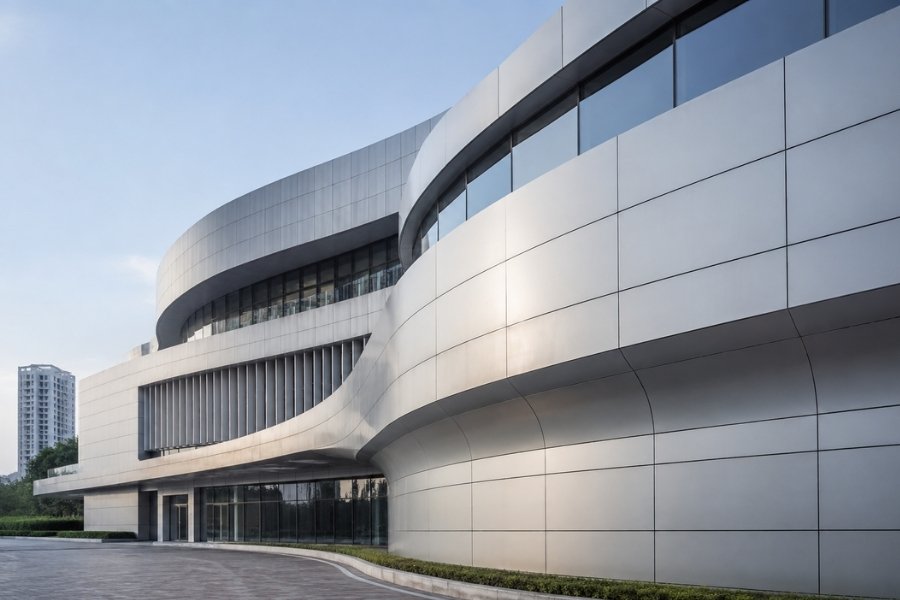
This allows architects to preserve the intended visual rhythm of the building without excessive field modification during construction.
In large commercial developments, varying panel depths are often used to reduce the perceived scale of long building elevations. Metallic finishes and shadow transitions can also help create stronger facade identity across large urban structures.
How Aluminum Cladding Adapts to Modern Facade Systems
Modern facade assemblies must perform as engineered wall systems rather than simple exterior finishes.
In addition to appearance, these systems are expected to support:
Moisture management
Air barrier continuity
Thermal movement accommodation
Drainage performance
Long-term weather resistance
This is where aluminum performs particularly well within rainscreen facade systems and ventilated wall assemblies.
Compatibility With Rainscreen Construction
Many contemporary buildings use ventilated facade systems to improve moisture control and thermal efficiency.
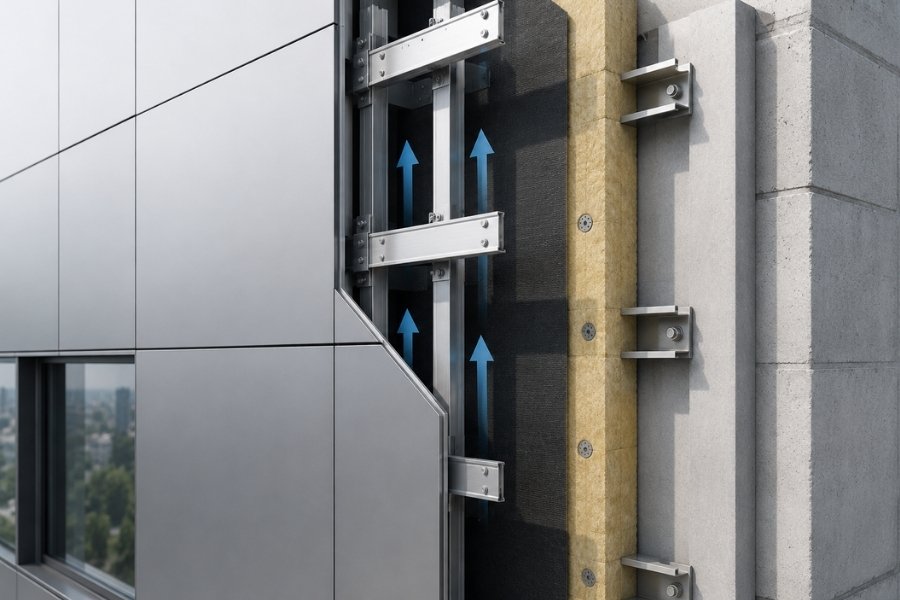
A typical rainscreen assembly includes:
Exterior cladding panels
Ventilated cavity
Air and water barrier
Insulation layer
Structural substrate
The cavity behind the facade helps manage drainage, ventilation, and pressure equalization. This reduces moisture accumulation inside the wall assembly and helps improve long-term envelope performance.
Because aluminum is lightweight and dimensionally stable, it integrates effectively into ventilated wall assemblies across both simple and highly complex geometries.
In coastal and humid environments, ventilated exterior systems are often used to improve drying performance and reduce long-term moisture-related deterioration within the wall assembly.
Flexible Attachment Systems Improve Field Coordination
Construction conditions frequently vary during installation. Structural tolerances, substrate irregularities, and sequencing constraints can all affect facade alignment on site.
Modern engineered facade assemblies can accommodate many of these challenges through adjustable attachment methods and engineered support systems.
Benefits include:
Easier panel alignment
Reduced field correction
Better tolerance management
Improved air barrier continuity
Faster installation sequencing
These advantages become especially important in projects involving curtain wall integration, irregular geometries, or multi-material facade systems.
Thermal movement must also be considered in large aluminum facades. Properly engineered systems include expansion joints and flexible attachment details that allow the facade to expand and contract without creating stress concentration across the envelope.
Finish Options That Improve Modern Facades
One of aluminum’s strongest architectural advantages is its ability to support many finish systems while maintaining long-term consistency across large elevations.
This allows facade designers to create visually unified buildings even when using different panel sizes, facade depths, or installation orientations.
Common Finish Systems for Exterior Metal Panels
Modern architectural metal panels are available in a wide range of finishes and coating technologies, including:
PVDF coatings
FEVE coatings
Powder coatings
Metallic finishes
Woodgrain textures
Stone-effect surfaces
Brushed aluminum finishes
Mirror finishes
Digitally printed surfaces
These finishes allow architects to integrate aluminum into both contemporary and traditional building styles.
In hospitality and retail architecture, custom metallic finishes are often used to strengthen brand identity and create stronger interaction between facade surfaces and natural light conditions.
Why Coating Consistency Matters in Large Projects
Exterior coatings are continuously exposed to UV radiation, moisture, pollution, temperature fluctuation, and coastal salt exposure.
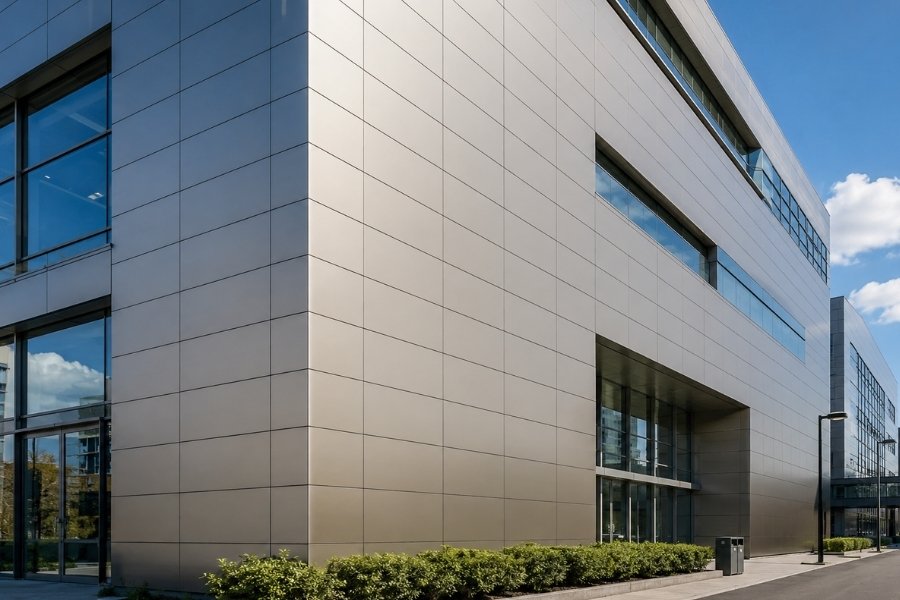
High-performance coating systems help maintain long-term color stability and surface durability under these conditions.
PVDF coatings are commonly specified in commercial architecture because of their weather resistance and long-term finish retention. In large facade projects spanning hundreds of thousands of square feet, coating consistency becomes especially important.
Delta E measures the difference between two colors in a three-dimensional color space. Lower Delta E values indicate greater color consistency across the facade surface.
Even minor finish variation can become visually noticeable on large metallic facades, particularly when panels are installed across different construction phases or under varying lighting conditions.
Why Aluminum Cladding Simplifies Installation
Successful facade projects depend not only on design quality but also on fabrication precision and installation efficiency.
Factory Fabrication Improves Accuracy
Modern prefabricated facade panels are typically manufactured under controlled factory conditions. This helps improve:
Dimensional consistency
Edge precision
Panel alignment
Coating uniformity
Installation predictability
Factory fabrication also reduces on-site cutting and adjustment, helping contractors maintain tighter installation schedules.
For large transportation and commercial projects, factory-controlled production can significantly reduce coordination issues during multi-phase construction.
Modular Systems Support Faster Construction
Modular facade systems are increasingly common in contemporary construction because they simplify installation sequencing and reduce field complexity.
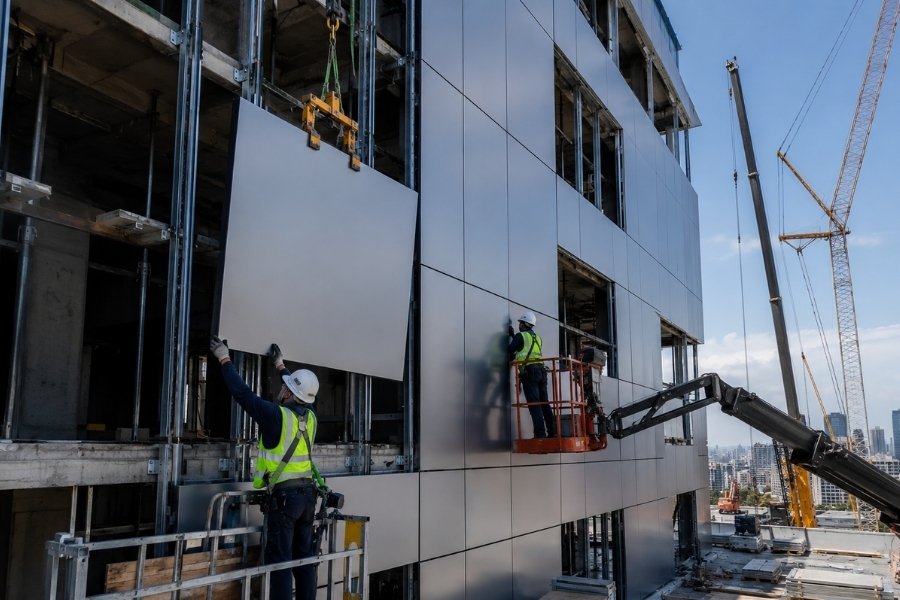
Pre-engineered panelized systems can reduce:
On-site labor requirements
Installation time
Material handling risks
Coordination between trades
Field measurement adjustments
Some large facade projects also use full-scale facade mockups and 1:1 benchmark installation testing before production begins. These procedures help verify panel alignment, joint detailing, finish consistency, and constructability under real installation conditions.
This type of verification is particularly valuable for projects involving curved facades, custom metallic finishes, or highly visible architectural surfaces.
Long-Term Performance in Exterior Facades
Long service life remains one of the primary reasons architects continue specifying aluminum across demanding exterior environments.
Durability Across Different Climate Conditions
Aluminum naturally resists corrosion and performs well in environments including:
Coastal regions
High humidity climates
Urban pollution zones
High UV exposure areas
Freeze-thaw environments
Unlike steel, aluminum does not rust. Properly coated high-performance cladding assemblies can maintain both structural stability and visual consistency for decades with relatively low maintenance requirements.
This makes aluminum especially suitable for transportation facilities, public buildings, and commercial developments where long-term operational reliability is important.
Low Maintenance Requirements Reduce Lifecycle Costs
Compared with painted steel or porous masonry systems, aluminum facades generally require less maintenance over time.
Routine maintenance often involves:
Water cleaning
Mild detergent washing
Periodic facade inspection
This helps reduce long-term operational costs while maintaining the building’s exterior appearance.
In dense urban environments, facade materials that resist staining and weather-related discoloration are particularly valuable because they help maintain consistent visual quality across large public-facing elevations.
Sustainability and Environmental Performance
Aluminum is highly recyclable and supports sustainable building strategies.
Many green building projects value aluminum because of its:
Recyclability
Long lifecycle performance
Reduced transportation weight
Compatibility with energy-efficient facade assemblies
When integrated into rainscreen facade systems, these ventilated assemblies can also help improve thermal performance and reduce cooling demand within the building envelope.
Fire Safety and Structural Performance
Facade safety has become an increasingly important part of modern building design.
Aluminum itself is non-combustible, although the fire performance of a facade depends on the complete wall assembly, including:
Core materials
Insulation systems
Air barriers
Attachment systems
Joint detailing
Many commercial projects now specify fire-resistant composite panel systems designed to meet stricter code requirements for high-rise and public buildings.
Depending on project type and local regulations, facade assemblies may also require full-scale wall assembly testing to verify fire performance under realistic installation conditions.
Structural Stability in Large Facade Systems
Large engineered facade assemblies must accommodate thermal movement, wind loading, and structural deflection over time.
These systems can incorporate:
Expansion joints
Flexible attachment details
Thermal movement allowances
Reinforced support systems
These details help maintain facade alignment and reduce stress accumulation across large building elevations.
In tall commercial towers, thermal expansion management becomes especially important because facade surfaces may experience significant temperature variation throughout the day.
Where Aluminum Cladding Is Commonly Used
The adaptability of aluminum allows it to perform across many sectors of modern architecture.
Commercial Buildings
Office towers and mixed-use developments frequently use exterior metal panel systems because they support:
Large-format panels
Modern facade aesthetics
Long-term color consistency
Efficient installation sequencing
Metallic finishes and modular panel systems are especially common in high-rise commercial architecture where clean visual continuity is important across large elevations.
Transportation Hubs
Airports and transit facilities often require facade systems capable of spanning extremely large surfaces while maintaining finish consistency and structural stability.
Some transportation projects involve metallic aluminum panel systems installed across more than 500,000 square feet of envelope area over multi-year construction schedules.
Healthcare and Educational Facilities
Hospitals and educational campuses often prioritize durability, low maintenance, hygiene, and long-term operational efficiency.
Certain composite panel systems also provide antimicrobial surface technologies suitable for high-traffic public environments.
Hospitality and Retail Architecture
Hotels, retail spaces, and entertainment venues often use architectural metal surfaces to strengthen visual identity through customized finishes, lighting interaction, and detailed facade articulation.
Woodgrain, mirror, metallic, and digitally printed finishes are increasingly used to create visually distinctive exterior environments.
Conclusion
The versatility of aluminum cladding exterior solutions extends far beyond appearance alone.
Modern facade projects require materials that support architectural creativity, efficient construction, weather resistance, long-term durability, and reliable envelope performance at the same time.
Aluminum continues to meet these demands because it combines lightweight efficiency, fabrication flexibility, coating durability, and compatibility with advanced facade engineering systems.
As contemporary architecture becomes increasingly performance-driven, architectural cladding materials based on aluminum remain among the most adaptable solutions available for modern exterior construction.
As part of ALUMAX Composite Material Co., Ltd., Aluwell® develops and manufactures advanced composite materials for architectural applications.
In modern facade construction, many projects require more than standard panel supply alone. Complex geometries, modular installation strategies, coating consistency requirements, and large-scale fabrication coordination all place greater demands on facade manufacturers.
Aluwell® supports these requirements through:
Collaborative facade design support
Customized engineering solutions
CNC precision machining
Modular fabrication services
Full-scale installation verification
Large-scale composite panel manufacturing
The company’s manufacturing facility covers more than 63,000 square meters with an annual production capacity of approximately 6 million square meters.
Its product range includes:
Aluminum composite panels
Aluminum honeycomb panels
Stainless steel composite panels
Digitally printed architectural panels
Specialized composite facade systems
By integrating engineering, fabrication, and processing support into facade development, Aluwell® helps project teams improve constructability, installation precision, and long-term exterior performance across demanding architectural applications.
FAQ
What is the difference between aluminum composite panels and aluminum honeycomb panels?
Aluminum composite panels use a thermoplastic or mineral-filled core bonded between aluminum sheets, while honeycomb panels use an aluminum honeycomb core structure. Honeycomb systems typically provide higher rigidity, lower weight, and improved strength-to-weight performance for large architectural facade applications.
Why are PVDF coatings commonly used on aluminum facades?
PVDF coatings are widely used because they provide excellent resistance to UV exposure, moisture, pollution, and weathering. These coatings help exterior panels maintain long-term color stability and surface durability, especially on large commercial buildings exposed to demanding environmental conditions.
Why are full-scale facade mockups important?
Full-scale facade mockups allow architects, contractors, and fabricators to verify panel alignment, joint detailing, finish consistency, and installation methods before full production begins. They help reduce field corrections, improve coordination, and identify potential constructability issues early in the project process.
Can aluminum cladding support curved or irregular facade designs?
Yes. Aluminum can be fabricated into curved panels, angled surfaces, segmented elevations, and custom architectural forms while maintaining dimensional stability and clean facade alignment. This flexibility makes aluminum suitable for complex exterior geometries used in modern commercial and public architecture.
Is aluminum cladding environmentally sustainable?
Aluminum is highly recyclable and supports sustainable construction through long lifecycle performance, reduced maintenance requirements, and compatibility with energy-efficient rainscreen facade systems. Its lightweight properties can also reduce transportation energy and improve overall building envelope efficiency.