

13 May
Should I Use Aluminum Plate or ACM for My Building Project?
Choosing the right architectural cladding material is no longer just about appearance. Modern building envelopes must balance fire safety, structural performance, installation efficiency, long-term durability, and architectural design goals.
For decades, solid aluminum systems dominated commercial metal façades. Later, Aluminum Composite Material (ACM) became widely used because of its lightweight structure, visual flatness, and broader finish options. Today, both materials remain common across commercial buildings, transportation facilities, retail projects, and institutional architecture.
The challenge is that neither material is universally better.
A transportation terminal may prioritize impact resistance and long-term durability. A retail façade may prioritize lightweight installation and large-format visual consistency. In many modern projects, architects even combine solid aluminum panels and composite façade panels within the same exterior wall assembly.
Understanding how these materials perform in real construction conditions is critical before finalizing a façade specification.
Aluminum Plate vs ACM — Why the Choice Matters
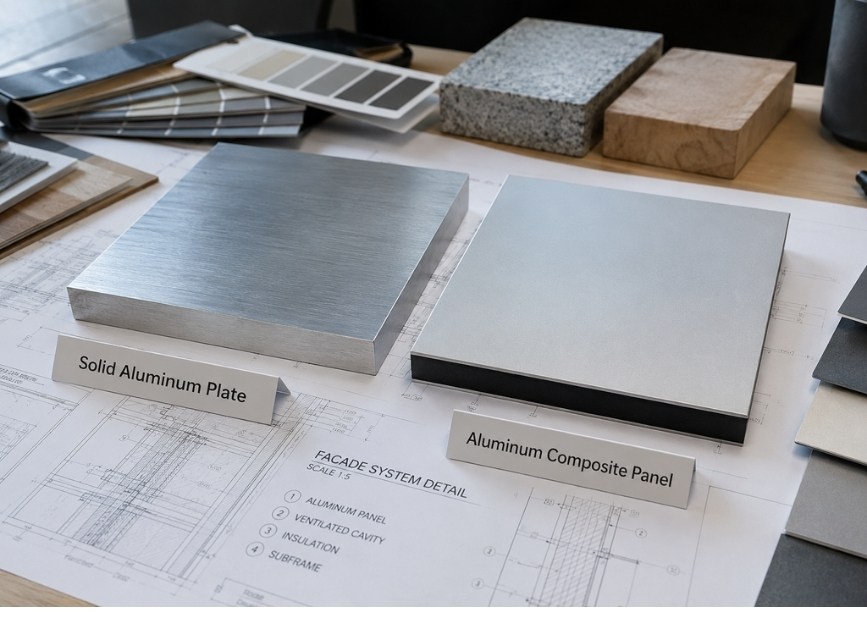
Although solid aluminum cladding and laminated composite panels can look similar from a distance, they behave very differently in real façade systems.
A solid aluminum façade system functions as a rigid metal material with strong impact resistance and non-combustible performance. ACM functions as a lightweight engineered panel system optimized for visual flatness, finish flexibility, and faster installation.
This affects:
Fire safety strategy
Wind-load behavior
Fabrication methods
Panel movement
Installation sequencing
Long-term maintenance planning
For architects and contractors, the decision is usually less about which material is “better” and more about which material fits the project conditions more effectively.
What Is Aluminum Plate?
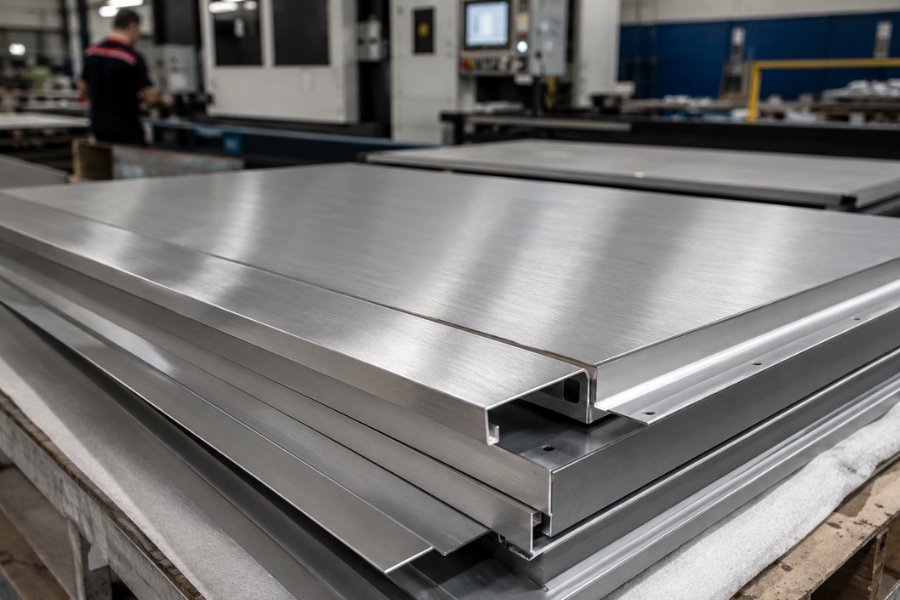
Aluminum plate is a solid, non-laminated aluminum material commonly used in façade systems, transportation projects, and high-durability architectural applications.
Unlike composite cladding products, aluminum plate contains no plastic or mineral core. This gives it:
Excellent rigidity
High impact resistance
Strong structural stability
Non-combustible performance
Architectural systems commonly use 1/8-inch (.125") solid aluminum panels with PVDF-coated finishes.
Because the material is fully metallic, it can be:
Welded
Ground smooth
CNC-machined
Formed into custom geometries
This makes solid aluminum cladding especially useful for:
High-traffic façade areas
Sculptural architecture
Transportation facilities
Stadiums and civic buildings
Welded cassette panel systems
Many architects still prefer monolithic aluminum panels for projects requiring a seamless appearance or long-term durability in demanding environments.
What Is Aluminum Composite Material (ACM)?
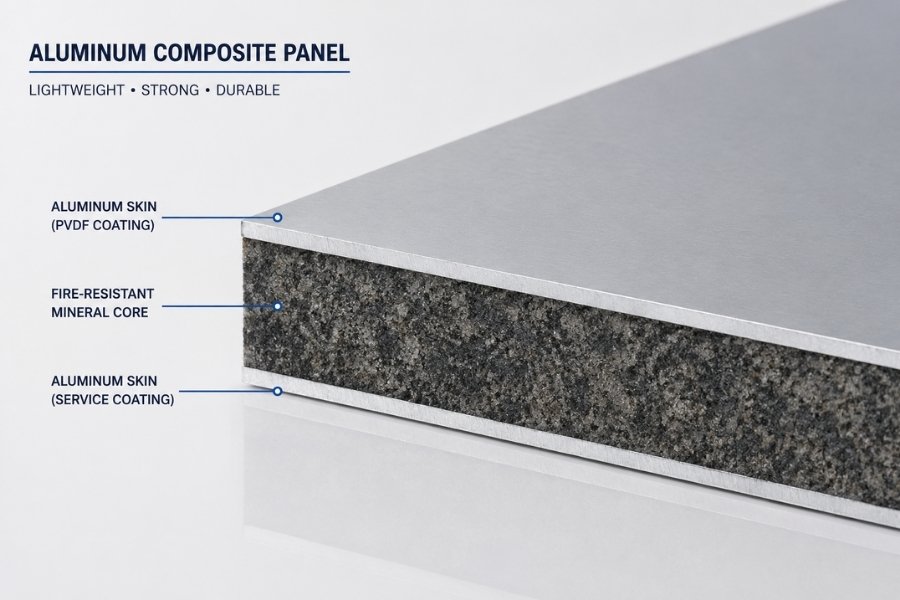
Aluminum Composite Material (ACM) consists of two thin aluminum skins bonded to a core material, typically polyethylene (PE) or a fire-resistant mineral-filled core (FR).
Standard aluminum composite panels are usually available in 4mm or 6mm thicknesses.
Compared with solid aluminum systems, these lightweight composite panels significantly reduce panel weight while maintaining strong visual flatness across large surfaces.
This combination helped ACM become one of the most widely used materials in modern commercial cladding systems.
Architects and fabricators often choose architectural composite panels because they offer:
Lightweight installation
Large-format panel capability
Excellent visual flatness
Extensive finish options
Easier routing and forming
Faster fabrication speed
Composite rainscreen panels are commonly used for:
Commercial façades
Retail storefronts
Corporate buildingsAluminum Plate an
Canopies and soffits
Interior architectural panels
Ventilated wall systems
Their consistent surface appearance also helps architects create cleaner shadow lines and more uniform façade rhythm on large elevations.
How Aluminum Plate and ACM Perform Differently
Weight and Installation
One of ACM’s biggest advantages is weight reduction.
Lightweight composite cladding systems are typically about half the weight of comparable solid metal façade panels, which helps reduce:
Structural load
Transportation cost
Installation labor
Subframe support demands
This is especially valuable for retrofit projects or fast-track commercial construction.
Architectural aluminum sheet systems are heavier, but they also provide greater inherent rigidity and durability.
Impact Resistance
Solid aluminum cladding performs better in high-impact environments because the material is fully metallic and thicker.
This makes it more suitable for:
Transit concourses
School entrances
Stadium podiums
Parking structures
Service corridors
Laminated aluminum panels perform well visually but are generally more vulnerable to dents and scratches.
Visual Flatness and Oil-Canning
ACM is widely appreciated for its smooth, consistent appearance.
The laminated structure helps reduce visible waviness, often called oil-canning, across large reflective surfaces.
This becomes important on modern commercial façades where inconsistent reflections can affect perceived façade quality and façade rhythm.
Solid aluminum systems can still achieve excellent visual results, but larger panels may require additional reinforcement, panel rigidity analysis, and tighter fabrication control.
Wind Load and Structural Rigidity
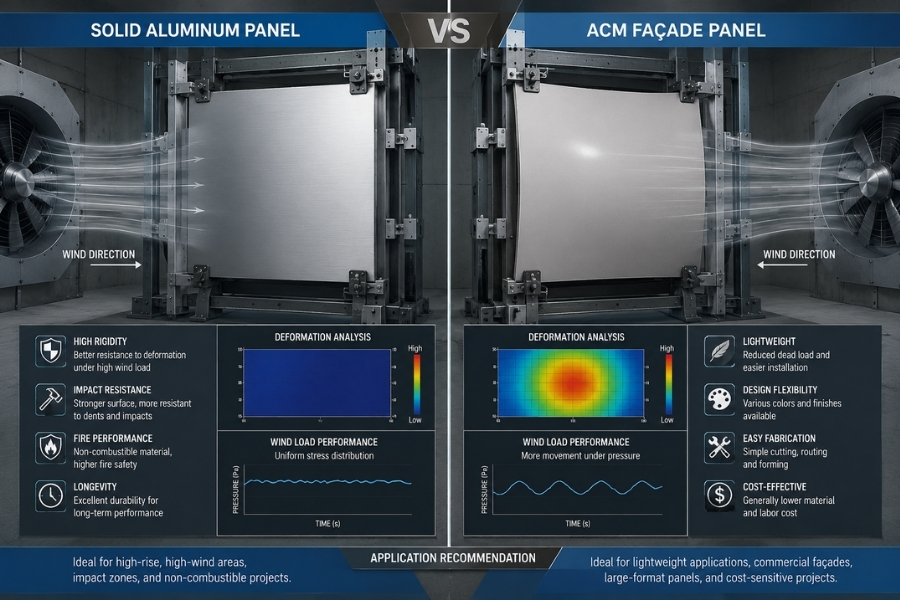
Solid aluminum plate generally offers stronger rigidity under high wind pressure.
Composite façade systems can still perform successfully on high-rise buildings, but they often require:
Reinforced cassette panel systems
Proper subframe engineering
Deflection analysis
Additional back support
Without proper engineering, large aluminum composite panels may experience visible movement under extreme wind conditions.
How These Materials Work in Modern Façade Systems
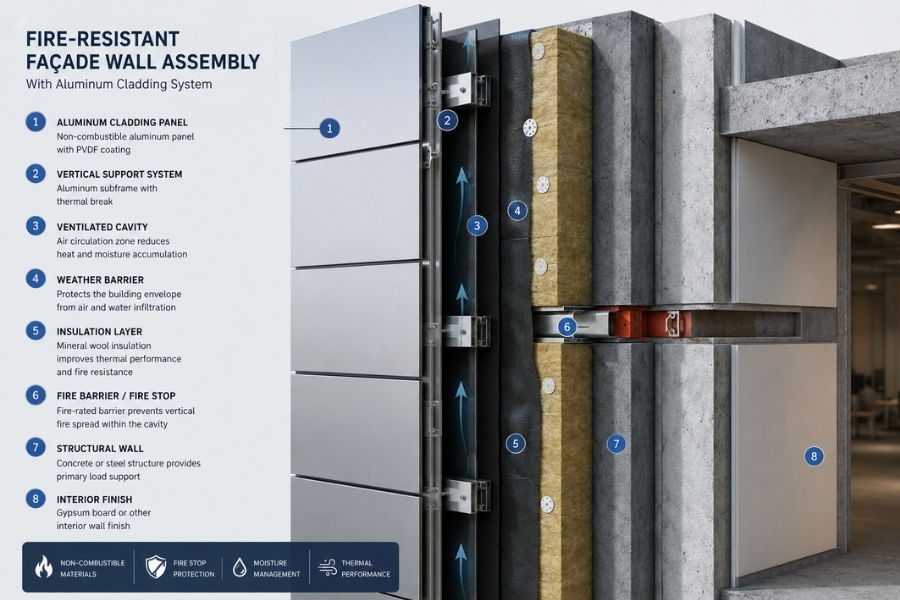
Most modern commercial façades use ventilated rainscreen systems rather than simple exterior wall coverings.
In these systems, the cladding assembly works together with:
Air barriers
Insulation
Subframing
Ventilated cavities
Drainage layers
The cavity behind the panels helps manage:
Moisture drainage
Air circulation
Thermal performance
Pressure equalization
Both monolithic aluminum panels and composite rainscreen panels are commonly used in these assemblies.
Why ACM Is Common in Commercial Rainscreens
ACM is widely used because it offers:
Lightweight installation
Faster fabrication
Large panel capability
Consistent visual appearance
This makes it especially popular for:
Corporate headquarters
Retail developments
Commercial towers
Airport interiors
Why Aluminum Plate Remains Important
Solid aluminum façade systems are still heavily specified for projects requiring:
Higher impact resistance
Non-combustible assemblies
Long-term durability
Deep custom geometry
Transportation facilities, hospitals, and civic architecture often continue using solid aluminum cladding because these projects prioritize durability and fire safety over installation speed alone.
Fire Safety Differences Between Aluminum Plate and ACM
Fire performance is one of the biggest differences between solid aluminum systems and metal composite material panels.
Aluminum Plate
Solid aluminum plate is considered non-combustible because it contains no plastic core material.
This simplifies compliance in many:
High-rise buildings
Hospitals
Airports
Schools
Government facilities
ACM and Core Types
The fire behavior of aluminum composite panels depends heavily on the core material.
PE Core ACM
Polyethylene-core panels are combustible and may contribute to flame spread under fire conditions.
FR Core ACM
Fire-resistant ACM uses mineral-filled cores that improve fire performance significantly.
Common classifications include:
B1
A2
These systems are widely used in modern commercial architecture.
Why NFPA 285 Matters
One common misunderstanding is that ACM fire safety depends only on the panel itself.
In reality, NFPA 285 evaluates the entire wall assembly, including:
Insulation
Air barriers
Subframing
Ventilation cavities
Exterior cladding systems
This matters because fire can spread differently inside ventilated façade cavities than in isolated material testing.
As a result, some architects still prefer non-combustible aluminum wall systems for projects with highly conservative fire strategies.
Which Material Is Easier to Fabricate and Install?
ACM Installation Advantages
One reason architectural composite panels became so dominant is installation efficiency.
ACM panels are:
Lightweight
Easier to carry
Faster to fabricate
Easier to route and fold
This helps reduce:
Labor cost
Installation time
Site handling difficulty
Large retail and commercial projects often favor lightweight composite cladding because installation speed directly affects construction schedules.
Aluminum Plate Fabrication Advantages
Solid aluminum fabrication is generally more labor-intensive and may involve:
Welding
Grinding
Reinforcement integration
Heavier support framing
However, solid aluminum cassette systems also enable fabrication capabilities ACM cannot easily replicate, including:
Seamless welded corners
Sculptural forms
Deep custom folds
Heavy-duty cassette geometries
Why Some Projects Use Both Materials
Many real-world projects combine ACM and solid aluminum systems strategically.
For example:
Solid aluminum panels may be used at pedestrian-level impact zones.
Composite façade panels may be used on upper elevations to reduce structural load and installation cost.
This hybrid strategy helps balance:
Budget
Durability
Appearance
Structural performance
Fire safety
across the entire building envelope.
Which Material Offers Better Long-Term Value?
In most cases, ACM offers lower upfront cost because of:
Reduced weight
Faster installation
Standard finish availability
Lower labor requirements
This makes composite cladding attractive for budget-sensitive commercial projects.
However, solid aluminum cladding may provide stronger long-term value in:
High-impact environments
Heavy public-use buildings
Projects with long ownership cycles
One important distinction is that ACM lifespan discussions often refer to coating appearance retention rather than structural durability.
Solid aluminum panels may experience coating aging over time, but the material itself remains highly durable structurally.
A transportation terminal expected to operate for decades under heavy public use may justify the higher initial investment of a non-combustible aluminum façade system.
Which Material Is More Sustainable?
Sustainability has become increasingly important in façade specification.
Solid aluminum plate is highly recyclable and can typically be processed through standard recycling systems.
ACM recycling is more complicated because the aluminum skins must be separated from the bonded core material.
However, composite cladding products also use less aluminum overall, which reduces initial raw material consumption.
The better environmental choice often depends on whether the project prioritizes:
Long-term recyclability
Lower initial material usage
Lifecycle durability
Reduced replacement frequency
When Should You Choose Aluminum Plate or ACM?
Aluminum Plate May Be Better For
High-rise non-combustible façades
Transportation facilities
High-impact environments
Sculptural architecture
Welded façade systems
Long-term ownership projects
ACM May Be Better For
Lightweight cladding systems
Budget-sensitive commercial projects
Large-format façades
Retail architecture
Fast-track construction schedules
Projects requiring extensive finish options
Successful façade material selection usually balances:
Fire performance
Structural behavior
Installation efficiency
Lifecycle durability
Architectural appearance
rather than relying on a single factor alone.
FAQ
Is aluminum plate better than ACM for high-rise façades?
Solid aluminum plate is often preferred for high-rise projects because it is non-combustible and simplifies fire compliance. ACM can still perform successfully when FR or A2-rated cores are combined with properly engineered wall assemblies that meet NFPA 285 and local building code requirements.
Can ACM panels show oil-canning on large façades?
Yes. Large reflective façade panels may show slight surface waviness depending on panel size, lighting direction, reinforcement design, and installation quality. Compared with thinner solid aluminum sheets, ACM panels generally maintain better visual flatness across large commercial elevations and modern curtain wall systems.
Why do some architects combine ACM and aluminum plate on the same building?
Many commercial projects use aluminum plate at lower pedestrian-level areas where impact resistance is important, while ACM is installed on upper elevations to reduce structural load and installation cost. This hybrid façade strategy helps balance durability, appearance, engineering performance, and overall project efficiency.
Which material performs better in high-wind areas?
Solid aluminum systems usually provide greater rigidity and impact resistance under strong wind conditions. ACM systems can still perform effectively on tall buildings, but larger panels often require reinforced cassette systems, stronger subframe support, and proper deflection analysis to maintain long-term façade stability.
Should I choose PE-core or FR-core ACM?
PE-core ACM is generally more affordable but combustible, making it more suitable for lower-risk applications with limited height restrictions. FR-core or A2-rated ACM is recommended for high-rise buildings, hospitals, transportation facilities, and projects requiring stricter fire safety performance and code compliance.
Why Engineering Support and Fabrication Experience Matter
Many façade failures are caused not by the material itself, but by coordination gaps between design, fabrication, engineering, and installation.
Issues such as:
Incorrect thermal movement allowance
Poor subframe alignment
Inadequate drainage detailing
Improper cassette fabrication
Inaccurate field dimensions
can all affect long-term façade durability regardless of whether the project uses aluminum plate or ACM.
Founded in 1999, ALUMAX Composite Material Co., Ltd. produces the Aluwell® brand of architectural composite materials for façade, signage, and interior applications. With a 63,000-square-meter production base and annual production capacity reaching 6 million square meters, the company supports a wide range of commercial and architectural projects worldwide.
Beyond standard panel supply, ALUMAX also provides:
Collaborative design assistance
Customized façade solutions
CNC machining services
Modularized assembly support
Prototype verification
Specialized processing for architectural applications
This integrated approach helps reduce communication gaps between architects, fabricators, contractors, and project owners while improving construction accuracy and installation efficiency.
Whether a project requires solid aluminum cladding or advanced Aluwell® aluminum composite panels, long-term façade performance depends on combining the right material with the right engineering and manufacturing support.