


30 Apr
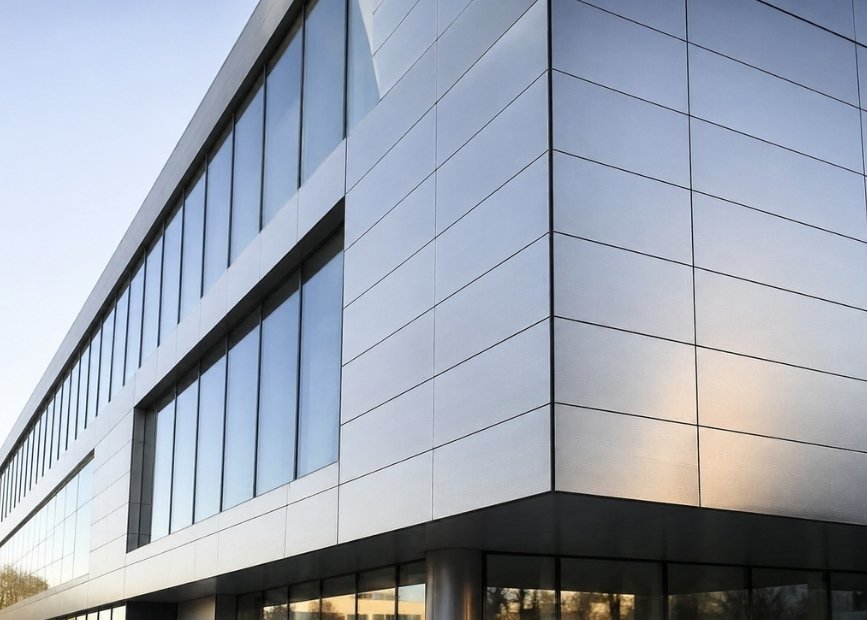
In large-scale façade projects, visual consistency is evaluated across entire elevations rather than individual panels. Once panel quantities exceed several hundred units or façade widths extend beyond 20 meters, even minor variation becomes visually amplified.
Unlike opaque coatings, brushed finishes are semi-translucent. The final appearance is influenced by both the coating system and the aluminum substrate. This is why brushed aluminum cladding panels behave differently from standard painted cladding materials.
For façade systems using ACP facade systems, the goal is not to eliminate variation, but to control it within an acceptable visual range.
In practice, façade consultants and contractors widely accept that perfect uniformity is not achievable. Instead, successful projects focus on consistency across viewing distances and lighting conditions.
In architectural applications, appearance is not defined by color alone. It is the result of three interacting factors:
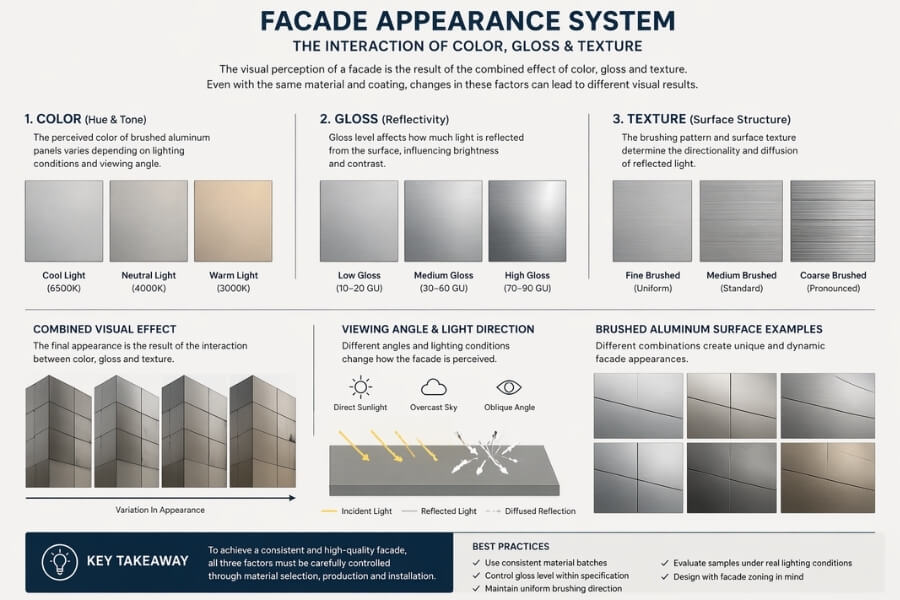
Color – the perceived tone and hue
Gloss – the level of reflectivity under light
Texture – surface grain, brushing pattern, and coating structure
Facade engineers often observe that two panels with identical color values can still appear different due to variations in gloss or surface texture.
This effect is particularly pronounced in metal facade cladding systems, where brushed finishes create directional reflection. As a result, façade consistency must be evaluated as a combined visual system rather than a single measurable value.
In professional façade specifications, color variation is typically evaluated using Delta E (ΔE).
Delta E measures the difference between two colors in a three-dimensional color space. Lower values indicate greater color consistency.
Industry practice generally follows:
Exterior metallic finishes – ΔE ≤ 1.2
Interior applications – ΔE ≤ 1.0
However, experienced façade consultants understand that instrument readings alone are not sufficient. According to common industry practice aligned with standards such as AAMA guidelines, visual inspection at a distance of approximately 3–5 meters under natural lighting remains the most reliable evaluation method.
Because of this, façade approval processes usually combine:
Instrument measurement
Approved batch samples
On-site visual comparison
Color variation in aluminum composite panels originates primarily from the aluminum coil itself.
Variations occur due to:
Alloy composition tolerances
Grain structure from rolling processes
Heat treatment conditions
Differences in mill production timing
Even when using the same alloy, different coil batches may produce visible differences. This is why façade contractors typically request single-coil sourcing for critical elevations.
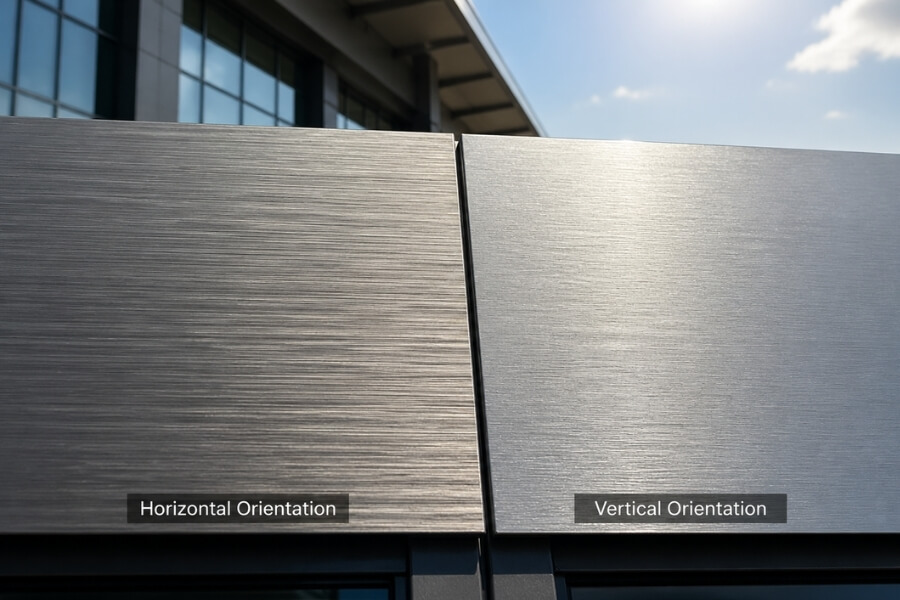
Brushed aluminum panels are inherently directional.
If panel orientation varies:
Light reflection changes significantly
Panels appear to have different shades
This issue is frequently observed on high-rise facades where inconsistent installation orientation leads to visible banding across elevations.
High-performance coatings such as PVDF improve durability, but do not eliminate variation.
Typical influencing factors include:
Coating batch differences
Film thickness variation
Oven temperature and curing conditions
Coil coating versus spray application
While coil coating provides higher consistency, metallic and brushed finishes still exhibit variation due to their reflective properties.
Facade systems often combine sheet panels with extruded components.
Common material combinations include:
Sheet panels – 3003 or 5052 aluminum
Extrusions – 6063 aluminum
Due to metallurgical differences, these materials reflect light differently even when coated with the same system. In practice, façade designers avoid placing these materials in the same visual plane when strict consistency is required.
Fabrication processes can introduce localized variation.
These include:
Welding
Heat bending
Mechanical surface processing
Thermal exposure can alter the aluminum temper, creating visible color shifts or halo effects. These changes cannot be corrected after finishing and must be managed during design and fabrication planning.
Order all brushed aluminum composite panels in one production run
Specify supply from a single coil or consecutive lots
Avoid mixing batches within the same elevation
For projects exceeding 2,500 square meters, façade zoning becomes essential to maintain visual consistency.
Mark directional arrows on each panel
Maintain consistent orientation during installation
Align brushing direction across the façade
Avoid mixing panel widths within the same visual plane
Use horizontal joints or floor lines to separate batches
Design façade segmentation to reduce visual risk
This approach allows architects to control variation through design rather than relying solely on manufacturing precision.
Approve production batch samples instead of small lab swatches
Define acceptable Delta E values in specifications
Ensure all stakeholders work from the same reference samples
This step is critical for aligning expectations between designers, contractors, and suppliers.
Inspect panels upon delivery
Group panels with similar color values
Install panels within controlled visual zones
Many façade contractors use this step to significantly improve perceived uniformity without additional material cost.
Order 5–10 percent extra material from the same batch
Store panels for future replacement
In real projects, replacement panels produced later rarely match the original batch, making early planning essential.
Color variation is often introduced before coating, during:
Coil production
Composite bonding
Surface preparation
This is why manufacturing capability directly defines the achievable consistency level.
ALUMAX, the parent company behind Aluwell®, has over 40 years of experience in composite material equipment and panel production. Its background in developing ACP production systems provides deeper control over process stability compared to conventional panel suppliers.
This results in:
More stable coil selection and bonding processes
Reduced batch-to-batch variation
Better alignment between design intent and finished façade appearance
In complex façade projects, this level of integration helps reduce downstream installation challenges.
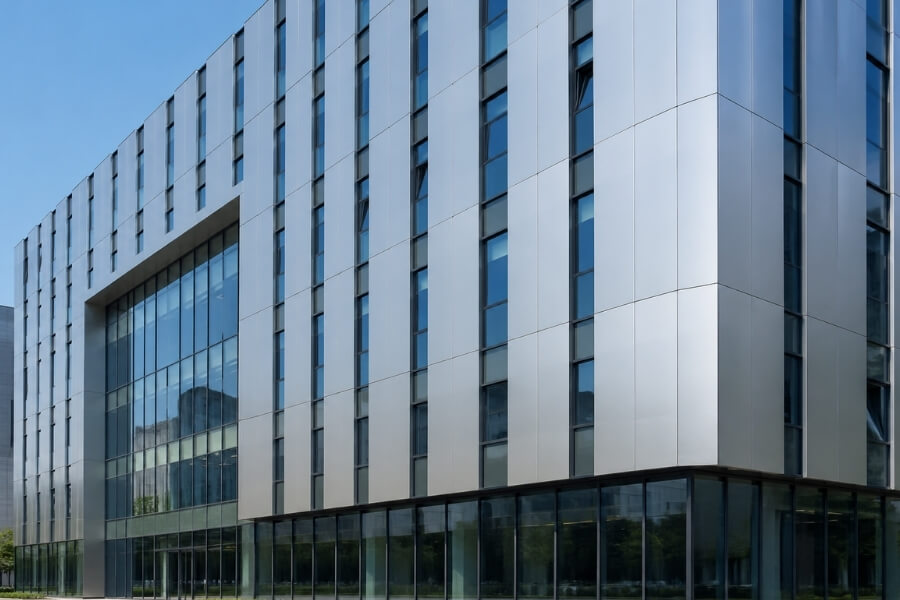
A mid-rise commercial office building in a high solar exposure region required over 10,000 square feet of metallic brushed facade panels for its curtain wall system.
The architectural concept focused on a metallic façade with controlled reflectivity to reduce perceived building scale while maintaining brand identity.
Panels sourced from a single coil batch
PVDF coil coating applied under controlled production conditions
Directional brushing standardized across all panels
Panels labeled and installed with consistent orientation
Façade divided into elevation zones to avoid batch mixing
Pre-installation sorting applied on site
The façade maintained consistent visual performance under both direct sunlight and diffuse lighting, while preserving the dynamic reflective quality of brushed metal finishes.
Why do panels of different widths show variation even within the same order
Different panel widths are often produced from separate coil runs, even within a single order. Variations in alloy composition, grain structure, and rolling conditions can slightly change the substrate appearance. For façade consistency, it is recommended to group panels by width or request material sourced from the same coil.
Why does the façade look different under sunlight versus cloudy conditions
Brushed aluminum surfaces exhibit angle-dependent reflectivity. Under direct sunlight, reflections are more uniform, while diffuse lighting conditions such as cloudy weather can highlight subtle differences in texture and grain direction. This behavior is a natural optical property of metallic finishes rather than a material defect.
Can touch-up paint solve color variation issues
Touch-up paint applied on site cannot replicate factory-controlled coating conditions, including curing temperature and film thickness. As a result, repaired areas will almost always appear different. The most reliable solution is to replace affected panels using spare units from the same production batch.
How should color variation be evaluated on site
Color variation should be assessed under natural lighting conditions at a viewing distance of approximately 3 to 5 meters. Close-range inspection or artificial lighting can exaggerate minor differences that are not visible in real façade conditions. Standard practice focuses on overall visual consistency rather than exact color matching.
Are surface marks after film removal considered color defects
Surface marks after protective film removal are typically caused by handling, storage conditions, or residue rather than coating inconsistency. These marks can often be removed with proper cleaning using neutral solutions. In most cases, they do not indicate a defect in the coating or panel material.
When specifying aluminum composite panel facade systems, architects and façade designers should:
Accept controlled variation rather than expecting perfect uniformity
Specify batch sourcing and direction requirements clearly
Integrate façade zoning into early design stages
Work with suppliers capable of full-process control
These decisions significantly reduce façade risk during construction.
Color variation in brushed aluminum panels is a natural result of material behavior and processing conditions. It cannot be eliminated, but it can be effectively controlled.
Successful façade projects manage variation through:
Early design coordination
Controlled material sourcing
Consistent fabrication practices
Careful installation planning
In practice, early collaboration with experienced material suppliers during the design development stage helps reduce uncertainty and improves final façade performance. This is especially important when working with brushed aluminum facade systems in large-scale architectural projects.