

01 Jun
Aluminum Composite Panel Installation Methods for Cylindrical and Curved Walls
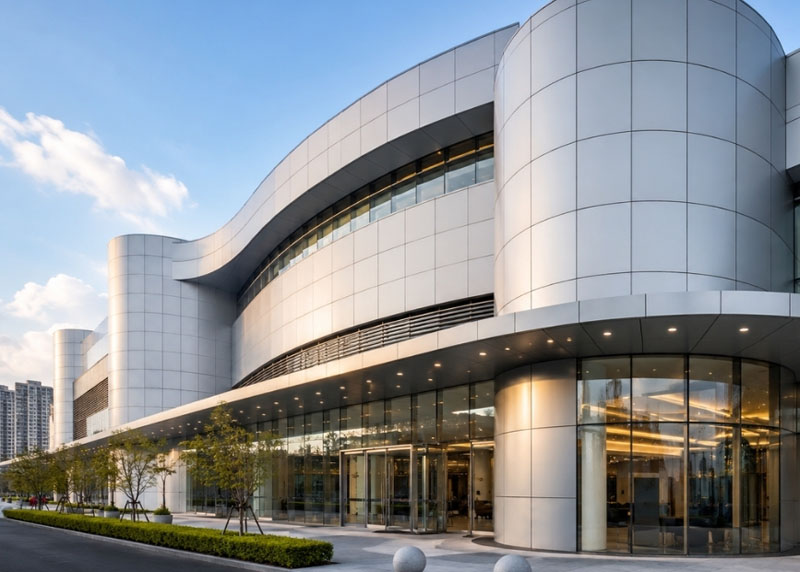
Curved architecture is increasingly used in airports, hotels, museums, transportation hubs, and commercial developments. While aluminum composite panels are widely recognized for their versatility, installing ACP on cylindrical columns and curved façades involves challenges that are rarely encountered on flat wall systems.
In curved façade projects, the final appearance depends not only on panel fabrication but also on radius control, support structure accuracy, joint consistency, and installation sequencing. Small dimensional deviations that may be acceptable on flat walls often become highly visible when repeated around a curved building envelope.
Understanding the fabrication methods, support systems, and installation procedures behind curved ACP systems helps architects, façade consultants, and contractors avoid costly rework while achieving a smooth and consistent architectural finish.
Why Curved ACP Projects Require Different Construction Strategies
Flat façades can often absorb minor fabrication and installation tolerances without obvious visual consequences. Curved façades cannot.
Every panel contributes to a continuous radius, meaning small deviations may accumulate as installation progresses. Common challenges include radius inconsistency, uneven joints, thermal movement constraints, and support structure misalignment.
Many contractors discover that the final closure panel around a cylindrical column becomes the most difficult component to install. In most cases, the issue is not panel fabrication but cumulative dimensional variations created throughout the installation process.
For this reason, curved façade systems generally require tighter quality control than conventional ACM panel installations.
Common Fabrication Methods for Curved Aluminum Composite Panels
The fabrication method should be selected according to project geometry, bending radius, visual requirements, and budget.
Roll Bending for Large Radius Façades
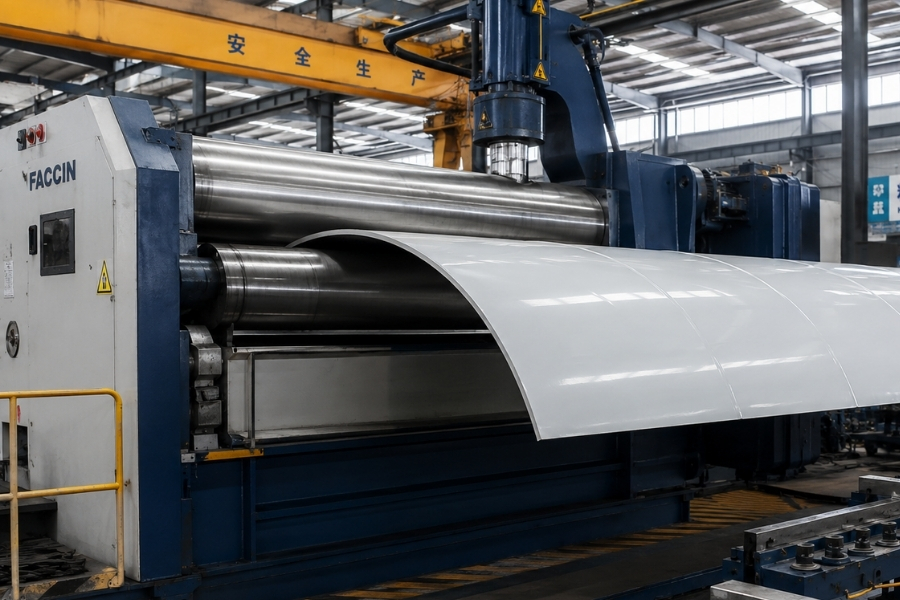
Roll bending is the most common solution for large-radius curved façades.
The panel passes through a series of rollers that gradually form the desired curvature without damaging the aluminum skins or coating system.
Typical applications include:
Airport terminals
Hotel façades
Commercial towers
Transportation facilities
Large architectural feature walls
Large-radius curves generally begin at approximately R3000 mm and can extend far beyond R10000 mm.
Roll bending provides:
Smooth visual continuity
Consistent curvature
Minimal faceting
Suitability for large panel formats
For PVDF-coated architectural cladding panels, roller settings must be carefully controlled to prevent visible surface distortion.
V-Grooving and Routed Folding for Tight Radii
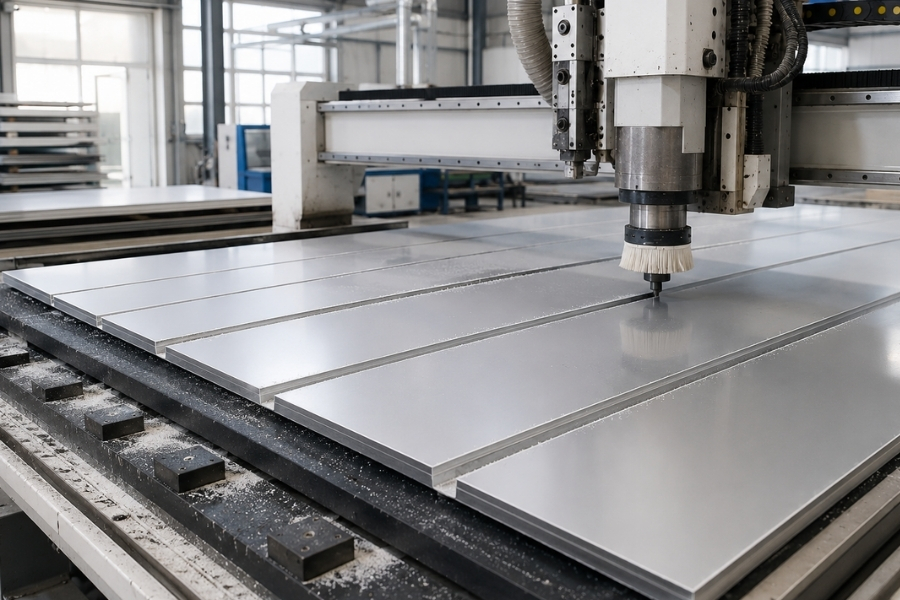
When tighter radii are required, routed bending becomes a practical solution.
A CNC router creates a V-shaped groove on the rear side of the panel while preserving the front aluminum skin and a controlled amount of core material.
The panel is then folded along the routed line.
This method is frequently used for:
Curved columns
Entrance canopies
Architectural features
Interior wall cladding
Soffit applications
For a typical 4 mm FR aluminum composite panel, manufacturers often leave approximately 0.2 mm to 0.4 mm of core material beneath the groove.
Proper groove geometry is essential. Excessive material removal may weaken the panel, while insufficient routing can lead to spring-back or cracking during bending.
Faceted Panel Systems for Circular Columns
Not every cylindrical façade requires continuously curved panels.
Many commercial projects create circular columns using multiple flat panels arranged around the circumference.
Common configurations include:
8-sided systems
12-sided systems
16-sided systems
24-sided systems
This approach resembles traditional stone column construction, where multiple segments are assembled to approximate a circular form.
Advantages include:
Lower fabrication costs
Faster installation
Easier transportation
Simplified replacement procedures
When designed correctly, a segmented column system can achieve an appearance very close to a true curved surface while significantly reducing project costs.
Selecting the Appropriate Fabrication Method by Radius
Choosing the correct fabrication strategy requires balancing aesthetics, fabrication complexity, and installation efficiency.
| Radius Range | Recommended Method | Typical Applications |
|---|---|---|
| Above R3000 mm | Roll bending | Large commercial façades |
| R1000-R3000 mm | Roll bending or segmented systems | Hotels and retail projects |
| Below R1000 mm | Routed bending | Columns and feature walls |
| Full cylindrical wrapping | Segmented or custom curved panels | Architectural columns |
Early collaboration between designers, fabricators, and installers can prevent costly redesigns later in the project.
Preparing the Support Structure for Curved ACP Installation
The support structure often has a greater influence on final façade quality than the panel itself.
Existing Circular Concrete Columns
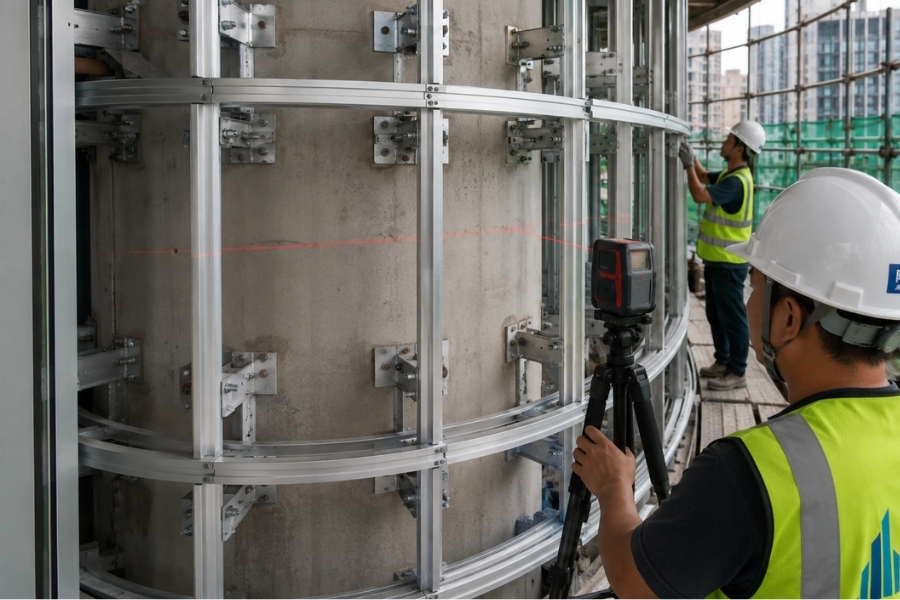
For existing circular columns, brackets and secondary framing are usually attached directly to the substrate.
Before installation begins, contractors should verify:
Diameter consistency
Surface irregularities
Verticality
Anchor capacity
Concrete condition
Laser measurements are commonly used to compare field conditions with design geometry.
Converting Square Columns into Curved Architectural Features
Many decorative cylindrical columns originate from square or rectangular structural columns.
A secondary framework is constructed around the existing structure using:
Steel supports
Aluminum rails
Radius-forming ribs
Adjustable brackets
The ACP panels are then installed on the secondary structure to create the desired cylindrical appearance.
Radius Templates and Mock-Up Verification
Radius templates remain one of the most effective quality-control tools for curved façade projects.
Templates and mock-ups help verify:
Curvature accuracy
Panel fit
Joint consistency
Closure alignment
Many installation issues become visible during mock-up construction long before they would appear in full production.
Installation Workflow for Cylindrical and Curved Walls
Layout Survey and Radius Control
Installation begins with detailed surveying.
Control points, centerlines, reference grids, and radius locations should be established before any framing is installed.
Correcting errors at this stage is significantly easier than after panels are in place.
Subframe Installation
Brackets and secondary framing are installed according to approved shop drawings.
Inspection should focus on:
Radius accuracy
Alignment
Bracket spacing
Structural rigidity
Thermal movement allowances
Panel Positioning and Temporary Fixing
Panels are generally installed sequentially around the curved surface.
Temporary fixing allows installers to make fine adjustments before permanent attachment.
Joint widths, panel orientation, and curvature should be continuously monitored throughout installation.
Joint Alignment and Circumference Adjustment
Joint alignment is often the most time-consuming stage of curved ACP installation.
Installers must maintain:
Consistent joint widths
Continuous radius geometry
Accurate closure dimensions
Visual continuity
Any adjustment made early in the process can affect the entire circumference.
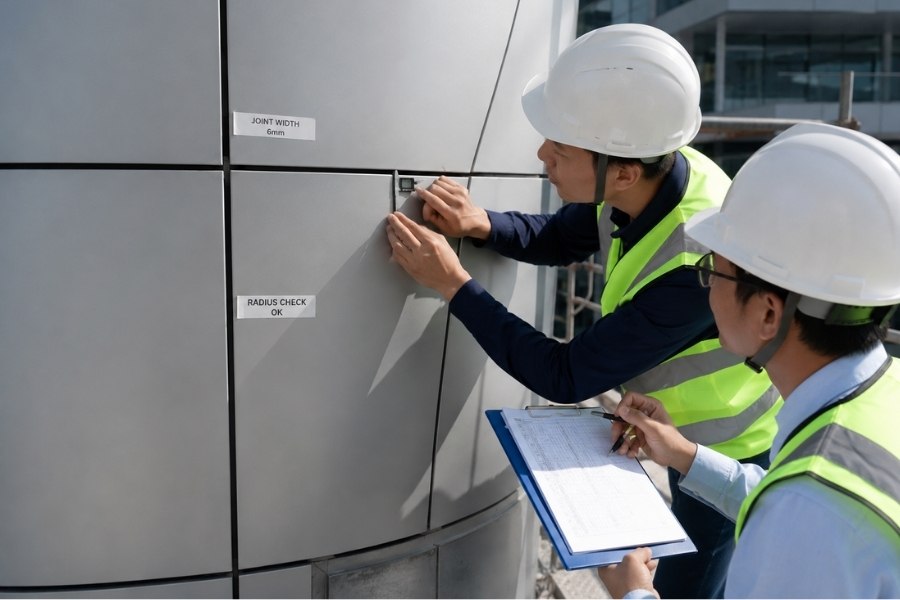
Final Inspection and Surface Verification
Final inspection should verify:
Radius consistency
Joint uniformity
Surface smoothness
Panel alignment
Sealant quality
Viewing the façade from multiple angles is important because reflected light often reveals imperfections that are not visible from close range.
Managing Joint Consistency and Tolerance Accumulation
Why Small Errors Multiply Around Circular Surfaces
A 1 mm deviation repeated across twenty panels can create a significant closure discrepancy.
Tolerance accumulation is one of the most common causes of joint irregularity on cylindrical façades.
Joint Width Control
Most curved façade systems specify consistent joint widths to accommodate thermal movement and maintain visual continuity.
Installers should avoid varying joint dimensions simply to compensate for accumulated installation errors.
Radius Consistency Across Multiple Panels
Radius gauges, templates, and laser verification tools are frequently used to confirm that adjacent panels maintain the intended curvature.
This becomes especially important at transitions between curved and flat façade sections.
Common Installation Problems on Curved ACP Projects
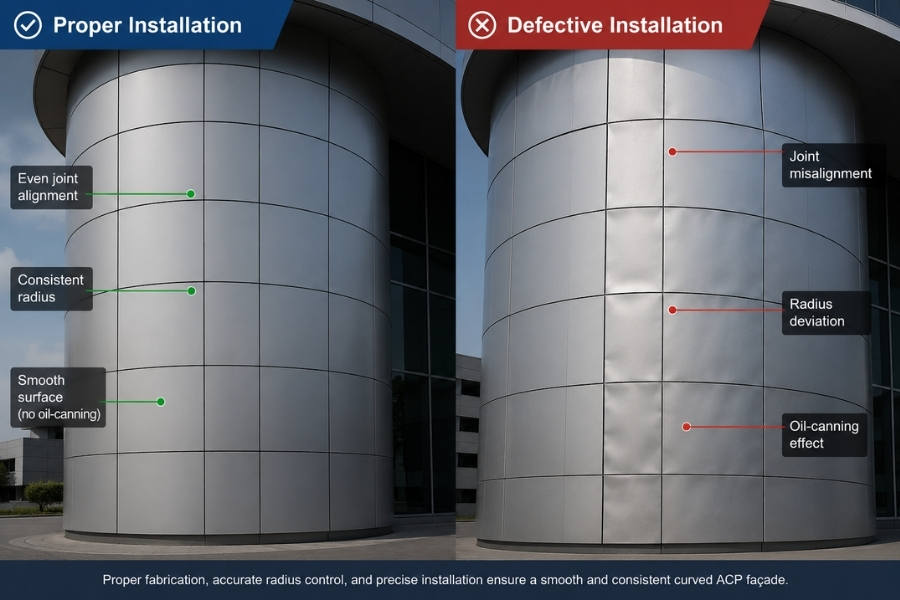
Radius Deviation
Radius deviation may result from fabrication inaccuracies, support structure errors, or poor survey control.
Uneven Panel Joints
Joint inconsistency is commonly caused by accumulated tolerances, installation sequencing issues, or dimensional variations within the support structure.
Oil-Canning on Curved Surfaces
Oil-canning refers to visible waviness in metal-faced panels.
Large panel sizes, reflective finishes, and direct sunlight can make the effect more noticeable on curved surfaces.
Panel Stress Around Tight Curves
Very small bending radii can introduce excessive stress into the aluminum skins, potentially causing coating damage or edge distortion.
Water Ingress at Curved Transitions
Curved-to-flat transitions, parapets, and opening details require careful waterproofing design to prevent long-term moisture intrusion.
Design Considerations for Curved Architectural Cladding
Architects should evaluate whether a project truly requires a continuously curved façade or whether a segmented system can achieve similar visual results.
Important considerations include:
Desired curvature
Panel dimensions
Joint layout
Thermal movement
Reflection characteristics
Maintenance accessibility
In many projects, a well-designed segmented system provides a practical balance between appearance, constructability, and cost.
Conclusion
Installing aluminum composite panels on cylindrical and curved walls requires careful coordination between fabrication, support structure design, and installation procedures.
Successful projects depend on selecting the appropriate bending method, maintaining radius accuracy, controlling joint consistency, and managing accumulated tolerances throughout construction.
For projects involving custom curved ACP fabrication, cylindrical column cladding, and project-specific façade engineering requirements, Aluwell® supports architects, façade consultants, and contractors with tailored solutions designed to balance aesthetics, manufacturability, and installation efficiency.
FAQ
Can aluminum composite panels be bent into a circular shape?
Yes. ACP panels can be fabricated into curved forms using roll bending, routed bending, or segmented construction methods. The appropriate solution depends on the required radius and project geometry.
What is the minimum bending radius for ACP panels?
The minimum radius varies according to panel thickness, core type, and fabrication method. Tight radii often require routed bending, while larger radii are typically achieved through roll bending.
Are curved ACP façades more difficult to install than flat façades?
Yes. Curved installations require additional attention to radius control, joint consistency, support structure accuracy, and tolerance management.
How are joints controlled on cylindrical ACP columns?
Joint control relies on accurate circumference calculations, consistent panel dimensions, proper installation sequencing, and continuous field verification.
Can square columns be converted into circular ACP columns?
Yes. Secondary framing systems are commonly installed around existing square columns to create cylindrical architectural features.