

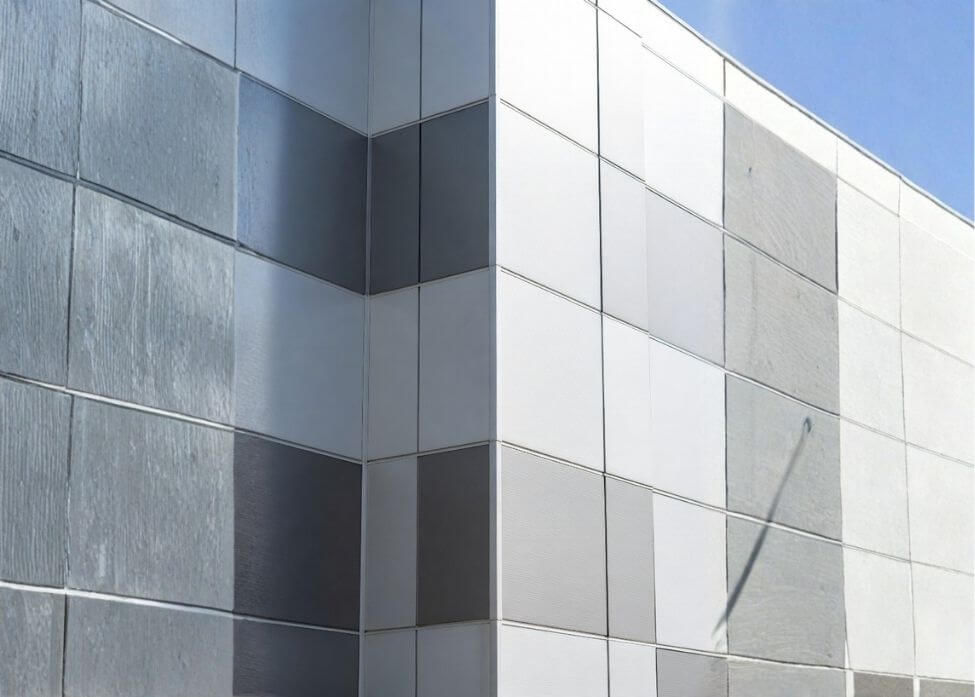
27 Mar
How to Customize Colors for Aluminum Composite Panels - Matching, Process, and What Affects Results
Why Custom Colors Matter in Real ACM Projects
In modern façade design, color is not just a visual decision. It defines brand identity, influences perceived scale, and determines how a building is experienced in its environment.
However, many projects encounter a common issue - panels that were specified as the same color appear inconsistent after installation. This is especially noticeable in large façades where even small variations become visible across continuous surfaces.
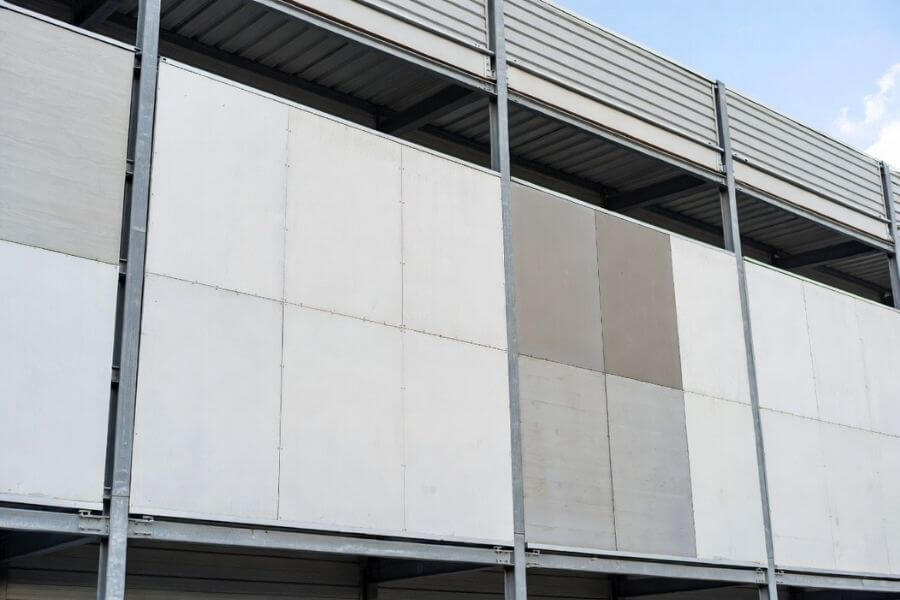
For aluminum composite panels, achieving a custom color is not only about matching a shade. It is about ensuring that the color performs consistently across manufacturing, installation, and long-term exposure.
What Custom Colors Really Mean for Aluminum Composite Panels
Custom color in aluminum composite panels is an engineering-controlled process rather than a simple design selection.
It involves:
Translating a visual reference into measurable color data
Adapting that data to a specific coating system
Ensuring repeatability across production batches and panel formats
This is why custom color matching is often described as both science and experience. A color must not only look correct in isolation, but remain consistent across thousands of panels under varying conditions.
How Custom ACM Colors Are Developed - From Sample to Production
The process begins with a reference, typically a physical sample that reflects the intended color, texture, and gloss.
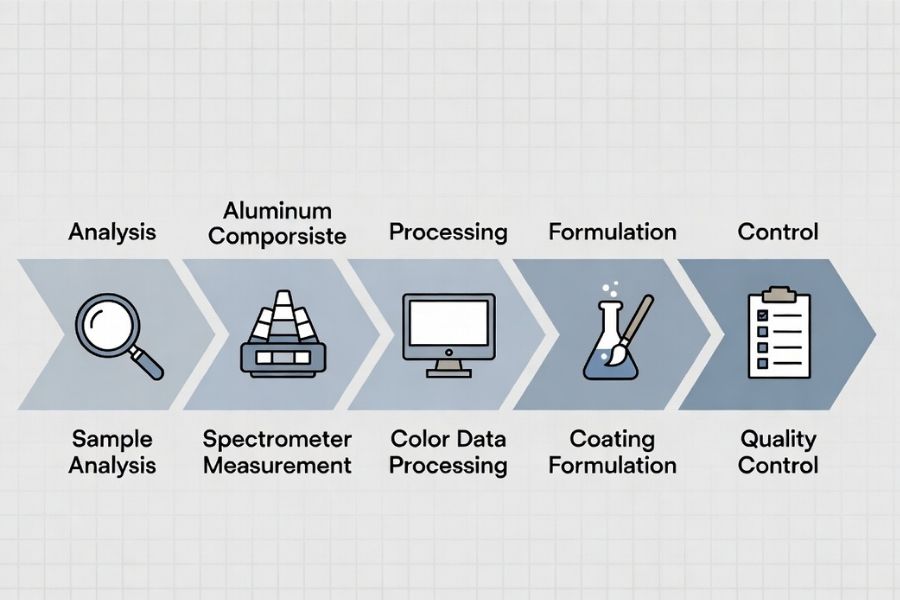
Sample Analysis and Data Conversion
A spectrometer measures the sample and converts it into numerical color coordinates. This allows manufacturers to compare the color against existing libraries or begin developing a new formulation.
Matching and Adjustment
If no exact match exists, coating specialists adjust pigment composition, gloss level, and coating thickness to achieve the closest result.
However, numerical matching alone is not sufficient. Experienced technicians evaluate surface reflectivity, lighting response, and finish characteristics to refine the result.
Validation and Approval
Laboratory samples are produced and reviewed against the original reference. Multiple iterations may be required before final approval.
At ALUMAX, this process is supported by integrated manufacturing knowledge. The Aluwell® system ensures that color formulations developed in controlled conditions can be reliably reproduced in large-scale production.
Why ACM Colors Look Different - Lighting, Coating, and Material Factors
Even when panels share the same target color, visual differences can occur due to several technical factors.
Coating Application
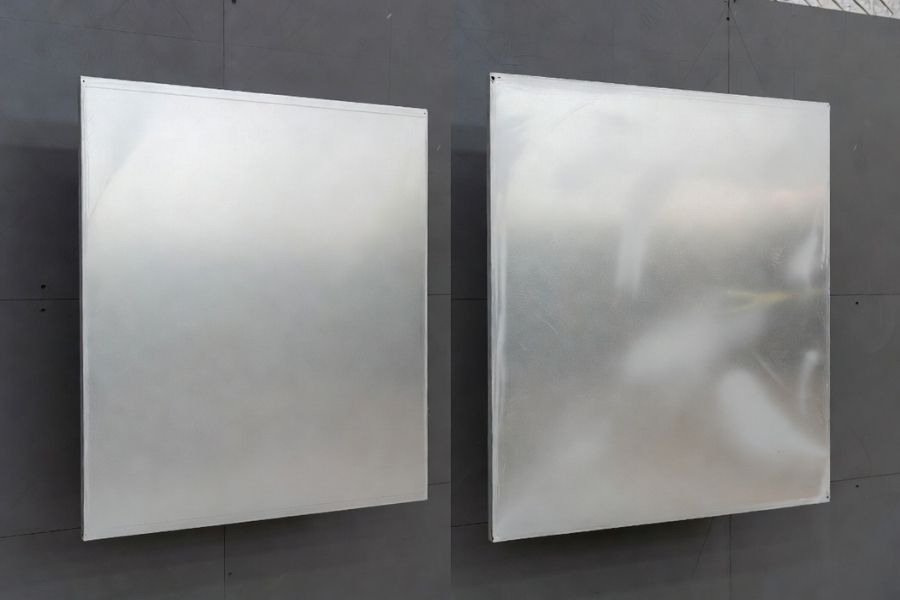
Coil coating produces a uniform finish with controlled particle orientation, while spray coating creates a more random distribution. This affects gloss, reflectivity, and perceived depth.
Lighting Conditions
Color appearance varies under different lighting environments, including natural daylight, artificial lighting, and changing viewing angles.
Material and Finish
Metallic, mica, and textured finishes respond differently to light. These finishes are directional, meaning their appearance changes depending on installation orientation.
Batch Variation
Small differences between production batches are unavoidable. In large façade systems, these variations can become visible if panels are mixed.
The Critical Point Most Projects Overlook - Why Matching Still Fails
Even when the correct color is selected and approved, projects can still experience visible inconsistencies. This is often due to a misunderstanding of how color is controlled in production.
In façade engineering, color consistency is typically evaluated using Delta E (ΔE), a numerical value that measures the difference between two colors.
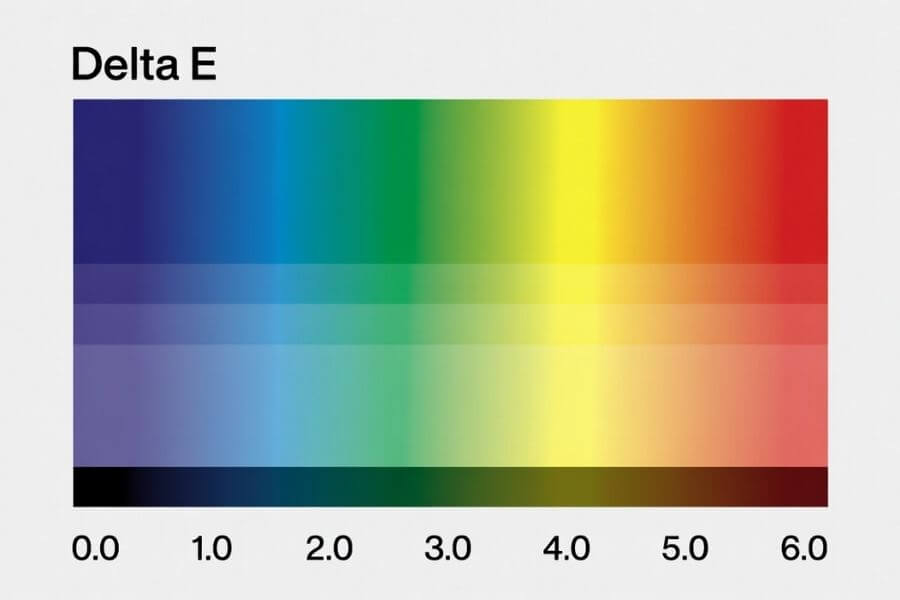
A ΔE value below 1 is nearly imperceptible
A ΔE value between 2–3 becomes noticeable in large surfaces
Values above 5 are clearly visible
In large-scale applications, even small ΔE variations can create visual inconsistency when panels are installed side by side.
Gloss level also plays a critical role. Differences in gloss can make panels appear inconsistent even when color values are technically matched.
At this level, color becomes a controlled performance variable within the façade system rather than a purely visual element.
How to Keep ACM Panel Colors Consistent Across a Project
Maintaining color consistency requires coordination across design, manufacturing, and installation.
Key practices include:
Ordering sufficient material in a single production batch
Maintaining consistent panel orientation during installation
Avoiding mixing coating systems or suppliers
A Practical Project Scenario
In a commercial façade project exceeding 15,000 square feet, panels with identical specifications were installed from two separate production batches.
Although both batches met standard tolerances, slight variations in gloss and ΔE resulted in visible banding across the façade under daylight conditions.
This issue was not caused by incorrect color matching, but by batch inconsistency and installation sequencing.
To avoid such outcomes, façade planning must include batch control and installation alignment as part of the color strategy.
ALUMAX addresses this through its modularized service approach. By integrating fabrication, pre-assembly verification, and installation coordination, the Aluwell® system helps maintain visual consistency throughout the project lifecycle.
FAQ
Is a physical sample better than a color code?
A physical sample provides the most reliable reference because it reflects real surface conditions, including gloss, texture, and substrate effects. This helps ensure that the final panel color matches the intended design under actual lighting and installation conditions.
Why do similar color names not match?
Color names are not standardized across manufacturers. Even if two colors share the same name, differences in pigment formulation, coating systems, and application methods can result in visible variations, especially on large façade surfaces.
Can Pantone colors be matched on metal panels?
Pantone colors are based on ink printed on white paper, which reflects light differently than metal surfaces. As a result, exact matching on aluminum composite panels is often not achievable, particularly for brightness and saturation levels.
Why do metallic colors change with viewing angle?
Metallic finishes contain reflective particles that align differently depending on light direction and viewing angle. This causes visible color shifts, making consistency dependent on panel orientation and installation alignment across the façade.
How can color variation be minimized?
Color variation can be reduced by ordering panels from a single production batch, maintaining consistent panel direction during installation, and avoiding mixing materials from different suppliers or coating systems within the same project.
How Aluwell® Supports Custom Color Projects in Practice
Delivering consistent custom colors requires more than coating capability. It requires coordination between design intent and manufacturing execution.
The Aluwell® system supports this through:
Engineering-level color matching based on project requirements
A wide range of finishes including metallic, brushed, mirror, wood, and stone effects
Multiple coating systems such as PE, PVDF, and Nano for different environments
More importantly, ALUMAX integrates design support, processing, and fabrication into a unified workflow. This reduces the risk of mismatch between specification and final installation.
As with all custom materials, practical considerations apply:
Minimum order quantities are required
Custom colors involve longer lead times
Specialized finishes may increase cost
These factors should be incorporated into early project planning.
Conclusion - Making Custom ACM Colors Work in Real Projects
Custom colors in aluminum composite panels are not simply a design feature. They are the result of coordinated control across materials, coating systems, and project execution.
When properly managed, custom colors enhance architectural identity and maintain visual consistency over time. When overlooked, even minor variations can affect the overall perception of a building.
By combining technical control with project-level coordination, ALUMAX and the Aluwell® brand help ensure that custom colors are not only achieved, but reliably delivered in real construction environments.