

22 May
The Benefits of Exterior Metal Wall Panels for Commercial Façade Systems
Why Exterior Metal Wall Panels Continue to Gain Popularity
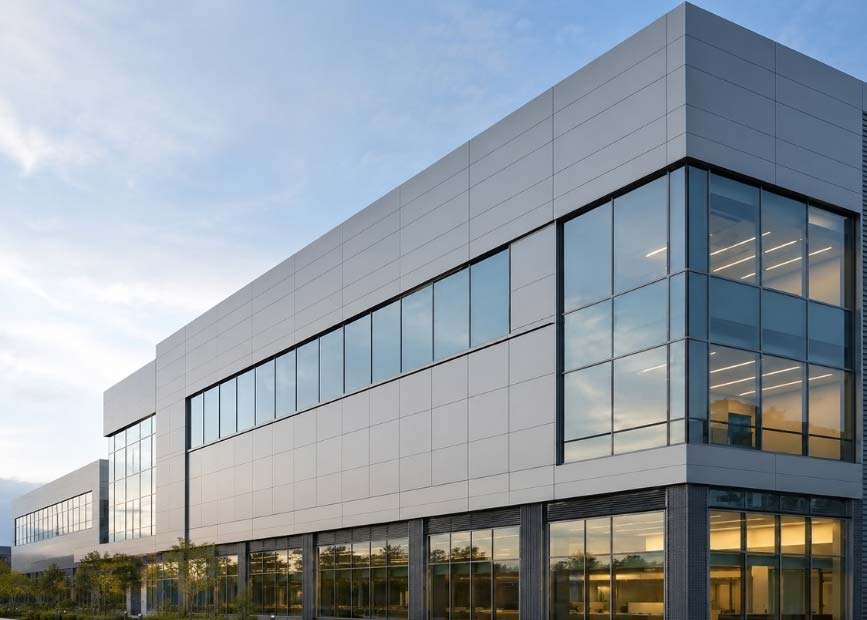
Exterior metal wall panels have become one of the most widely used cladding solutions in modern commercial construction because they combine lightweight installation, long-term durability, controlled fabrication, and flexible architectural detailing within a highly adaptable façade system.
Compared with heavier exterior materials such as stone veneer, precast concrete, or masonry assemblies, metal façade panels help simplify transportation, installation, and structural coordination while still supporting large-scale commercial building envelopes.
Their growing use is driven not only by appearance, but also by practical project advantages related to construction efficiency, weather resistance, maintenance control, and fabrication flexibility.
Lightweight Cladding Helps Reduce Structural and Installation Pressure
One of the biggest advantages of exterior metal wall panels is their relatively low structural weight.
Lightweight façade systems help reduce:
façade dead load
crane lifting pressure
transportation complexity
installation labor intensity
retrofit reinforcement requirements
This becomes especially important in:
high-rise commercial buildings
façade renovation projects
modular construction systems
large-format building envelopes
Many architectural aluminum panel systems use formed sheet profiles that maintain rigidity through geometry and subframe support rather than excessive material thickness alone. Certain traditional formed aluminum panel systems may use material thicknesses around 0.6 mm to 0.7 mm for specific profile applications, while solid aluminum plate systems typically use thicker structural configurations.
Lighter cladding systems also improve jobsite handling efficiency. Large prefabricated panels can often be transported and positioned faster than heavier façade materials, helping reduce installation time across large elevations.
Prefabricated Panel Systems Improve Construction Efficiency
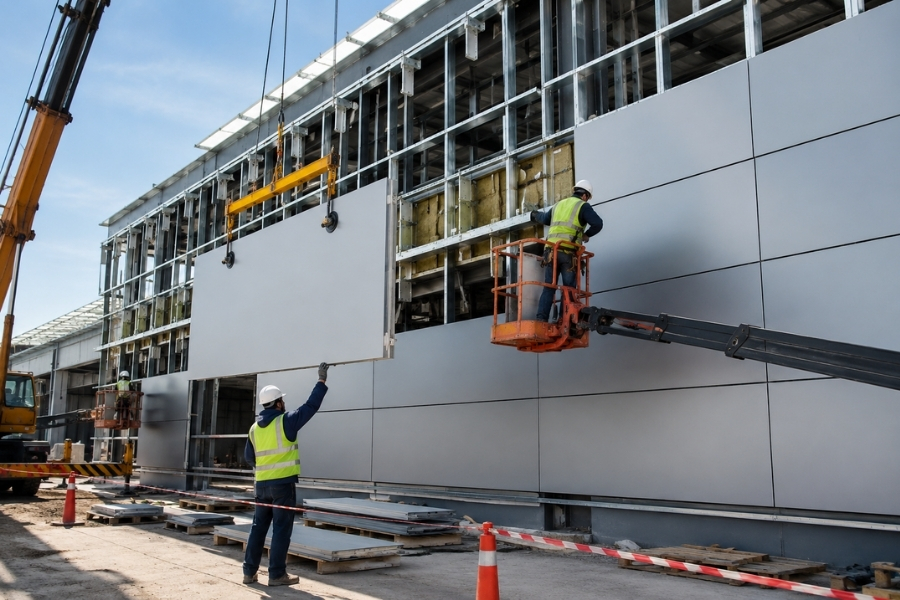
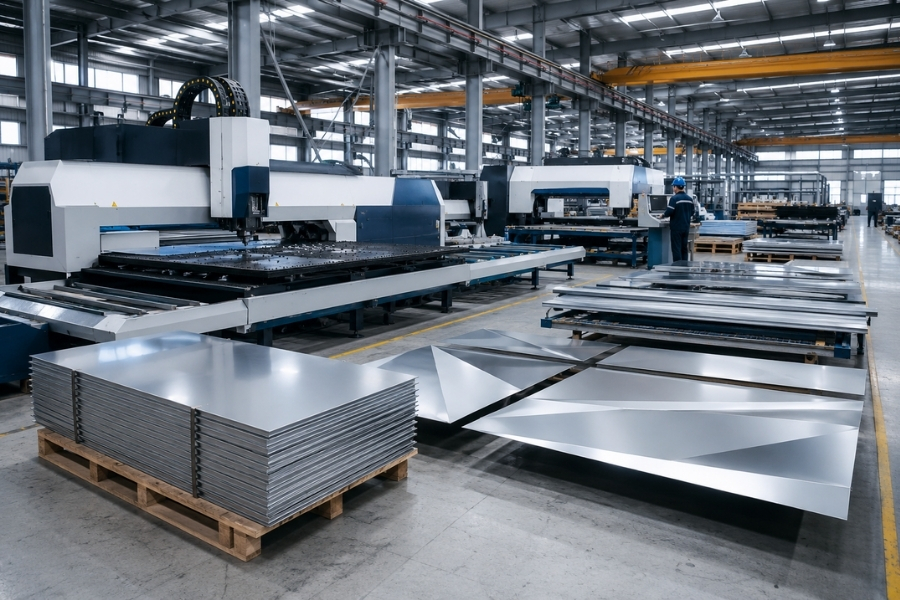
Exterior metal wall panels are commonly manufactured using factory-controlled fabrication processes before arriving at the project site.
This prefabrication approach improves:
dimensional consistency
installation repeatability
project scheduling
quality inspection efficiency
façade alignment control
Because panels, trims, rails, and accessories are typically prepared in advance, contractors can reduce field cutting and minimize installation adjustments during façade assembly.
A typical installation sequence may include:
substrate preparation
layout marking
support rail installation
alignment correction
panel installation
trim and joint detailing
final surface inspection
Installation speed depends heavily on proper subframe preparation. Even high-quality metal façade panels may appear visually uneven if rail alignment and support spacing are not properly controlled before panel installation begins.
For large commercial projects, repeatable installation methods help improve façade consistency while reducing coordination pressure between fabrication teams and field installers.
Exterior Metal Wall Panels Support Flexible Architectural Detailing
Modern commercial façades often require more than flat wall surfaces. Buildings may include:
parapets
recessed glazing
curved façades
column wraps
soffits
canopy transitions
mixed-material interfaces
complex corner conditions
Exterior metal wall panels provide strong detailing flexibility because aluminum, stainless steel, and composite panel systems can be bent, folded, perforated, welded, or fabricated into customized geometries.
This allows architects to maintain cleaner visual continuity across difficult façade transitions.
Window heads, sill returns, edge trims, and façade corners can often be integrated more precisely compared with rigid cladding materials that are more difficult to shape or adjust during fabrication.
Curved and cylindrical surfaces particularly benefit from formed metal systems. Stainless steel and aluminum panels can be fabricated into rounded architectural forms while maintaining relatively controlled joint spacing and cleaner edge transitions.
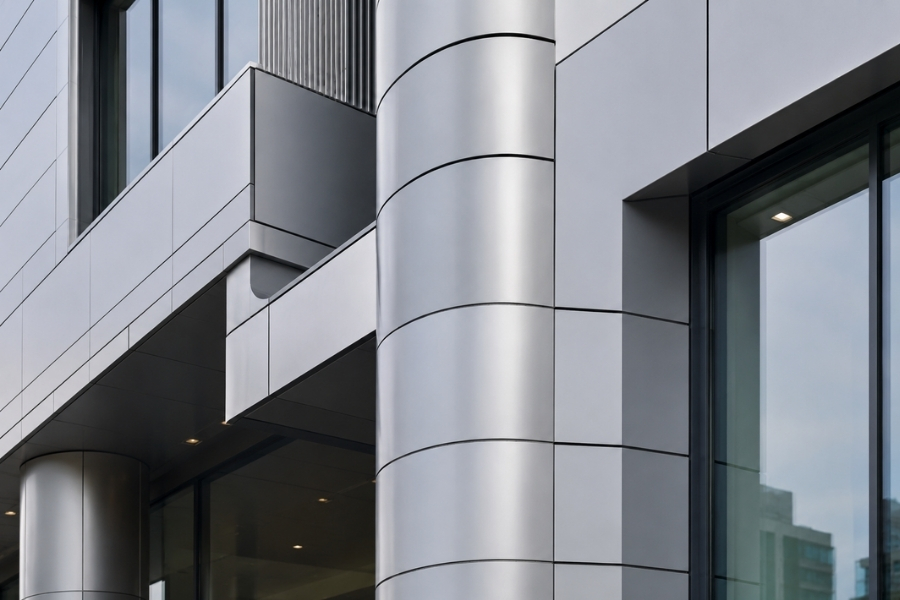
The real advantage is not simply that metal can bend. The larger project value comes from the ability to create repeatable façade detailing with controlled geometry and fabrication consistency across large building surfaces.
Weather Protection Depends on the Full Façade Assembly
Exterior metal wall panels are frequently used within rainscreen and ventilated façade systems because they help shield the building envelope from direct environmental exposure.
However, long-term weather resistance depends on the full façade assembly rather than the panel surface alone.
Effective façade systems must coordinate:
drainage
ventilation
flashing integration
movement accommodation
joint sealing
moisture evacuation
pressure equalization
Window transitions, parapets, corners, and panel joints are some of the most sensitive areas within exterior wall systems. Improper detailing in these locations may increase the risk of water intrusion even when high-quality panels are specified.
Many modern metal façade systems are designed so the exterior panel layer sheds most water while allowing incidental moisture behind the cladding to drain or dry through ventilated cavity spaces.
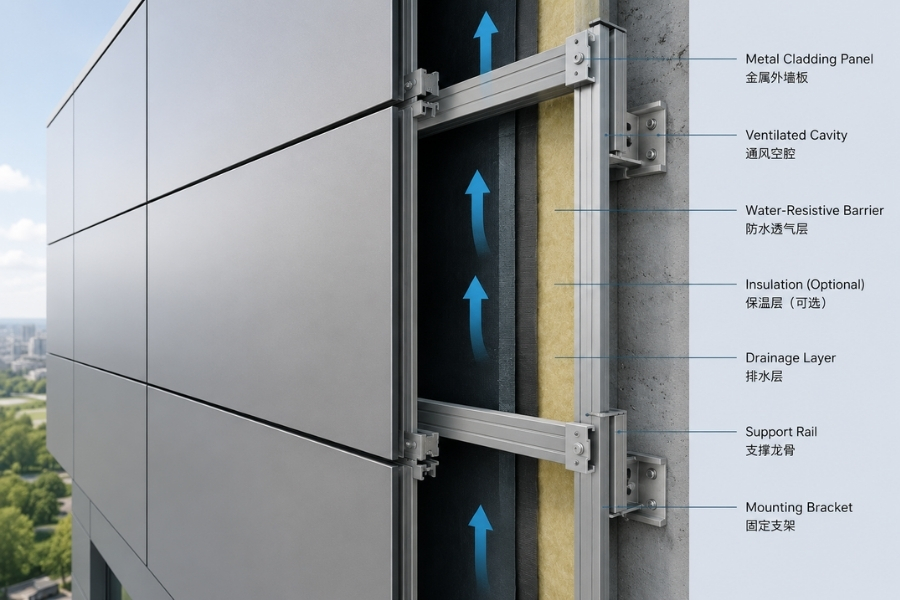
This rainscreen approach helps improve long-term wall durability and moisture management, especially in coastal climates, humid regions, and high-rise projects exposed to wind-driven rain.
Long-Term Durability Depends on Material and Finish Selection
Exterior metal wall panels are available in multiple material configurations, each with different project advantages and engineering considerations.
| Material | Common Advantages | Typical Considerations |
|---|---|---|
| Aluminum panels | Lightweight, corrosion-resistant with coating, formable | Flatness and coating quality |
| Stainless steel panels | Strong durability, impact resistance, metallic appearance | Cost and surface scratch visibility |
| Galvanized steel panels | Structural strength and cost efficiency | Edge corrosion protection |
| ACM or MCM panels | Lightweight with smooth appearance | Fire compliance and core selection |
| Zinc and copper panels | Natural weathering and architectural identity | Patina variation and budget |
Durability should never be evaluated using material type alone.
Long-term façade performance also depends on:
coating systems
UV exposure
environmental conditions
cut-edge protection
fastening compatibility
drainage detailing
thermal movement allowance
For example, stainless steel gains much of its corrosion resistance from chromium and nickel content, while aluminum façade systems rely heavily on coating performance and proper detailing to maintain long-term appearance stability.
Commercial coastal projects often require enhanced corrosion management strategies because salt exposure may accelerate finish degradation around fasteners, joints, and exposed cut edges if detailing is not properly controlled.
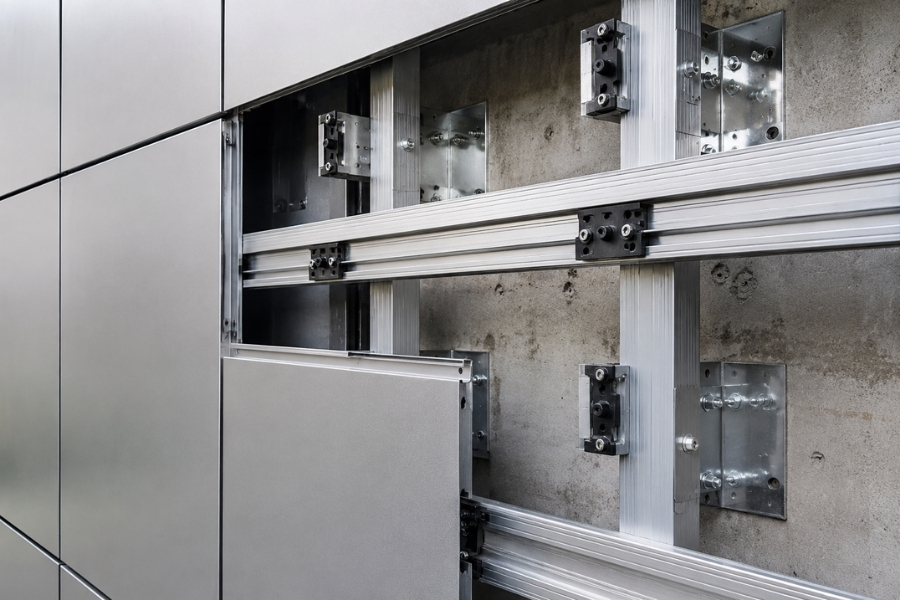
Subframe Engineering and Fastening Layout Affect Façade Stability
Many façade performance problems originate from subframe and fastening conditions rather than the metal panel itself.
Exterior metal wall panels rely on coordinated relationships between:
panel thickness
support rail spacing
bracket positioning
wind load resistance
fastening methods
thermal movement
joint width control
Improper support spacing may contribute to:
oil-canning
panel waviness
inconsistent joints
fastening stress
visual deformation
long-term alignment problems
Wind pressure is one of the most important engineering factors affecting rail spacing and fastening layout design. Larger panel spans often require additional reinforcement or reduced support spacing depending on panel geometry and project exposure conditions.
Concealed fastener systems and exposed fastener systems also produce different visual and maintenance outcomes.
Concealed fastening systems generally provide cleaner façade appearance and stronger visual continuity, while exposed fastening systems may simplify replacement access in certain industrial and utility-oriented applications.
Thermal movement must also be considered carefully. Large metal façade surfaces naturally expand and contract as temperatures change. Without proper movement joints and fastening allowance, stress accumulation may eventually affect panel alignment and long-term system stability.
Exterior Metal Wall Panels Help Reduce Long-Term Maintenance Requirements
Compared with many traditional cladding materials, exterior metal wall panels generally require relatively low ongoing maintenance when properly engineered and installed.
Metal façade systems typically resist:
biological decay
moisture absorption
insect damage
surface rot
freeze-thaw deterioration
Routine maintenance usually focuses on:
surface cleaning
sealant inspection
drainage verification
fastening checks
localized panel replacement
Maintenance behavior varies depending on coating systems and environmental exposure conditions.
PVDF coatings are commonly used for long-term color stability and UV resistance in commercial façade applications. Brushed stainless steel and anodized aluminum surfaces may behave differently under pollution exposure, coastal salt conditions, and environmental contamination.
Façade geometry also influences maintenance pressure. Horizontal projections, deep recesses, and poorly drained transitions may accumulate dirt and moisture more aggressively than flatter vertical surfaces.
Exterior Metal Wall Panels Support Energy and Sustainability Goals
Many commercial projects use exterior metal wall panels to improve building envelope efficiency and support sustainability targets.
Insulated metal panel systems may help reduce uncontrolled heat transfer by integrating metal skins with insulated core materials.
Ventilated façade cavities and reflective metal finishes may also help improve thermal behavior in certain climate conditions when coordinated with proper insulation and air barrier systems.
From a sustainability perspective, metal façade systems often provide advantages such as:
recyclable material content
long service life
reduced replacement frequency
lower maintenance demand
reduced construction waste through prefabrication
However, actual energy performance depends on the complete wall assembly rather than the exterior metal surface alone.
Insulation continuity, thermal bridge control, air barrier integration, and joint detailing all influence real-world façade efficiency.
What Architects and Contractors Should Evaluate Before Specification
Selecting exterior metal wall panels requires more than choosing a visual finish or color.
Project teams should evaluate:
panel material type
panel thickness
coating system
fire compliance requirements
support rail compatibility
wind load resistance
fastening systems
movement joint spacing
drainage detailing
fabrication tolerances
finish consistency between batches
maintenance accessibility
For large commercial façades, fabrication precision becomes especially important because small dimensional inconsistencies may become visually noticeable across long elevations.
Procurement teams should also evaluate supplier manufacturing capability, quality control systems, fabrication experience, and project coordination support before final specification approval.
Frequently Asked Questions About Exterior Metal Wall Panels
Are exterior metal wall panels suitable for high-rise commercial buildings?
Yes. Many high-rise commercial buildings use engineered metal façade systems because they combine relatively low structural weight with strong weather resistance and flexible detailing capability. However, wind load calculations, fire compliance, thermal movement allowances, and attachment engineering must all be reviewed carefully during façade design.
What is the difference between solid aluminum panels and ACM panels?
Solid aluminum panels are fabricated from a single aluminum sheet and generally provide higher structural rigidity and noncombustible performance. ACM panels use two thin aluminum skins bonded to a composite core, creating lighter-weight panels with smooth appearance and improved fabrication flexibility for many façade applications.
Do exterior metal wall panels require frequent maintenance?
Most architectural metal wall panel systems require relatively low maintenance compared with traditional exterior cladding materials. Routine maintenance typically includes cleaning, sealant inspection, drainage review, and occasional fastening checks. Long-term maintenance frequency depends heavily on coating quality, environmental exposure, and façade detailing conditions.
Can metal wall panels improve building energy efficiency?
Yes. Insulated metal panel systems can improve thermal performance by reducing uncontrolled heat transfer through the building envelope. Reflective coatings and ventilated rainscreen assemblies may also help lower cooling demand in certain climate conditions when coordinated with proper insulation and air barrier systems.
Are metal wall panels resistant to corrosion and weather exposure?
Properly coated aluminum, stainless steel, and galvanized steel façade systems can provide strong resistance against rain, humidity, UV exposure, and temperature fluctuations. However, long-term corrosion resistance depends on coating systems, drainage detailing, environmental exposure severity, and cut-edge protection quality.
Why do architects prefer metal wall panels for modern façades?
Architects often prefer metal wall panels because they provide clean visual lines, flexible geometry, lightweight construction, and broad finish customization options. Metal systems also support curved surfaces, perforated designs, modular layouts, and mixed-material façades commonly used in contemporary commercial architecture.
Supporting Complex Commercial Façade Projects
Modern exterior metal wall panel systems require more than basic fabrication capability. Large commercial projects often involve strict dimensional tolerances, custom panel geometry, finish consistency requirements, wind load engineering, and coordination between façade consultants, contractors, and manufacturers.
For projects involving aluminum composite panels, solid aluminum cladding, stainless steel composite systems, or customized architectural façade panels, experienced manufacturers can help reduce production inconsistency and installation risk through better fabrication control and technical coordination.
Companies specializing in architectural metal fabrication and composite panel manufacturing typically support:
custom façade panel fabrication
CNC processing and precision forming
coating and finish coordination
large-format panel production
rainscreen and ventilated façade systems
project-based OEM manufacturing
installation-compatible panel engineering
As a manufacturer focused on architectural cladding systems, Aluwell® supports commercial façade projects with aluminum composite panels, honeycomb panels, stainless steel composite panels, and customized metal façade fabrication solutions. For architects, contractors, and procurement teams, early coordination with an experienced façade panel manufacturer can help improve fabrication consistency, installation efficiency, and long-term exterior performance across complex commercial building envelopes.
Conclusion
Exterior metal wall panels have become a core component of modern commercial façade construction because they combine lightweight engineering, controlled fabrication, durable finishes, flexible detailing, and efficient installation methods within a highly adaptable building envelope system.
Their growing popularity is driven not only by aesthetics, but also by practical project advantages such as improved weather protection, reduced maintenance pressure, prefabrication efficiency, and compatibility with contemporary rainscreen façade assemblies.
As commercial façade systems continue evolving toward higher energy performance and more complex architectural geometry, exterior metal wall panels are expected to remain one of the most important solutions for modern building envelope design.