

09 May
How Fire-Rated ACM Panels Influence Modern Facade Design
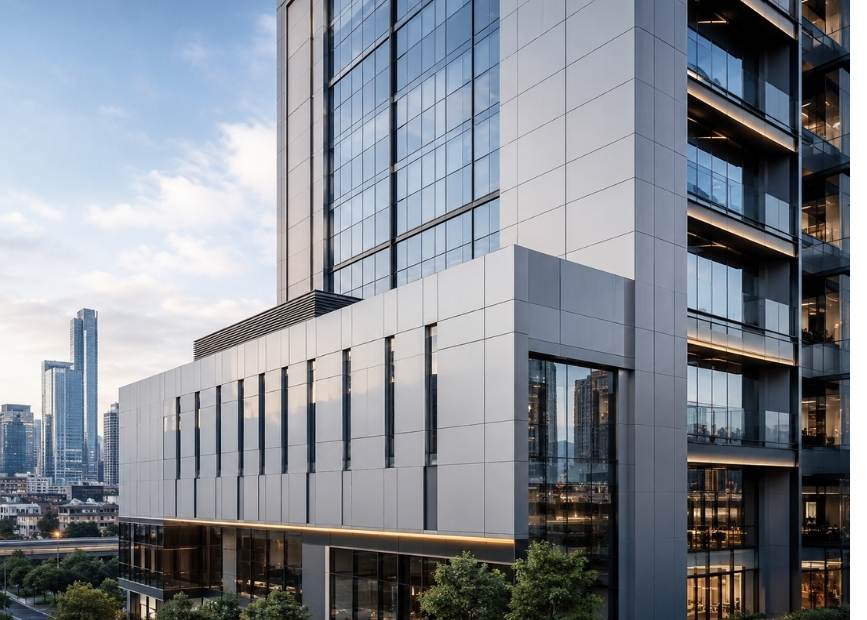
Modern facade design has changed significantly over the last decade. Exterior wall systems are no longer evaluated only by appearance, material cost, or fabrication flexibility. For architects working on commercial towers, healthcare campuses, transportation hubs, and institutional buildings, facade performance now begins with fire safety strategy.
As cities continue to expand vertically, the role of high-performance ACM systems has evolved from decorative cladding to a critical component of modern building envelope design. In many commercial projects, facade material selection now starts during schematic planning rather than later design stages because fire compliance affects everything from cavity design and insulation selection to panel dimensions and installation sequencing.
For facade consultants and contractors, the conversation has also changed. The focus is no longer simply about choosing attractive cladding materials. It is about designing exterior wall systems that balance code compliance, architectural identity, constructability, moisture control, and long-term durability without compromising design intent.
Why Fire Safety Is Changing Facade Design
In contemporary commercial architecture, exterior wall systems are increasingly shaped by fire regulations long before final facade aesthetics are developed.
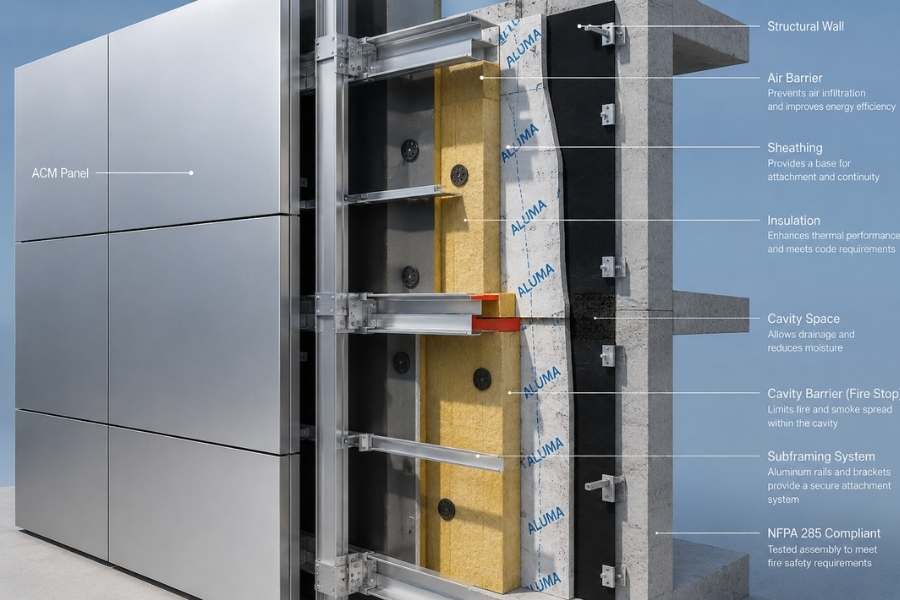
One of the most influential standards in North American facade construction is NFPA 285, which evaluates how fire spreads through an entire exterior wall assembly. Unlike single-material laboratory tests, NFPA 285 examines how all facade components interact during a fire event.
The tested assembly typically includes:
ACM panels
Insulation systems
Air and water barriers
Attachment rails
Framing components
Fire stopping materials
Sealants
Ventilated cavities
This system-based approach has fundamentally changed commercial facade engineering priorities.
In practice, even relatively small changes can affect compliance. Replacing insulation density, adjusting cavity depth, or changing subframing layouts may require additional engineering review because the wall assembly functions as an interconnected system rather than a collection of independent materials.
For many architects, stricter fire regulations initially appeared to limit facade creativity. In reality, the opposite has happened. Fire compliance has pushed facade systems toward better coordination, more advanced engineering, and greater material precision across the entire building envelope.
From Decorative Cladding to High-Performance Facade Systems
Earlier generations of aluminum composite panels were often selected primarily for visual consistency and lightweight fabrication. Modern facade systems demand considerably more.
Today, architectural ACM systems are expected to function as part of a larger high-performance exterior envelope that controls moisture, thermal movement, weather exposure, structural loading, and fire propagation simultaneously.
This shift has elevated the importance of facade detailing.
Modern rainscreen cladding systems now require careful coordination between:
Ventilated cavity depth
Horizontal and vertical fire compartmentation
Insulation combustibility
Attachment rail continuity
Slab edge transitions
Drainage pathways
Expansion joint locations
On large commercial projects, facade geometry is often influenced as much by compliance and constructability as by visual composition.
A large-format facade with deep shadow lines and minimal visible joints may create a strong monolithic appearance from street level, but achieving that appearance requires extensive coordination behind the cladding surface. Fire stopping locations, cavity interruptions, and thermal movement tolerances must all align without disrupting the architectural rhythm of the elevation.
This is why modern facade engineering increasingly begins during conceptual design rather than after facade aesthetics have already been finalized.
How Fire-Rated ACM Panels Work
Aluminum composite material panels consist of two aluminum cover sheets bonded to a core material. The core composition largely determines how the panel behaves during fire exposure.
Most commercial facade projects today specify either FR-core ACM systems or A2-core assemblies because they significantly reduce flame spread and smoke development compared with traditional polyethylene cores.
| Core Type | Typical Fire Performance | Common Applications |
|---|---|---|
| Polyethylene core | Combustible | Signage, low-rise interiors |
| FR mineral-filled core | Reduced flame spread and smoke generation | Commercial facades |
| A2 non-combustible core | Very limited heat release | High-rise and code-sensitive projects |
In facade engineering discussions, the more technically accurate term is often “reaction-to-fire” rather than “fire resistance.”
Reaction-to-fire evaluates how materials behave during ignition and flame exposure, including:
Flame spread
Heat release
Smoke generation
Burning droplets
Toxicity
This distinction matters because smoke and toxic gas generation frequently present greater life safety risks than direct flame contact during facade-related fire incidents.
For many commercial projects, the specification process now focuses less on whether a panel is simply labeled “fire-rated” and more on whether the entire assembly has verified testing compatibility under real installation conditions.
Designing Rainscreen Systems With Fire Compliance in Mind
The widespread adoption of ventilated rainscreen assemblies has significantly increased demand for code-compliant ACM rainscreen systems in modern facade construction.
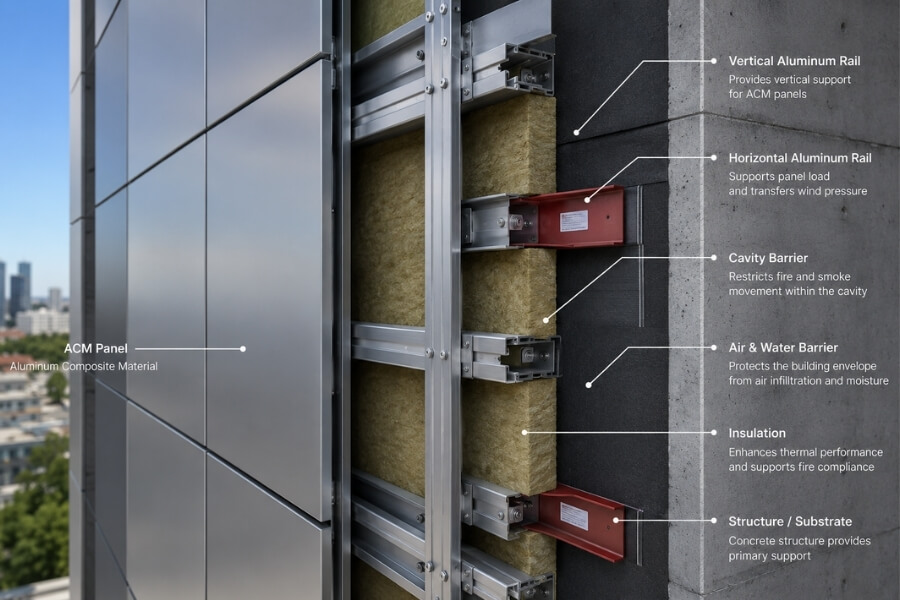
Ventilated facade assemblies improve drainage, reduce trapped moisture, and enhance thermal efficiency. At the same time, the air cavity behind the cladding introduces additional fire engineering considerations that did not exist in older wall systems.
Facade engineers now carefully evaluate:
Cavity ventilation paths
Horizontal fire barriers
Vertical compartmentation
Insulation performance
Attachment continuity
Joint spacing
Airflow interruption points
In many high-rise projects, cavity barriers directly influence panel layouts and support rail geometry. Fire stopping locations may interrupt otherwise continuous facade lines, requiring architects to coordinate visual rhythm with concealed life safety systems.
This coordination challenge becomes even more complex on projects with accelerated schedules, multiple trades, and prefabricated facade sections.
Hospitals and airport expansions often demand rapid enclosure sequencing while maintaining strict installation tolerances across large facade areas. In these environments, prefabricated ACM facade assemblies can improve quality consistency while reducing installation variability on site.
The growing complexity of these systems is one reason many facade teams now prefer tested assembly approaches rather than mixing independently sourced facade components.
Modern Facade Design Without Compromising Fire Performance
One of the biggest changes in facade design over the last decade is that architects no longer need to choose between fire compliance and visual flexibility.
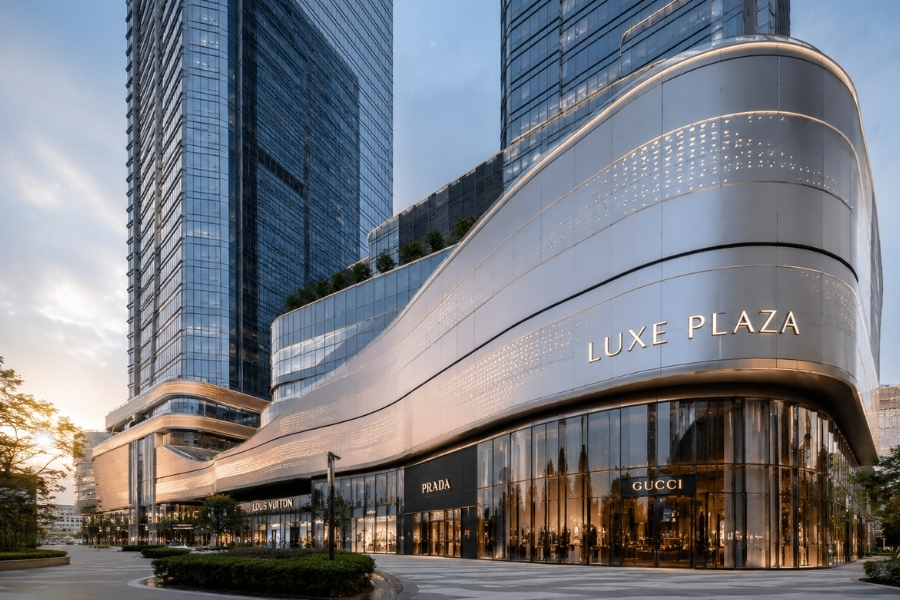
Modern fire-retardant ACM systems support a wide range of architectural expressions while still meeting demanding code requirements for commercial construction.
Today’s facade systems can accommodate:
Large-format panel layouts
Curved geometries
Folded facade elements
Deep shadow reveals
Metallic finishes
Stone-inspired textures
Wood-look surfaces
Precision corporate color matching
This flexibility has become increasingly important in branded commercial architecture where facade identity contributes to urban visibility and tenant recognition.
On large mixed-use developments, alternating panel finishes and subtle gloss variations are often used to reduce perceived building scale across long elevations. In healthcare architecture, smoother monolithic facade surfaces are frequently preferred because they reinforce visual clarity and simplify long-term maintenance.
At skyline level, carefully coordinated ACM panel systems can create sharp visual transitions between glass curtain walls, opaque facade zones, and recessed architectural elements without introducing excessive structural weight.
High-performance PVDF coatings also contribute to facade longevity by maintaining color consistency under prolonged UV exposure and environmental pollutants. For projects in coastal regions or high-solar environments, coating stability becomes just as important as visual appearance during initial specification.
What Architects Need to Know About Long-Term ACM Performance
While fire compliance often drives initial specification decisions, long-term facade performance ultimately determines whether a cladding system remains successful over decades of service.
One reason commercial ACM facade systems remain widely used in modern construction is their ability to balance lightweight fabrication with long-term durability.
Compared with heavier facade materials, ACM systems reduce structural dead load and simplify transportation logistics. A typical 4 mm FR ACM panel system may weigh substantially less than comparable precast or solid metal assemblies while still maintaining facade rigidity across large elevations.
Long-term facade reliability depends on multiple interconnected factors, including:
Coating quality
Aluminum alloy selection
Core stability
Fabrication precision
Attachment detailing
Moisture drainage
Thermal movement accommodation
Even highly durable facade materials can experience premature failure if expansion movement, drainage paths, or fastening tolerances are poorly coordinated during installation.
This becomes especially important in projects exposed to significant thermal cycling, coastal humidity, or long-term UV exposure. Airports, transportation terminals, educational campuses, and healthcare facilities often require facade systems capable of maintaining visual consistency for 20 to 30 years with limited operational disruption.
For many developers, lifecycle stability now matters as much as initial construction cost.
The Growing Role of Prefabrication in Facade Construction
As facade systems become more technically demanding, prefabrication has become increasingly important in commercial construction workflows.
Factory-controlled fabrication improves:
Dimensional consistency
Installation efficiency
Quality verification
Material traceability
Coordination between trades
For tested ACM facade systems, assembly consistency is particularly important because installation variations may affect overall wall system performance.
This has accelerated demand for modular facade approaches that simplify on-site coordination while improving installation predictability.
At Aluwell®, facade support increasingly extends beyond panel manufacturing alone. Through collaborative design assistance, CNC processing capabilities, and modular verification workflows, ALUMAX works with architects, contractors, and facade teams to improve constructability during early project phases.
This coordination may include:
Panel optimization
Attachment integration
Mock-up evaluation
Joint alignment studies
Fabrication sequencing
Installation planning
In some projects, full-scale mock-up verification and benchmark installation reviews help identify tolerance conflicts before large-scale facade installation begins on site.
This type of early coordination can significantly reduce schedule risk on complex commercial projects where multiple facade systems intersect across large building envelopes.
Why Early Collaboration Matters in Complex Facade Projects
Modern facade construction requires far more interdisciplinary coordination than many traditional cladding systems.
Architects focus on facade composition and visual continuity. Contractors prioritize sequencing and installation efficiency. Developers evaluate lifecycle costs and project risk. Fire consultants review compliance pathways. Manufacturers assess fabrication feasibility and assembly compatibility.
Without early collaboration, these priorities frequently collide during construction.
This challenge becomes particularly visible in projects involving:
High-rise rainscreen assemblies
Large-format ACM systems
Complex facade geometries
Modular enclosure strategies
Mixed-material facade transitions
Accelerated construction schedules
A facade concept that appears visually simple in renderings may require highly coordinated cavity barriers, movement joints, and attachment transitions once detailed engineering begins.
This is one reason collaborative facade development has become increasingly valuable for projects using fire-compliant facade systems.
With more than 20 years of composite panel manufacturing experience and advanced production support from Taiwan Alumax Industrial Co., ALUMAX has participated in projects where facade engineering, fabrication precision, and installation sequencing must align from the earliest planning stages.
Rather than treating compliance as a final-stage approval exercise, many facade teams now integrate manufacturers, installers, and engineering consultants much earlier in the design process to reduce downstream coordination risk.
Balancing Fire Safety, Sustainability, and Facade Durability
Modern facade systems are expected to deliver much more than regulatory compliance alone.
Architects and developers increasingly evaluate facade materials based on long-term durability, maintenance requirements, environmental impact, and operational efficiency alongside fire safety performance.
Many high-performance ACM systems contribute to sustainable construction strategies because they provide:
Long service life
Recyclable aluminum content
Lightweight transportation efficiency
Reduced maintenance requirements
Improved thermal performance
Durability also plays an important sustainability role. Facade systems that maintain coating stability, structural integrity, and visual consistency over extended service periods reduce replacement frequency and minimize material waste across the building lifecycle.
For large commercial projects, sustainable facade design is no longer limited to energy performance alone. It increasingly involves balancing occupant safety, constructability, architectural quality, maintenance planning, and long-term operational resilience within a single integrated envelope strategy.
FAQ
Are all ACM panels suitable for high-rise facade applications?
No. High-rise projects typically require FR-core ACM systems or A2-rated assemblies that comply with local building codes and tested wall assembly requirements. Panel selection should always be reviewed alongside insulation, cavity barriers, and attachment systems during facade specification.
Does NFPA 285 apply to individual ACM panels?
No. NFPA 285 evaluates the fire performance of the complete exterior wall assembly rather than a single cladding material. Changes to insulation, air barriers, subframing, or cavity configurations may affect overall compliance and require additional engineering review.
Why do cavity barriers affect facade layouts?
Cavity barriers help prevent concealed fire spread inside ventilated rainscreen cavities. Their placement often influences panel module sizes, joint alignment, support rail spacing, and facade sequencing, especially in high-rise commercial facade systems.
Can fire-rated ACM panels still support complex architectural designs?
Yes. Modern fire-retardant ACM systems support curved surfaces, large-format panel layouts, custom folded details, and precision color matching while maintaining compliance with demanding facade performance standards and architectural design goals.
What coatings are commonly used for exterior ACM facades?
PVDF coatings are commonly specified for exterior ACM facades because they provide long-term UV resistance, color retention, weather durability, and surface stability in demanding commercial and high-rise building environments.