


30 Apr
Fire incidents in high-rise buildings have shown that flame spread is often not driven by the structure itself, but by the exterior wall system. In several global cases, fires originating inside a building rapidly propagated along the façade, highlighting the importance of façade fire performance in composite panel systems.
Aluminum composite panels are widely used due to their light weight, flatness, and design flexibility. However, their fire performance depends not on the aluminum surface, but on how the panel core and full wall assembly behave under real fire exposure conditions.
For architects, contractors, and developers, understanding how these systems respond in fire scenarios is essential for compliance, liability control, and long-term building performance.
An aluminum composite panel is a sandwich structure composed of:
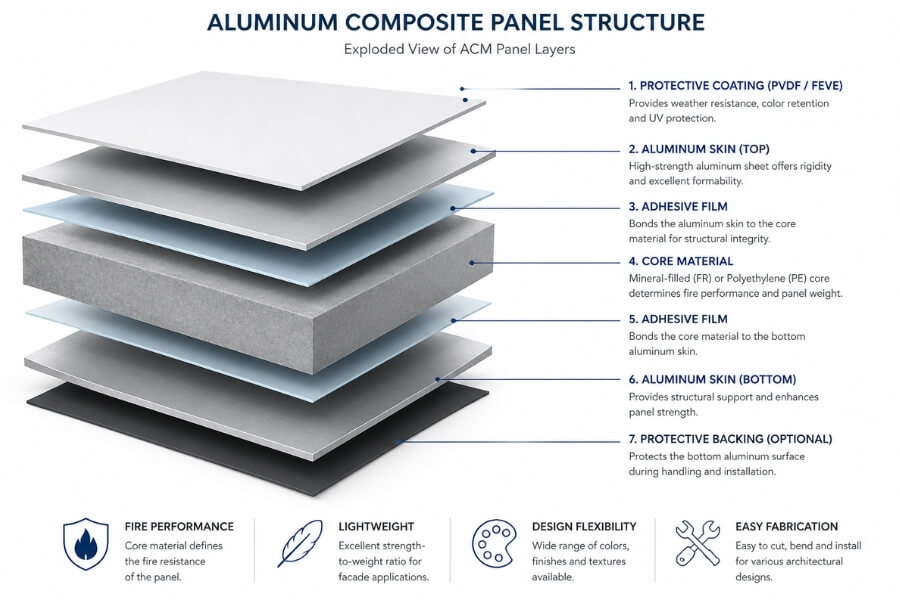
Two aluminum cover sheets
A bonded core material
A factory-applied coating system such as PVDF
Aluminum itself is non-combustible, but it conducts heat efficiently. During a fire, heat is rapidly transferred through the outer layers into the core.
The fire risk is determined by core composition:
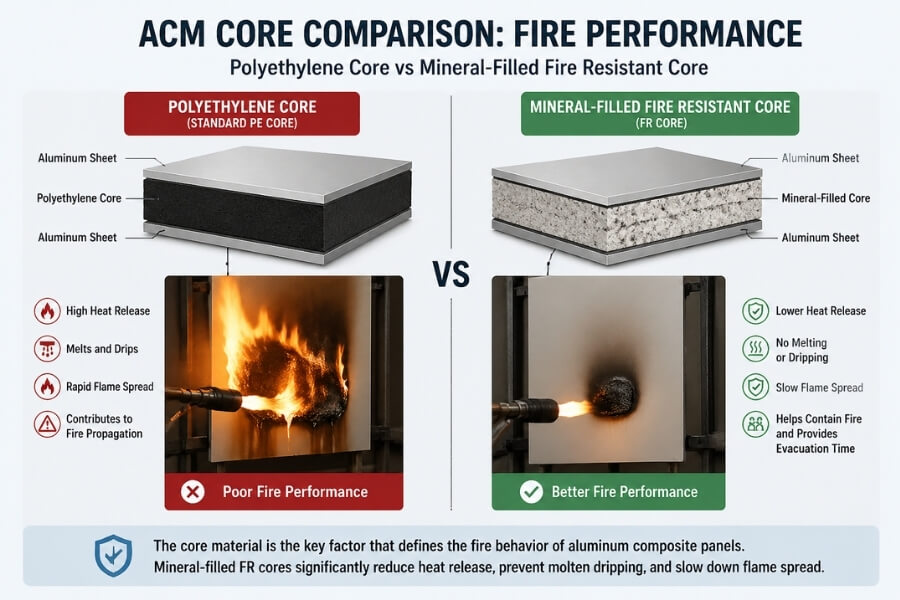
Polyethylene core
High heat release rate
Can melt and create burning droplets
Contributes to vertical flame spread
Mineral-filled core
Typically contains more than 70 percent inorganic material
Reduces fuel contribution
Slows ignition and flame propagation
This explains why visually identical panels can perform very differently under fire conditions.
Aluwell® panels, manufactured by ALUMAX Composite Materials Co., Ltd., are engineered with multiple core configurations to match different building safety requirements and regulatory environments.
Two primary classifications define fire performance in composite cladding:
FR core
Mineral-filled with limited polymer content
Designed to meet NFPA 285 wall assembly requirements
Suitable for most mid- to high-rise buildings
A2 core
Minimal combustible content
Lower heat release rate
Typically specified for high-risk or super high-rise structures
Mineral-filled cores are engineered to respond under fire conditions:
At approximately 350–420°C, the core initiates an endothermic reaction
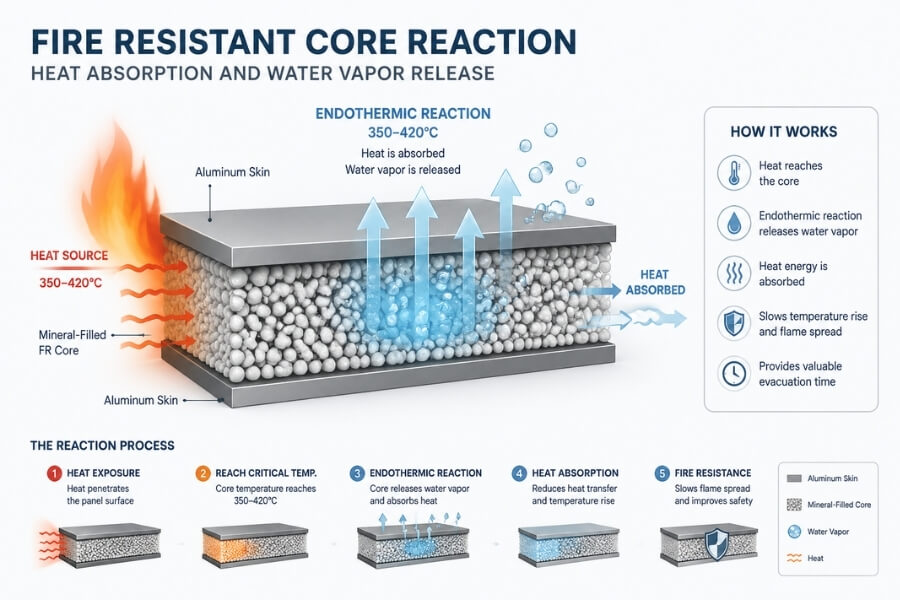
Water vapor is released from the mineral structure
Heat energy is absorbed, reducing flame intensity
Ignition is delayed and flame spread is controlled
Unlike polyethylene-based panels:
No molten dripping occurs
Flame propagation across the panel surface is significantly reduced
This mechanism allows fire-resistant façade systems to limit fire growth and provide critical evacuation time.
Fire testing standards are often misunderstood in façade specification.
ASTM E84
Measures surface flame spread and smoke development
Conducted on individual materials
Does not reflect real façade system behavior
NFPA 285
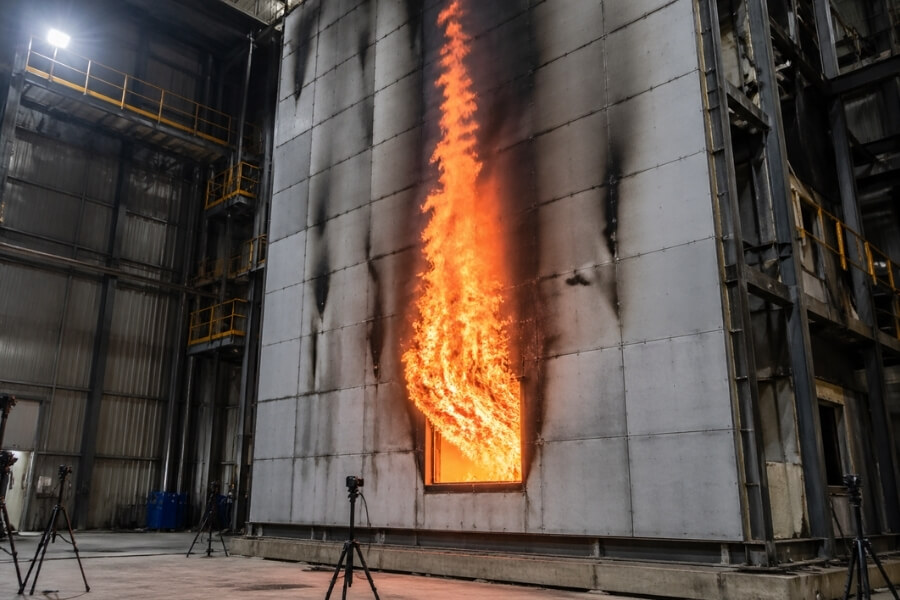
Evaluates full wall assembly performance under multi-story fire exposure
Includes panels, insulation, air barriers, and structural components
Measures vertical and lateral flame propagation
Under NFPA 285:
Vertical flame spread must remain below approximately 10 feet above the window opening
Temperature levels must remain within defined limits
Fire must not re-enter upper floors through the façade
NFPA 285 is the defining benchmark for fire performance in composite cladding systems.
According to the International Building Code:
Exterior wall assemblies in buildings exceeding 40 feet in height must demonstrate controlled fire propagation
Systems containing combustible components must meet NFPA 285 requirements
Compliance applies to the entire wall assembly rather than individual materials
Fire performance cannot be evaluated at the panel level alone.
Key system factors include:
Ventilated cavity design
Air gaps can accelerate vertical flame movement if not properly compartmentalized
Fire barriers
Horizontal and vertical barriers prevent inter-floor fire spread
Insulation materials
Certain insulation types can increase system fire risk
Joint and interface detailing
Open or poorly designed joints can allow flame penetration into the building envelope
Even when fire-resistant panels are used, improper system integration can lead to failure.
Selecting the correct composite panel configuration depends on building height, occupancy, and regulatory requirements.
Low-rise buildings
Polyethylene core may be acceptable depending on local codes
Mid- to high-rise buildings
Mineral-filled FR panels are typically required
Must be used within a tested wall assembly
High-risk buildings
A2 core materials are recommended
Common in hospitals, schools, and dense urban developments
Façade system type such as ventilated rainscreen or sealed system
Local code interpretation and approval processes
Integration with insulation and waterproofing systems
Aluwell® provides customized solutions supported by ALUMAX’s experience in composite material engineering, offering flexibility in core design, panel structure, and façade integration.
In a commercial office project in Kuala Lumpur, a ventilated rainscreen façade system was designed to meet strict fire safety and performance requirements.
Project details:
Over 10,000 square feet of façade coverage
4 mm fire-resistant aluminum composite panels specified
Integrated with mineral wool insulation and certified air barrier system
Designed to comply with NFPA 285 wall assembly requirements
Execution highlights:
Panels were pre-fabricated for dimensional accuracy
Installation followed tested assembly configurations
Coordination between façade contractor and material supplier ensured consistency
Final outcomes:
Controlled flame propagation performance under test conditions
Stable façade appearance with consistent color integration
Reduced on-site installation complexity
Through modularized fabrication and system coordination, ALUMAX improved both construction efficiency and compliance reliability.
Why does ACM burn if aluminum is non-combustible?
Aluminum itself does not burn, but it transfers heat rapidly to the core material. If the core is polyethylene, it can ignite, melt, and contribute to flame spread. The overall fire behavior of composite panels is determined by the core composition rather than the metal surface.
What is the difference between FR and A2 panels?
FR panels contain a mineral-filled core with limited polymer content and are widely used in high-rise construction. A2 panels contain minimal combustible material and offer a lower heat release rate. They are typically specified for high-risk buildings requiring higher fire performance standards.
Is ASTM E84 enough for façade compliance?
No. ASTM E84 measures surface flame spread and smoke development on individual materials. It does not reflect real façade system behavior. Full wall assembly testing such as NFPA 285 is required to evaluate fire propagation in multi-story exterior wall systems.
Does changing insulation or sealant affect system approval?
Yes. Fire performance depends on the entire wall assembly. Any change to insulation, sealants, or other components may alter system behavior. To maintain compliance, assemblies must match tested configurations or be validated through additional testing or engineering evaluation.
When is NFPA 285 required?
NFPA 285 is typically required for buildings exceeding 40 feet in height when exterior wall systems include combustible components. It is mandated by the International Building Code to ensure that fire does not propagate vertically or laterally through the façade system.
Fire performance in composite façade systems is not determined by appearance or product category. It is defined by core composition, system design, and verified behavior under full-scale testing.
Specifying non-compliant cladding systems can lead to regulatory rejection, insurance complications, and costly remediation. In contrast, selecting a properly engineered system reduces project risk and supports long-term durability.
With over two decades of production experience, ALUMAX Composite Materials Co., Ltd. continues to develop Aluwell® solutions that combine safety, durability, and architectural flexibility. Through collaborative design, customized material development, and modularized service support, Aluwell® helps project teams deliver façade systems that perform reliably in real-world conditions.
For architects and developers, choosing the right system is not only a technical requirement but a critical decision that directly impacts safety, compliance, and overall project success.