

01 Jun
How to Perform Quality Control During Metal Façade Installation
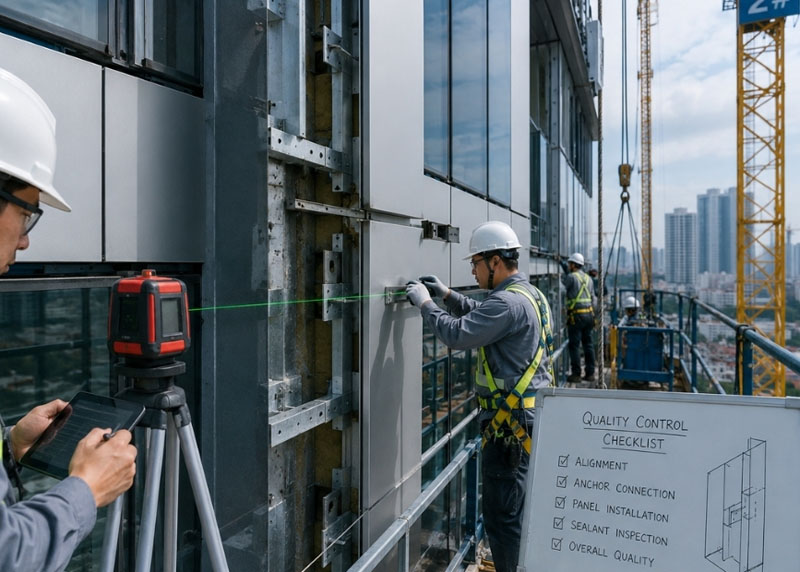
Metal façade quality control is one of the most important factors influencing the long-term performance of a building envelope system. Water leakage, joint inconsistency, panel distortion, and premature maintenance issues are often linked to installation deficiencies rather than panel materials themselves.
For architects, façade consultants, contractors, developers, and project owners, quality control should not be treated as a final inspection activity. It should be integrated throughout the entire installation process, from document review and anchor verification to panel alignment, waterproofing inspection, and final project acceptance.
A systematic quality control program helps reduce project risks, improve façade performance, and ensure that architectural metal panel systems meet both aesthetic and functional requirements.
Why Metal Façade Quality Control Matters
A modern metal façade is more than an exterior finish. It forms part of the building envelope and contributes to weather protection, thermal performance, fire safety, and architectural identity.
When installation quality is poorly controlled, common consequences include:
Water infiltration
Air leakage
Uneven panel joints
Visible panel misalignment
Sealant failure
Corrosion issues
Increased maintenance costs
On large commercial projects, minor installation deviations can become highly visible when repeated across thousands of square feet of façade surface.
Many façade defects discovered during project handover originate from issues that could have been corrected during earlier installation stages.
Quality Control Responsibilities Across Project Stages
Successful curtain wall quality control requires coordination among multiple stakeholders.
| Project Stage | Primary Responsibility |
|---|---|
| Design Development | Architects and façade consultants |
| Engineering Review | Structural engineers and façade engineers |
| Material Fabrication | Manufacturer |
| Site Installation | Contractor and installation team |
| Quality Verification | QA/QC inspectors |
| Final Acceptance | Owner representatives and consultants |
Projects with clearly defined responsibilities typically experience fewer installation conflicts and fewer late-stage corrections.
Pre-Installation Quality Control Requirements
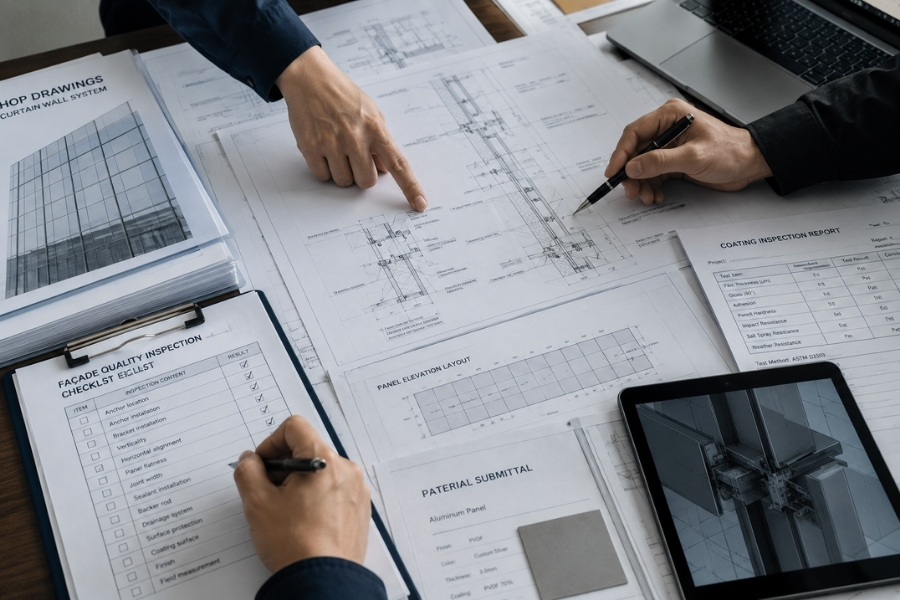
Before installation begins, project teams should verify that the structure, materials, and supporting documentation are ready for construction.
Review Design Documents and Shop Drawings
Installation teams should review:
Approved shop drawings
Structural calculations
Connection details
Expansion joint details
Waterproofing details
Fire barrier details
Architectural elevations
Field conditions should be compared with approved drawings before work begins.
A common project issue occurs when fabrication proceeds before field dimensions are verified, resulting in unexpected modifications during installation.
Verify Material Certifications and Test Reports
All façade materials should be supported by documentation.
Typical records include:
Material certificates
Coating reports
Factory inspection records
Mechanical property reports
Product compliance documentation
For architectural metal panels, inspectors should verify panel thickness, alloy grade, coating system, finish, and color consistency.
Inspect Embedded Anchors and Structural Supports
Anchors and support systems form the structural foundation of the façade.
Inspection should verify:
Anchor location
Anchor spacing
Installation depth
Corrosion protection
Pull-out test results
On high-rise projects, anchor location errors discovered after panel fabrication often create alignment issues that affect multiple floors.
Structural Attachment and Anchorage Inspection
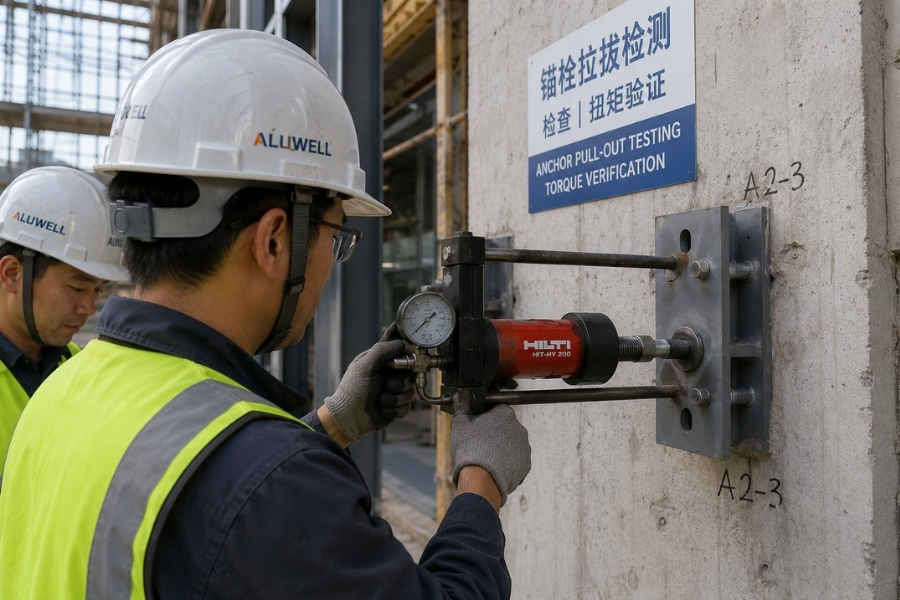
The connection system transfers wind loads, dead loads, thermal movement forces, and building movements into the primary structure.
Verify Anchor Position Accuracy
Anchor locations should match approved layout drawings.
Inspection should confirm:
Horizontal positioning
Vertical positioning
Edge distances
Bracket compatibility
Anchor deviations may result in:
Uneven joints
Panel distortion
Excessive shimming
Installation delays
Confirm Pull-Out Resistance
Post-installed anchors should undergo pull-out testing where required by project specifications.
Testing records should identify:
Anchor type
Test location
Applied load
Test results
Approval status
Pull-out testing provides confidence that structural loads can be safely transferred into the building structure.
Inspect Connection Stability and Anti-Loosening Measures
All structural connections should be checked for:
Proper fastener selection
Secure tightening
Locking devices
Corrosion protection
Where aluminum interfaces with other metals, appropriate separation materials should be used to minimize galvanic corrosion risks.
Quality Control Focus
Before panels are installed:
Verify anchor locations
Confirm curing of chemical anchors
Review pull-out test records
Inspect bracket alignment
Correcting connection issues before panel installation is significantly less expensive than correcting them after façade completion.
Metal Panel Installation Quality Control
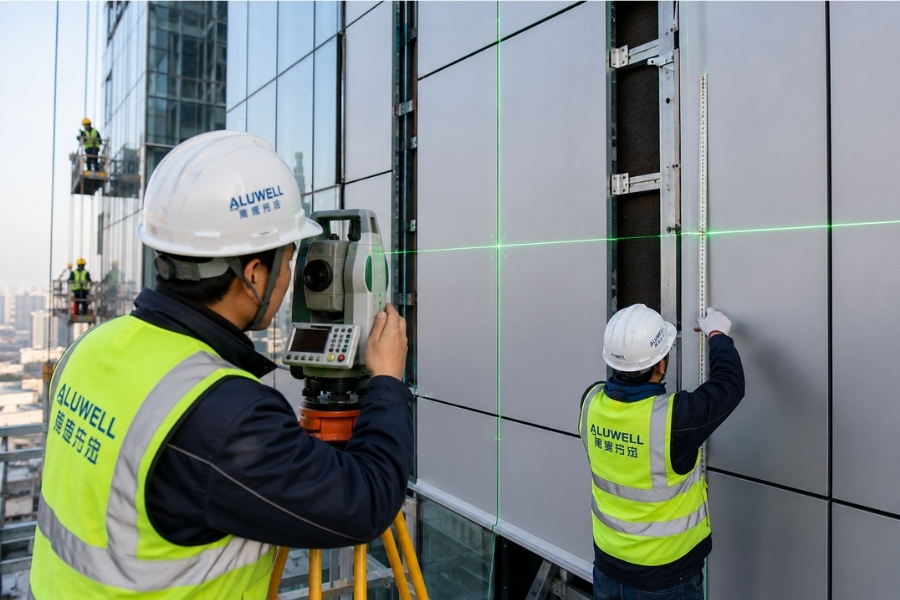
Panel installation directly affects both façade performance and architectural appearance.
Control Panel Alignment
Vertical and horizontal alignment should be continuously monitored during installation.
Surveying equipment and laser instruments are commonly used to verify alignment.
Typical Site Observation
On tall buildings, small alignment deviations often accumulate from floor to floor. Without periodic verification, these deviations can become visible across large façade elevations.
Many experienced contractors verify alignment every two to three floors rather than waiting until an entire elevation is completed.
Maintain Consistent Joint Widths
Joint consistency influences:
Visual quality
Sealant performance
Thermal movement accommodation
Weather resistance
Inspectors should verify:
Joint width uniformity
Straight joint lines
Proper gasket positioning
Consistent reveal dimensions
Monitor Panel Flatness
Flatness inspection helps identify:
Bracket adjustment issues
Uneven support conditions
Manufacturing dimensional variations
Excessive fastening pressure
Panel flatness becomes particularly important on large-format architectural metal panels where reflected light can make even minor deviations visible.
Verify Installation Tolerances
Typical acceptance criteria may include:
| Inspection Item | Typical Allowable Deviation |
|---|---|
| Façade verticality | 10-25 mm depending on building height |
| Surface flatness | 2 mm |
| Adjacent panel offset | 1 mm |
| Joint width variation | 1 mm |
| Joint level difference | 1 mm |
Project specifications should always take precedence over general tolerance guidelines.
Sealant and Waterproofing Quality Control
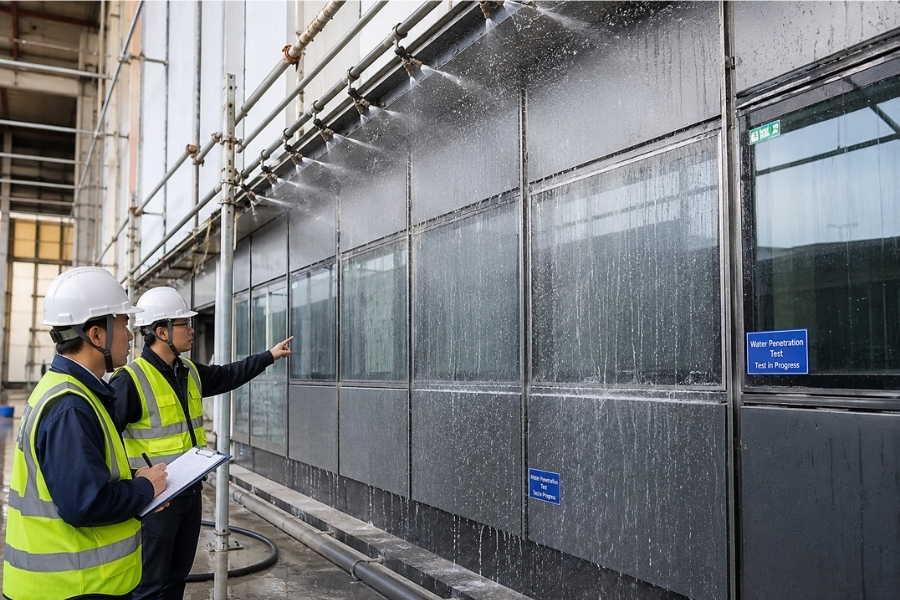
Water leakage remains one of the most common causes of façade performance failures.
Proper waterproofing inspection is essential for maintaining long-term building envelope performance.
Verify Sealant Materials
Inspectors should verify:
Product type
Manufacturer
Shelf life
Compatibility reports
Batch identification
Sealant substitutions should not be accepted without project approval.
Inspect Joint Geometry
Sealant performance depends on correct joint design.
Inspection should verify:
Joint width
Sealant depth
Backer rod installation
Surface cleanliness
Improper joint geometry can significantly reduce movement capability and increase failure risk.
Verify Drainage and Weep Systems
Most metal curtain wall systems rely on drainage paths to manage incidental water.
Inspectors should verify:
Weep holes are present
Drainage channels remain open
Flashing is correctly installed
Water pathways remain continuous
Blocked drainage paths often become a hidden cause of future leakage complaints.
Perform Water Penetration Testing
Water testing helps identify installation deficiencies before occupancy.
Depending on project requirements, testing may include:
Site spray testing
Water penetration testing
Performance mock-up testing
Field verification testing
International projects often reference standards such as ASTM E1105, ASTM E783, ASTM E330, and AAMA testing procedures to evaluate water resistance, air infiltration, and structural performance.
Quality Control Focus
Before project handover:
Verify drainage paths
Inspect sealant continuity
Check gasket installation
Complete water testing
Fire Safety and Movement Joint Inspection
Fire protection and movement accommodation are critical components of curtain wall quality control.
Inspect Fire Barrier Installation
Fire barriers should be installed at designated floor slab locations.
Inspection should verify:
Material type
Installation continuity
Required thickness
Proper fastening
Incomplete fire barriers can compromise compartmentation requirements.
Verify Expansion Joints
Thermal movement is unavoidable in exterior wall assemblies.
Expansion joints should:
Match design dimensions
Remain unobstructed
Accommodate anticipated movement
Review Seismic and Settlement Joints
Where seismic movement or building settlement is anticipated, movement joints must remain capable of absorbing displacement without damaging the cladding system.
Failure to maintain movement capability can result in cracked sealants, distorted panels, and water penetration issues.
Visual Quality Inspection Before Project Handover
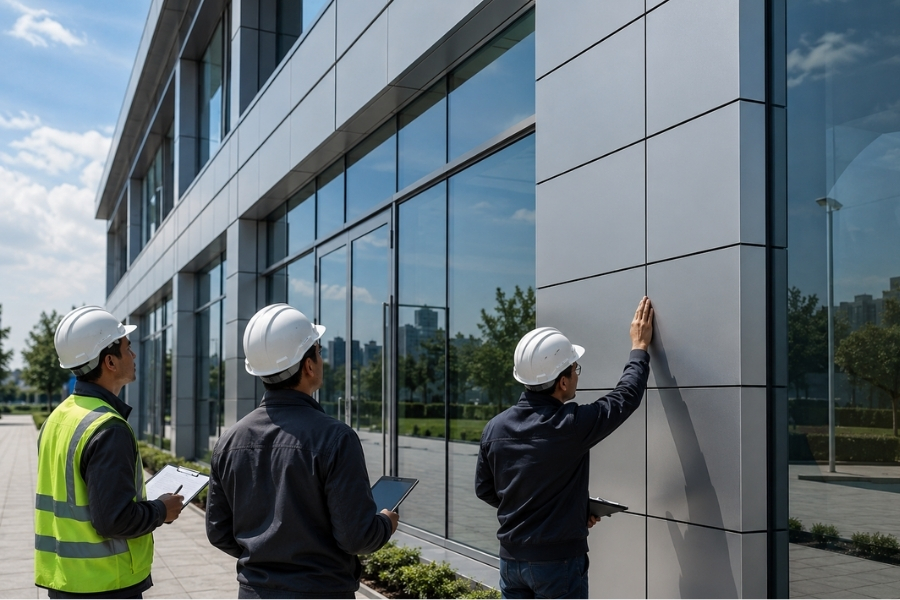
Visual inspection remains one of the final and most visible stages of façade acceptance.
Inspect Surface Condition
Panels should be:
Clean
Undamaged
Free of contamination
Consistent in appearance
Visible dents, scratches, and coating defects should be evaluated against project acceptance criteria.
Verify Color Consistency
Color variation should be reviewed under natural daylight conditions.
Inspectors should evaluate:
Color consistency
Gloss consistency
Reflection uniformity
Coating appearance
Large façade elevations often make small batch variations more noticeable than expected.
Review Sealant Appearance
Sealant joints should be:
Continuous
Uniform
Smooth
Free of voids
Free of bubbles
Poor sealant appearance often indicates installation deficiencies that may affect long-term weather resistance.
Metal Façade Final Acceptance Checklist
Before project handover, project teams should verify the following:
Documentation
Material certificates approved
Inspection records completed
Test reports available
Pull-out test records verified
Structural Inspection
Anchors inspected
Brackets aligned
Connections secured
Corrosion protection verified
Waterproofing Inspection
Drainage systems inspected
Sealants approved
Water testing completed
No visible leakage detected
Fire Protection Inspection
Fire barriers installed
Firestop materials verified
Compartmentation requirements satisfied
Appearance Inspection
Panels aligned
Joint widths consistent
Surface condition acceptable
Color appearance approved
Common Quality Defects and How to Prevent Them
Water Leakage
Common causes include:
Sealant failure
Blocked drainage paths
Missing flashing
Improper gasket installation
Routine inspection and testing help identify issues before occupancy.
Panel Misalignment
Typically caused by:
Anchor location errors
Inadequate surveying
Poor layout control
Early verification reduces the risk of cumulative deviations.
Joint Width Variation
Joint inconsistencies frequently result from dimensional control issues during installation.
Regular measurement helps maintain façade uniformity.
Sealant Failure
Typical causes include:
Incorrect material selection
Poor surface preparation
Inadequate joint dimensions
Proper installation procedures significantly improve sealant service life.
Surface Damage
Improper handling, storage, or installation can result in visible scratches and coating damage.
Material protection should remain in place until final cleaning whenever possible.
Conclusion
Metal façade quality control is not a single inspection performed at the end of construction. It is a continuous process that begins with design review and extends through fabrication, installation, testing, and final acceptance.
Projects that maintain strong control over anchors, installation tolerances, waterproofing systems, fire barriers, and visual quality generally experience fewer defects, lower maintenance costs, and more reliable long-term façade performance.
Manufacturers that provide fabrication accuracy, project documentation, quality records, and technical support can help reduce installation risks and improve project outcomes. Aluwell® works with architects, façade consultants, contractors, and developers to support quality-focused exterior wall systems through engineering-driven manufacturing and project-oriented façade solutions.
FAQ
What should be checked before metal façade installation starts?
Project teams should verify approved shop drawings, structural supports, anchor locations, material certifications, coating reports, and installation details. Early verification helps prevent fabrication conflicts, installation delays, and costly field modifications later in the project.
How often should alignment checks be performed during metal façade installation?
Many façade contractors perform alignment verification every two to three floors during installation. Frequent checks help prevent cumulative deviations that can affect panel alignment, joint consistency, and the overall appearance of large building elevations.
What installation tolerances are commonly accepted for metal façade systems?
Typical tolerances include approximately 2 mm for surface flatness and 1 mm for joint width variation or adjacent panel offset. Actual acceptance criteria should always follow project specifications, engineering requirements, and local standards.
Is water penetration testing required before façade handover?
Many commercial projects require water penetration testing before final acceptance. Field testing helps identify sealant defects, drainage issues, and installation deficiencies that may not be visible during standard visual inspections.
Why are movement joints important in metal curtain wall systems?
Expansion joints and movement joints accommodate thermal expansion, building movement, seismic displacement, and settlement. Without sufficient movement capability, façade systems may experience sealant failure, panel distortion, or water infiltration over time.