

21 Apr
What Is NFPA 285 — And Why It Matters for ACM Façade Systems
Why Façade Fire Safety Is Now a Critical Design Factor
In many façade failures, the issue is not the material itself, but how the overall wall assembly behaves under fire conditions.
Over the past decades, aluminum composite façade systems have transformed modern architecture by enabling lightweight construction, flexible fabrication, and strong visual identity. However, several high-rise fire incidents have exposed a critical weakness in building envelopes — fire does not spread through materials alone, but through poorly coordinated exterior wall systems.
This shift in understanding has placed façade fire safety at the center of architectural decision-making. In the United States, standards such as NFPA 285 play a critical role because they evaluate how complete exterior wall assemblies perform under realistic fire scenarios rather than how individual materials behave in isolation.
For manufacturers and system providers like Aluwell®, fire safety is approached as part of a broader strategy that integrates material performance, system design, and long-term reliability.
Understanding the Standard in Modern Façade Design
This standard is a large-scale fire test method used to evaluate the fire propagation characteristics of exterior wall assemblies containing combustible components.
Unlike small-scale material tests, it simulates a realistic building fire scenario in which a flashover develops inside a room, flames exit through a window opening, and fire spreads upward and outward along the building envelope.
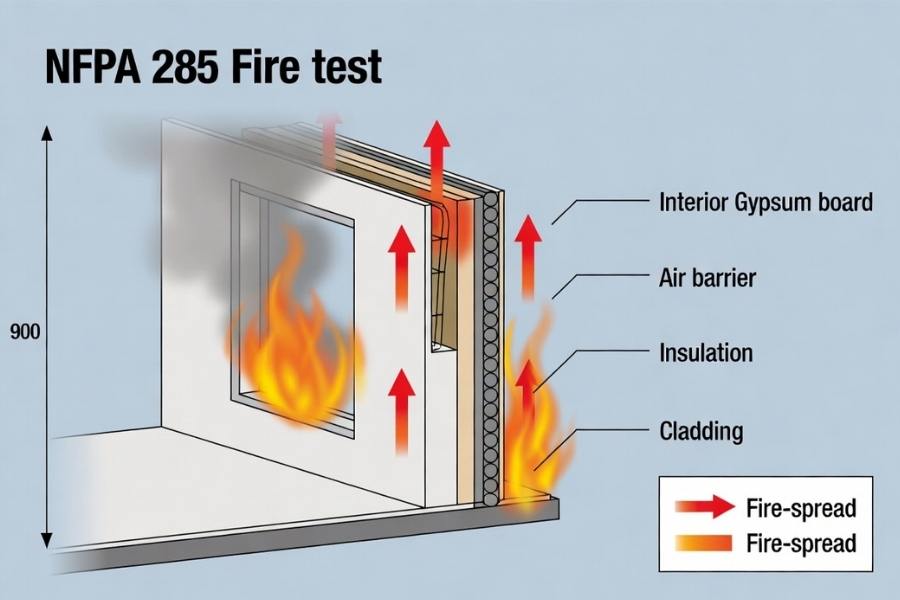
The evaluation focuses on vertical flame spread, horizontal flame spread, and fire penetration within the wall system.
A key principle defines this methodology. Individual materials cannot be evaluated independently, and only a complete exterior wall assembly can demonstrate compliance. Typical tested configurations include composite cladding panels, insulation layers, air and water barriers, and sub-framing components.
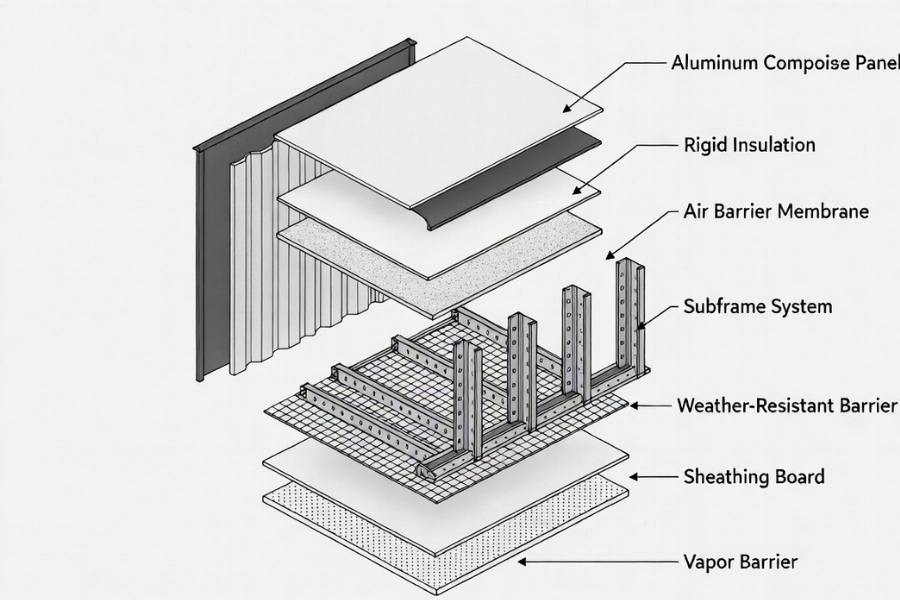
Fire performance is governed by the interaction between system elements rather than the rating of a single product, which reflects real construction conditions where assembly design determines overall behavior.
When This Requirement Applies to Your Project
In many projects, this requirement becomes necessary when composite façade assemblies are used in buildings that meet conditions defined by the International Building Code.
These conditions often include multi-story buildings classified as Type I, II, III, or IV, structures exceeding approximately 40 feet in height, and exterior wall systems incorporating combustible elements.
In practice, this means that a wide range of commercial and residential developments must consider compliance at an early stage.
Delaying this evaluation can lead to redesign of exterior wall systems, changes in material selection, and increased costs and schedule impacts.
From a planning perspective, fire compliance should be treated as a design parameter rather than a final-stage verification step.
How Aluminum Composite Façade Systems Respond to Fire Conditions
The fire performance of aluminum composite panel systems depends on both material behavior and assembly configuration.
At the material level, aluminum skins initially reflect and dissipate heat, delaying exposure to inner layers, while fire-retardant cores contain mineral fillers that react under high temperatures. These reactions include thermal decomposition, release of water vapor, reduction of heat intensity, and self-extinguishing behavior once the flame source is removed.
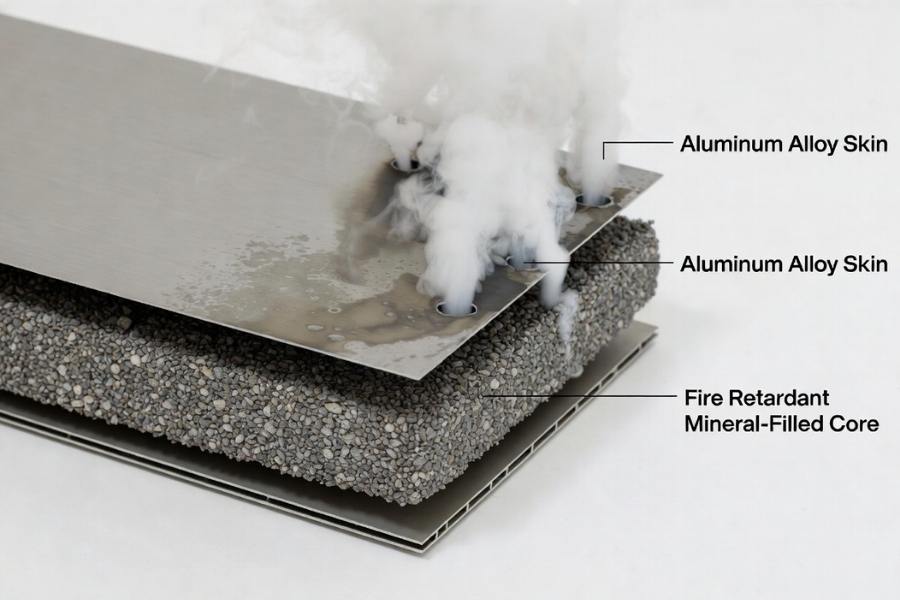
However, material response alone does not determine safety.
At the system level, cavity design can either restrict or accelerate flame movement, insulation selection affects heat transfer, and joint detailing influences fire penetration paths.
When exterior cladding assemblies are designed without verified system-level test data, fire can travel through concealed cavities and bypass floor separations, allowing rapid vertical spread across multiple levels.
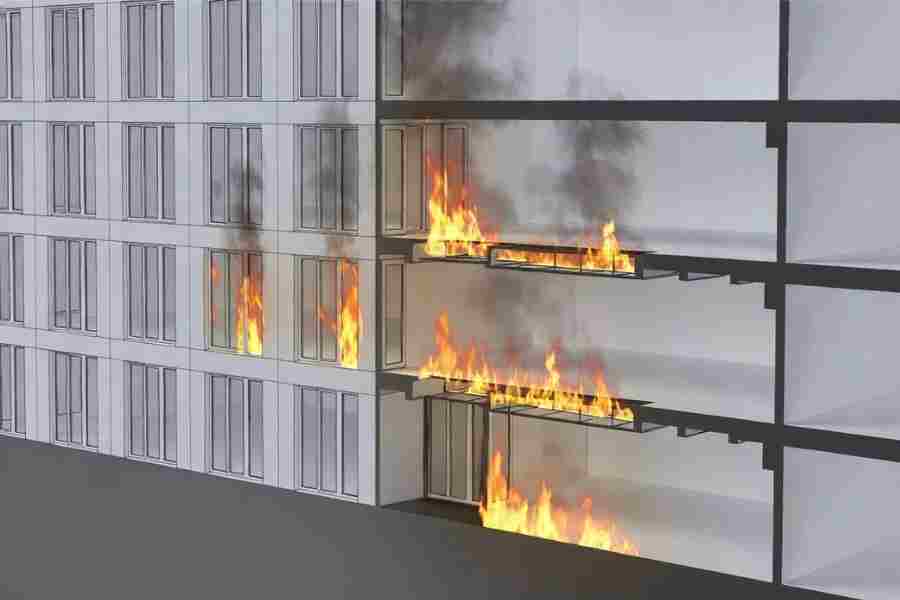
This is why façade fire safety must be evaluated as a system performance issue rather than a simple material selection decision.
In large-scale architectural applications, façade composition also plays a role. Panel layout, joint spacing, and color segmentation define visual rhythm while influencing how fire barriers and compartmentation strategies are integrated into the building envelope.

How to Specify a Compliant Composite Façade System
Specifying a compliant aluminum composite wall system requires a structured approach that aligns architectural intent with engineering validation.
Key considerations include verifying current NFPA 285 test reports, confirming that testing reflects the complete wall assembly configuration, avoiding substitution with non-equivalent tests such as ASTM E84, and ensuring third-party certification and documentation.
Beyond documentation, successful projects depend on coordination across disciplines. Exterior wall performance is influenced by design, material engineering, fabrication, and installation, and misalignment between these stages can result in compliance risks or performance inconsistencies.
In complex projects, integrated development approaches have proven more reliable. These approaches combine early-stage design coordination, customization of materials and system configurations, factory-level validation including mock-up testing, and precision fabrication aligned with project-specific requirements.
By treating the building envelope as a unified system rather than a collection of independent elements, projects can achieve both code compliance and architectural performance.
FAQ — NFPA 285 and ACM Cladding Systems
Where is NFPA 285 required
It is typically required for multi-story buildings using combustible exterior wall systems, especially when building height, construction type, and fire separation distances fall within IBC-defined thresholds. Early evaluation during design helps avoid costly changes and ensures compliance with façade fire safety requirements.
Can a single ACM panel be NFPA 285 compliant
No. The standard evaluates the performance of a complete exterior wall assembly rather than individual materials. All components, including cladding, insulation, and substructure, must be tested together to determine how the system behaves under fire conditions.
What is the fire exposure duration in NFPA 285
The test exposes the wall assembly to controlled fire conditions for approximately 30 minutes. During this period, both vertical and horizontal flame spread are monitored to evaluate how fire propagates across the exterior wall system.
How can compliance be verified
Compliance should be verified through third-party test reports that reflect the exact wall assembly configuration used in the project. Documentation should confirm alignment with current standards and demonstrate system-level performance under realistic fire conditions.
What is CAN/ULC-S134
It is a Canadian fire test standard used to evaluate flame spread in exterior wall assemblies. While similar in purpose to NFPA 285, it follows different testing procedures and is typically required for projects governed by Canadian building codes.
NFPA 285 as a Foundation for Safer Façade Design
NFPA 285 represents a shift in how building safety is evaluated from individual material performance to system-level fire behavior.
For architects, contractors, and developers, this framework helps control fire propagation within exterior wall assemblies, integrate safety into early-stage design decisions, and maintain long-term performance under real-world conditions.
Modern façade design requires balancing aesthetics, constructability, and safety. When approached as an integrated system, aluminum composite solutions can deliver consistent visual quality, efficient installation, and reliable performance.
With extensive experience in composite materials and façade system integration, Aluwell® supports coordination between design, engineering, and manufacturing, helping ensure that projects meet both technical requirements and architectural expectations.
In contemporary construction, fire safety is not a limitation. It is a defining factor that shapes how buildings are designed, detailed, and realized.