

22 May
Essential Elements of Hurricane Proof Construction for Modern Building Envelopes
Hurricanes rarely damage buildings through a single catastrophic failure. In many commercial and coastal projects, envelope deterioration begins when repeated wind pressure, water intrusion, and attachment fatigue gradually weaken vulnerable portions of the structure. Roof edges detach under uplift loading, façade joints begin leaking under pressure-driven rain, and perimeter transitions lose integrity after years of thermal movement and salt exposure.
For this reason, hurricane proof construction is fundamentally a building envelope engineering challenge. Long-term resilience depends on how structural systems, façade assemblies, waterproofing layers, fasteners, and movement joints work together under extreme environmental conditions.
Buildings located in hurricane-prone regions must resist not only high wind speeds, but also cyclic pressure fluctuation, moisture infiltration, corrosion fatigue, and repeated structural movement over decades of exposure.
Continuous Load Paths Determine Whether the Building Envelope Remains Intact
One of the most important principles in hurricane-resistant construction is maintaining a continuous load path throughout the structure and exterior envelope. During hurricane events, wind loads must transfer safely from roof systems and façade assemblies into the primary structure and foundation without interruption.
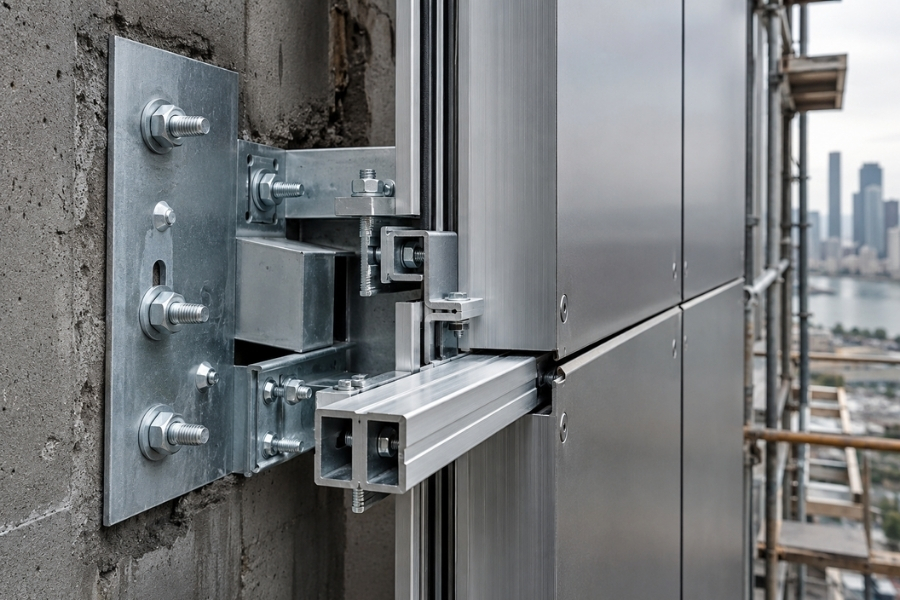
A façade system may perform well in laboratory testing yet still fail during real storms if load transfer continuity is compromised at transition zones or fastening locations.
This is especially common at:
Roof parapets
Corner zones
Soffit transitions
Curtain wall interfaces
Large façade openings
Mechanical penetrations
Wind pressure near building corners can be significantly higher than pressure at the center of the wall field. On coastal commercial buildings with large-format façade systems, repeated negative pressure cycles can gradually stress anchors, brackets, and attachment hardware during extended hurricane exposure.
To improve structural continuity, hurricane-resistant envelope systems typically include:
Reinforced roof-to-wall connections
Engineered fastening schedules
Continuous anchoring systems
Structural subframes
Edge-zone reinforcement
Uplift-resistant detailing
Installation quality is equally important. Improper anchor embedment depth, inconsistent fastener torque, or field misalignment between structural supports and façade subframes can reduce real-world performance even when materials meet specification requirements.
Many hurricane-related failures originate from installation variability rather than from the cladding material itself.
Wind-Driven Rain Creates Long-Term Building Envelope Damage
Structural collapse represents only one form of hurricane damage. In many projects, wind-driven rain creates far more extensive long-term deterioration after water penetrates the building envelope.
Once moisture enters the wall assembly, it can affect:
Insulation systems
Interior finishes
Electrical systems
Structural framing
Sealant adhesion
Interior air quality
Pressure differentials generated during hurricanes can force water through extremely narrow gaps around joints, transitions, and perimeter conditions. This type of pressure-driven infiltration often bypasses conventional waterproofing assumptions used in lower-wind environments.
Modern hurricane-resistant façades therefore rely on layered water management strategies rather than a single waterproof barrier.
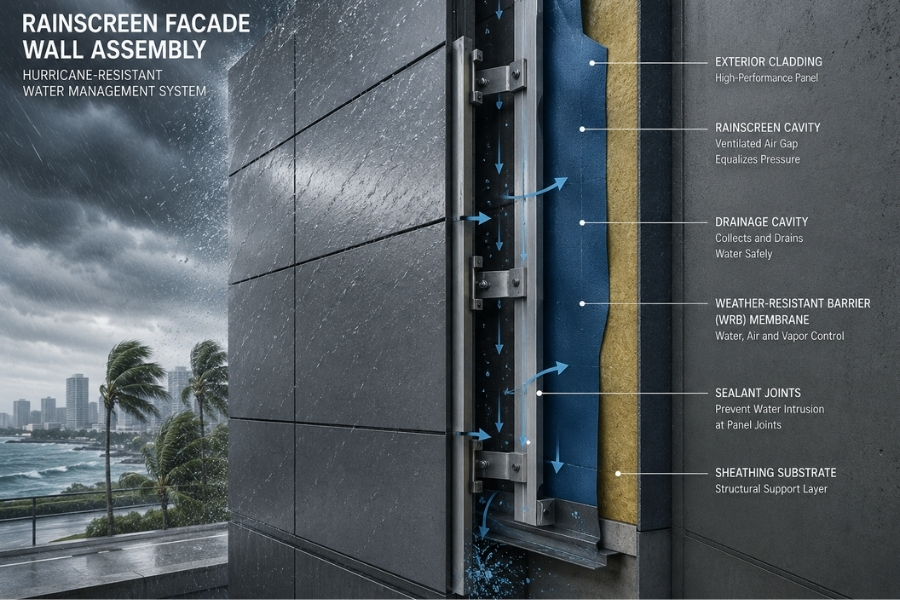
Common envelope protection measures include:
Pressure-equalized rainscreen systems
Continuous WRB integration
Drainage cavities
Redundant flashing systems
Ventilated façade assemblies
Sealant movement accommodation
Controlled drainage pathways
In coastal hurricane zones, sealant systems experience long-term stress from ultraviolet exposure, humidity, thermal cycling, and salt-laden air. Over time, joint elasticity may decrease, especially where movement tolerances were underestimated during design.
Some façade leakage problems only appear several years after installation because early-stage sealant fatigue can remain visually undetectable until a major storm event exposes hidden vulnerabilities.
Field workmanship also plays a major role in envelope waterproofing reliability. Drainage cavities blocked by debris, poorly compressed backer rods, inconsistent sealant depth, or discontinuous flashing installation can significantly reduce hurricane resistance.
Exterior Cladding Systems Must Resist Both Wind Pressure and Cyclic Movement
Many hurricane-resistant design discussions focus heavily on wind load resistance while overlooking movement-related stress within the façade assembly.
In reality, hurricane-prone buildings experience multiple simultaneous forces including:
Wind uplift
Structural sway
Thermal expansion
Pressure cycling
Moisture expansion and contraction
Vibration around attachment points
Large-format metal panels may satisfy structural pressure requirements during testing but still develop oil-canning, joint stress, or visible movement under real storm conditions if expansion detailing is insufficient.
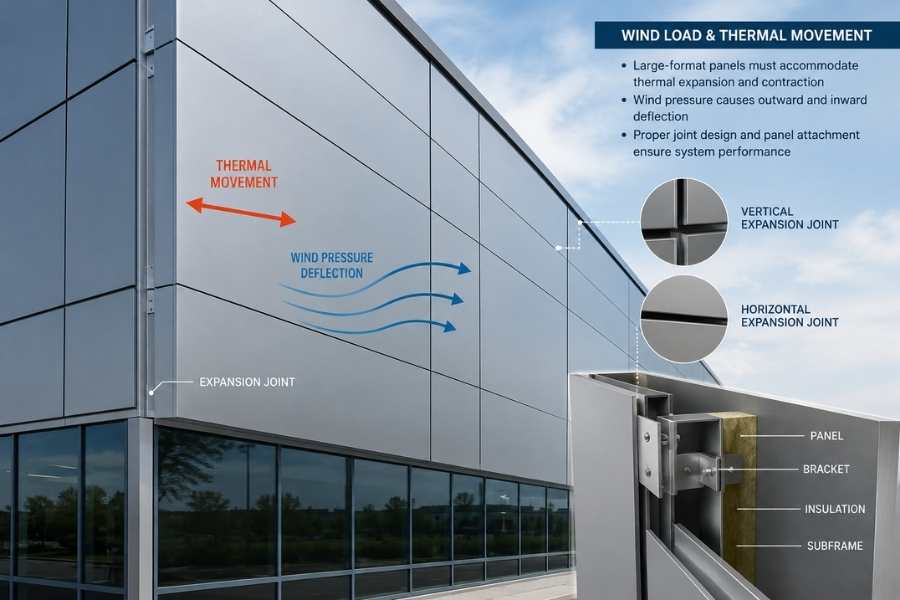
Critical façade engineering variables include:
Panel dimensions
Thermal expansion coefficients
Support spacing
Joint width design
Fastener tolerances
Subframe rigidity
Panel edge reinforcement
Movement accommodation becomes especially important around:
Expansion joints
Curved façade sections
Window perimeters
Soffit transitions
Roof edges
Corner conditions
Many façade systems experience their highest stress concentration near transition geometry where multiple assemblies intersect.
Improperly designed movement joints may eventually lead to:
Sealant rupture
Panel distortion
Fastener loosening
Water leakage
Subframe fatigue
Coating stress cracking
These problems may not appear immediately after installation. Some only become visible after years of cyclic movement and repeated hurricane exposure.
Lightweight Composite Panels Can Reduce Structural Loading When Properly Engineered
Reducing façade dead load can improve overall building efficiency in hurricane-prone regions, particularly in high-rise and large-span envelope systems.
Lightweight composite panels are frequently specified because they combine structural efficiency with fabrication flexibility and corrosion resistance.
Common hurricane-resistant façade materials include:
Aluminum composite panels
Aluminum honeycomb panels
Reinforced metal panel systems
High-performance rainscreen assemblies
Impact-resistant glazing systems
Honeycomb panel systems are particularly effective where high stiffness-to-weight ratios are required. By separating outer skins with a lightweight cellular core, the panel gains rigidity while minimizing overall mass.
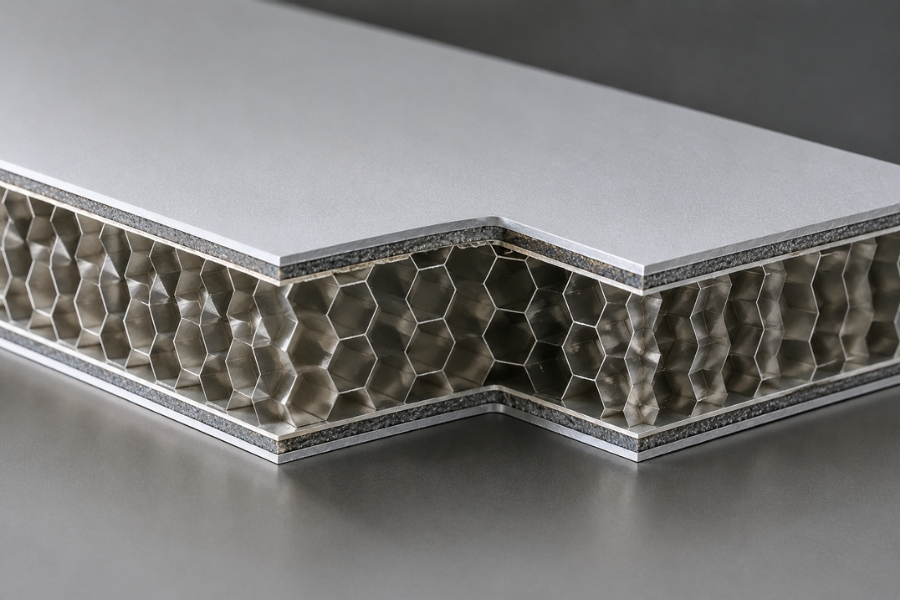
This structural principle can help reduce:
Subframe loading
Anchor stress
Transportation weight
Installation complexity
Long-term structural fatigue
However, lightweight systems are not automatically hurricane resistant. Long-term performance depends heavily on:
Core consistency
Adhesive bonding stability
Peel strength reliability
Panel flatness control
Attachment coordination
Fabrication tolerances
Manufacturing consistency becomes especially important for large façade projects. Variations in coating thickness, adhesive curing conditions, or panel dimensional accuracy can affect installation alignment and long-term movement behavior.
In some coastal projects, small fabrication inconsistencies become amplified once thermal movement, wind pressure, and structural tolerances interact under hurricane conditions.
For this reason, façade engineers increasingly evaluate assembly behavior rather than focusing solely on individual material strength.
Transition Zones and Perimeter Conditions Often Become the Weakest Points
Many hurricane failures begin at transition complexity rather than at the center of the wall system.
Perimeter conditions often involve multiple overlapping components including:
Flashings
Sealants
Anchors
Glazing systems
WRBs
Subframes
Drainage pathways
These interfaces experience concentrated movement and pressure variation during storms.
Common vulnerable locations include:
Window-to-wall interfaces
Roof edge terminations
Curtain wall perimeters
Balcony penetrations
Mechanical openings
Expansion joints
Corner transitions
Once one perimeter condition loses integrity, internal building pressure may rise rapidly. Increased internal pressure can intensify roof uplift forces and accelerate envelope failure across adjacent assemblies.
Impact-resistant glazing systems help reduce debris penetration risk, but glazing alone cannot guarantee hurricane resilience if perimeter detailing is inadequate.
Proper transition detailing typically requires:
Flexible movement accommodation
Redundant flashing continuity
Reinforced perimeter anchoring
Moisture evacuation pathways
Compatible sealant systems
Drainage integration
Field coordination between trades is often critical at these locations. Misalignment between waterproofing systems, façade framing, and glazing installation can create hidden vulnerabilities that only appear during severe storms.
Corrosion Resistance Is Essential in Coastal Hurricane Regions
Buildings located near coastlines face continuous exposure to salt spray, airborne chlorides, humidity, and ultraviolet radiation long before hurricanes occur.
Over time, corrosion may gradually weaken:
Fasteners
Structural anchors
Brackets
Subframes
Panel edges
Attachment hardware
This deterioration process often remains concealed until extreme wind loading exposes weakened connections.
Long-term corrosion resistance depends on several factors including:
Alloy selection
Surface pretreatment quality
Coating durability
Galvanic compatibility
Drainage performance
Fastener material coordination
Fluoropolymer coating systems such as PVDF are widely used in coastal façade applications because they provide improved resistance to:
UV degradation
Color fading
Chalking
Chemical exposure
Surface weathering
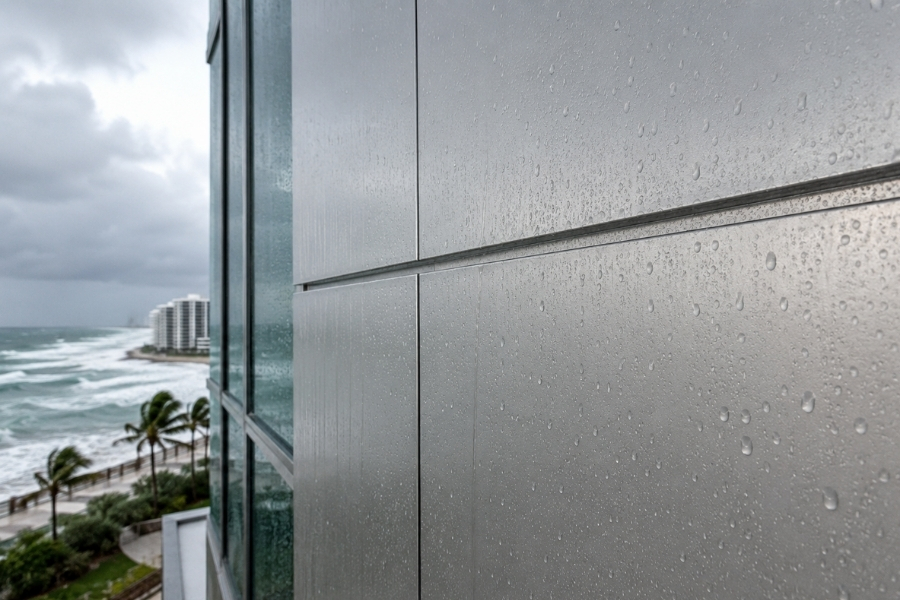
Coating consistency also matters. Uneven coating thickness or insufficient pretreatment may accelerate localized deterioration around cut edges, fastening zones, and formed panel transitions.
Corrosion management should therefore be considered part of hurricane-resistant engineering rather than a separate maintenance issue.
Hurricane-Resistant Construction Depends on Assembly-Level Validation
Material datasheets alone cannot predict real hurricane performance. Many envelope systems behave differently once installation tolerances, movement conditions, and multi-system interactions are introduced at full scale.
For this reason, hurricane-resistant projects often rely on assembly-level testing and mock-up verification.
Common validation procedures include:
Cyclic pressure testing
Water penetration testing
Structural performance testing
Impact resistance evaluation
Anchor pull-out testing
Deflection analysis
Full-scale mock-up installation
Frequently referenced standards include:
ASTM E330
ASTM E1886
ASTM E1996
Miami-Dade approval systems
Air infiltration testing
Dynamic water penetration testing
Mock-up verification is especially valuable because it reveals interaction problems between:
Cladding panels
Subframes
Fasteners
Sealants
Flashings
Glazing systems
Drainage assemblies
Some façade systems meet isolated laboratory requirements yet still develop field performance issues due to installation sequencing, movement incompatibility, or insufficient tolerance coordination between trades.
Project-specific validation helps identify these risks before large-scale construction begins.
Conclusion
Effective hurricane proof construction requires far more than stronger materials or thicker walls. Long-term building resilience depends on how structural systems, façade assemblies, waterproofing layers, attachment hardware, and movement joints function together under extreme wind and moisture exposure.
Continuous load paths, pressure-managed drainage systems, movement accommodation, corrosion-resistant materials, and reliable attachment detailing all play critical roles in maintaining envelope integrity during hurricanes.
As modern façades become larger, lighter, and more architecturally complex, successful hurricane-resistant construction increasingly depends on engineering coordination between manufacturing, fabrication, installation, and building envelope design.
Manufacturers with integrated façade engineering, custom composite panel fabrication, mock-up verification, CNC processing capability, and assembly-level coordination experience can often help project teams reduce long-term envelope risk in demanding hurricane-prone environments. Aluwell® supports these requirements through engineered composite façade systems developed for complex architectural and coastal applications.
FAQ
What is the most important element in hurricane proof construction?
Continuous load path design is one of the most critical elements. Hurricane forces must transfer safely from the roof and façade systems into the foundation. Weak attachment points, poor anchoring, or discontinuous structural connections can significantly increase the risk of uplift and envelope failure.
Why does wind-driven rain cause severe hurricane damage?
Wind-driven rain can penetrate joints, perimeter transitions, and façade openings under high pressure conditions. Once moisture enters the wall assembly, it may damage insulation, framing, finishes, and electrical systems while accelerating long-term deterioration inside the building envelope.
Are lightweight composite panels suitable for hurricane-resistant façades?
Yes, when properly engineered. Aluminum composite panels and honeycomb panels can reduce structural dead load while maintaining rigidity and corrosion resistance. Their long-term performance depends heavily on fastening systems, fabrication precision, adhesive stability, and movement accommodation design.
Why do façade failures often begin around openings and corners?
Corners, parapets, and window perimeters experience concentrated wind pressure and movement stress during hurricanes. These locations contain multiple intersecting systems including sealants, flashings, anchors, and glazing assemblies, making them more vulnerable to leakage and attachment fatigue.
How important is corrosion resistance in coastal hurricane regions?
Corrosion resistance is critical because salt spray and humidity can gradually weaken anchors, fasteners, coatings, and subframes long before visible damage appears. Coastal hurricane-resistant construction often requires durable alloys, PVDF coatings, compatible fasteners, and proper drainage detailing.
Why is assembly-level testing important for hurricane-resistant façades?
Individual materials may perform well independently but still develop problems once integrated into full-scale wall systems. Assembly-level testing helps evaluate how panels, subframes, sealants, glazing systems, and fasteners behave together under cyclic wind pressure and water exposure.