

22 May
Why NFPA 285 Tests Entire ACM Wall Assemblies Instead of Individual Panels
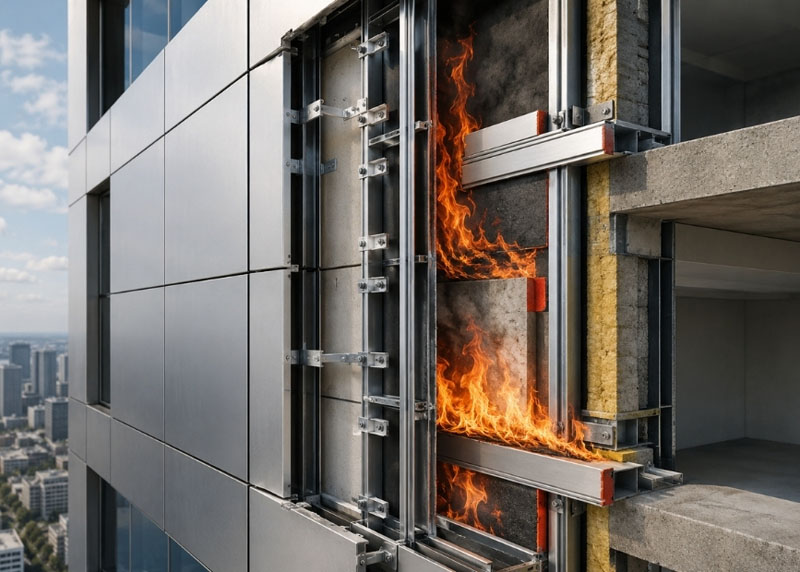
Many commercial façade projects assume that selecting a fire-retardant ACM panel is enough to satisfy high-rise fire safety requirements. In reality, exterior wall fire performance depends on the interaction between the cladding panel, insulation, water-resistive barrier, air cavity, attachment system, and movement joints throughout the entire wall assembly.
This is why NFPA 285 evaluates full exterior wall systems rather than isolated aluminum composite panels. In modern rainscreen façades, fire spread often occurs through concealed cavities, perimeter transitions, and assembly interfaces instead of across the exposed panel surface alone. For architects, façade consultants, contractors, and procurement teams, understanding assembly-level fire behavior has become increasingly important in code-sensitive projects.
Why Individual ACM Panel Fire Ratings Cannot Predict Full Assembly Performance
An aluminum composite panel may demonstrate acceptable small-scale fire behavior while the completed façade assembly still fails to control vertical flame propagation. Real building fires expose multiple materials simultaneously under dynamic airflow and heat conditions that cannot be replicated through isolated material testing alone.
Modern ACM façade systems typically combine:
aluminum composite panels
thermal insulation
water-resistive barriers
ventilated cavity systems
aluminum or steel subframing
movement joints
sealants and gaskets
perimeter fire containment details
When exposed to fire, these components interact as a system. Flame spread may occur through concealed air gaps, failed joint interfaces, or combustible secondary materials behind the panel surface.
Fire Spread Frequently Occurs Inside Ventilated Cavities
Ventilated rainscreen façades improve moisture drainage and thermal performance, but they also introduce continuous air spaces behind the cladding system.
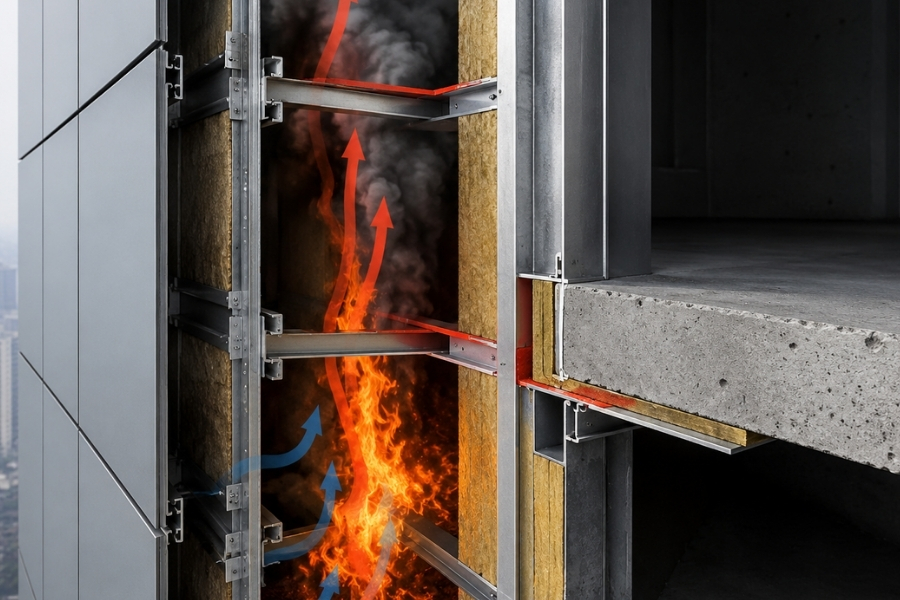
Under fire conditions, these cavities can create a chimney effect that accelerates vertical flame propagation.
In many tested ACM systems, cavity depth, airflow conditions, and fire barrier spacing directly influence assembly performance. Excessive uninterrupted cavity dimensions may allow flames and superheated gases to bypass floor slab edges and travel rapidly between stories.
This becomes especially critical in:
high-rise office towers
airports
hospitals
mixed-use developments
transportation facilities
where large uninterrupted façade elevations are common.
Joint Openings and Edge Conditions Can Intensify Fire Propagation
Façade joints are necessary to accommodate fabrication tolerances, thermal expansion, drainage, and installation movement. However, improperly designed joints may become fire pathways during elevated temperature exposure.
Common high-risk conditions include:
oversized open-joint systems
exposed combustible core edges
failed perimeter sealants
discontinuous cavity barriers
poorly protected slab edge transitions
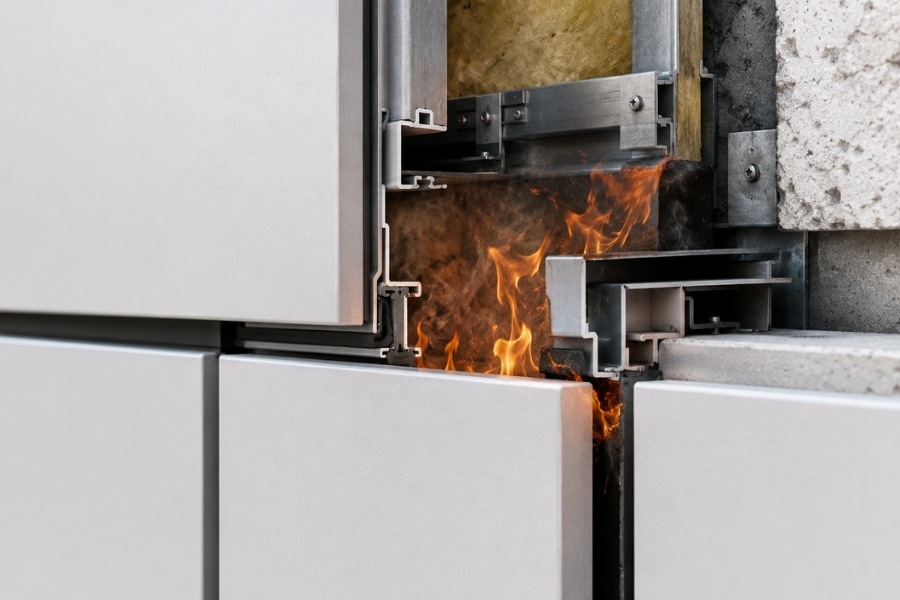
Aluminum naturally expands under heat exposure. In large-format ACM systems, thermal movement may widen panel gaps during fire conditions if joint tolerances and attachment systems are not properly coordinated.
In some façade failures, fire spread has accelerated not because the panel surface ignited first, but because flames entered concealed cavity spaces through compromised edge conditions.
What NFPA 285 Actually Evaluates in an Exterior Wall Assembly
NFPA 285 is a multi-story fire test designed to evaluate how a complete exterior wall assembly behaves when exposed to both interior and exterior fire sources. The test measures flame spread characteristics across the entire façade system rather than focusing on one individual material.
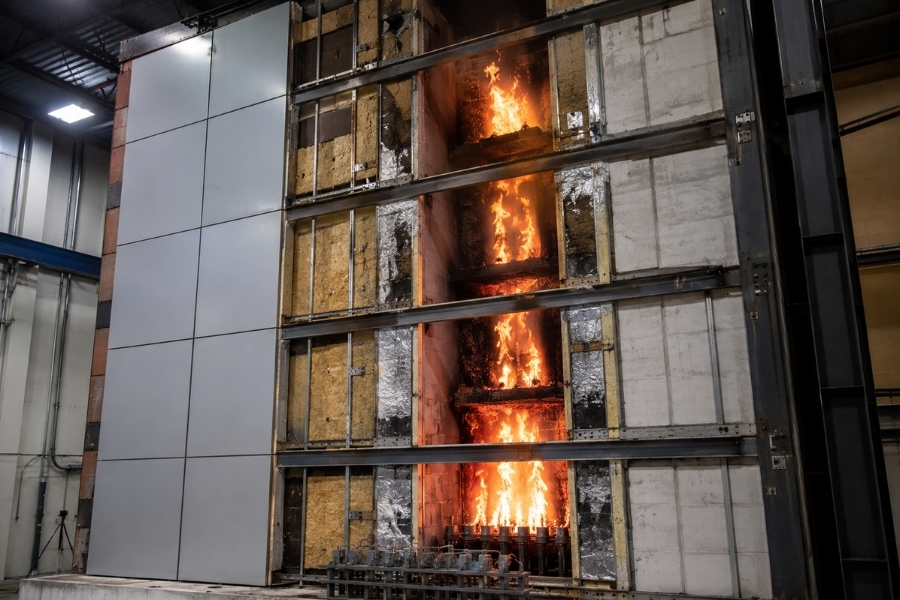
The evaluation typically includes:
flame propagation within cavities
vertical fire spread between floors
lateral fire movement
temperature rise at upper levels
combustibility of secondary materials
structural stability of assembly components
This system-level approach reflects real-world façade fire behavior more accurately than isolated material testing methods.
NFPA 285 Evaluates Assembly Interaction Rather Than Product Marketing Claims
One of the most misunderstood aspects of façade fire compliance is the assumption that an FR core ACM panel automatically creates a compliant wall assembly.
In practice, NFPA 285 approvals are tied to:
specific insulation types
cavity dimensions
WRB materials
fastening systems
panel configurations
joint conditions
air barrier placement
Even relatively minor assembly modifications may affect compliance pathways.
For example:
changing insulation density
increasing cavity depth
substituting WRB products
modifying attachment spacing
altering joint width
may invalidate previously tested assembly conditions if they exceed approved configurations.
This is why experienced façade consultants review complete tested assemblies rather than relying solely on panel core classifications.
Vertical Flame Propagation Between Floors Is a Primary Concern
One of the core objectives of NFPA 285 is limiting vertical flame spread above the ignition floor.
In real façade fire events, flames may travel upward through:
ventilated cavities
window perimeter gaps
slab edge interfaces
combustible insulation layers
failed movement joints
Without proper cavity barriers and perimeter fire containment, flames may bypass interior compartmentation systems and spread rapidly across multiple stories.
This risk has become increasingly important as contemporary façade systems use:
deeper ventilated cavities
lightweight composite materials
larger panel modules
continuous insulation systems
open-joint rainscreen designs
Combustible Secondary Components Often Influence Final Results
In many ACM projects, the panel itself is not the only combustible element inside the wall system.
Other components may significantly affect assembly performance, including:
water-resistive barriers
foam insulation
sealants
gaskets
adhesives
thermal breaks
This is why NFPA 285 focuses heavily on assembly interaction rather than evaluating one component in isolation.
A façade assembly using FR core ACM panels may still fail if secondary materials contribute to excessive flame spread inside the cavity system.
Why FR Core Panels Alone May Not Guarantee Compliance
FR core aluminum composite panels reduce combustibility compared with standard polyethylene core panels, but they do not eliminate all façade fire risks.
This distinction is frequently misunderstood during value engineering and procurement stages.
Tested Assembly Configuration Matters More Than Marketing Terminology
Terms such as:
fire-rated ACM
FR core panel
non-combustible façade
fire-resistant cladding
do not automatically guarantee code approval for every project condition.
Actual compliance depends on whether the entire assembly matches tested system parameters.
This becomes particularly important in Type I, II, III, and IV construction regulated under the International Building Code where NFPA 285 compliance is often mandatory for combustible exterior wall assemblies above certain building heights.
Substituting Untested Components Can Create Compliance Problems
In some projects, contractors or procurement teams substitute materials late in the construction process to reduce costs or shorten lead times.
Common substitutions include:
alternative insulation products
different WRBs
revised cavity dimensions
modified fastening systems
alternative sealants
Even when substituted materials appear similar, the modified assembly may no longer align with the original tested configuration.
This issue frequently appears in high-rise retrofit and façade renovation projects where existing wall conditions differ from current tested assemblies.
Common ACM Façade Design Mistakes That Increase Fire Risk
Many exterior wall compliance failures are not caused by one catastrophic design decision. Instead, they result from multiple smaller coordination problems across fabrication, detailing, and installation stages.
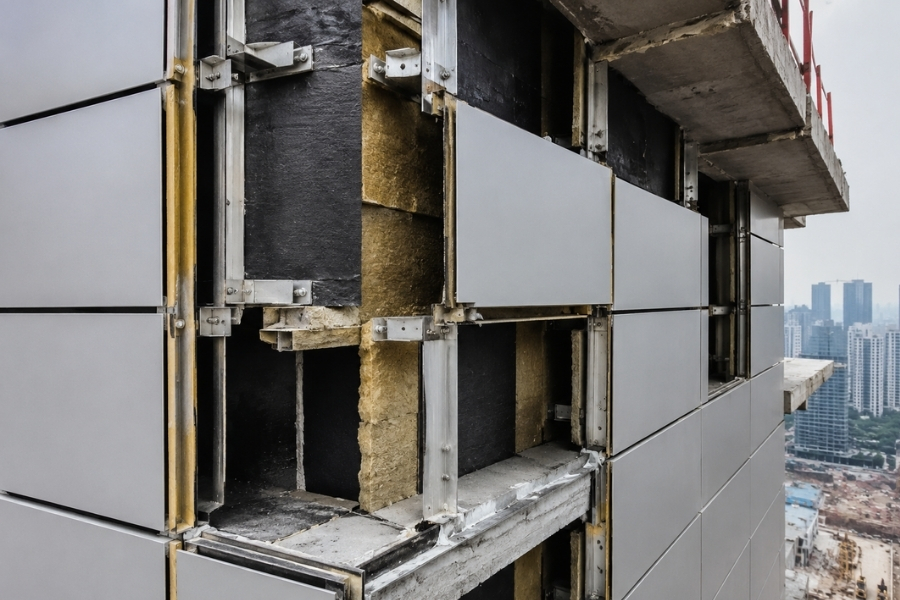
Oversized Cavities Without Proper Fire-Stopping
Large ventilated cavities improve drainage and pressure equalization, but they may also intensify chimney-driven flame spread if cavity barriers are improperly spaced or omitted.
In some façade systems, cavity barriers must align closely with:
slab edges
window heads
floor transitions
compartmentation lines
Poor coordination between façade and fire protection teams may leave concealed pathways for fire propagation.
Improper Protection Around Panel Edges
Rout-and-return ACM fabrication methods create folded panel edges that require careful detailing around joints and corners.
If edge protection is incomplete, elevated temperatures may expose combustible core materials during fire conditions.
This becomes particularly sensitive around:
corner transitions
movement joints
window perimeters
penetrations
slab edge conditions
Mixing Components From Multiple Untested Systems
Combining products from different manufacturers may create coordination conflicts if the assembly has not been tested together.
Potential issues include:
incompatible sealants
inconsistent cavity dimensions
mismatched fastening tolerances
different thermal expansion behavior
discontinuous fire barrier interfaces
System compatibility is often just as important as the fire rating of the individual panel itself.
Engineering Considerations for Fire-Rated ACM Façades
Exterior wall fire performance should be addressed early during façade design rather than after procurement decisions have already been finalized.
Thermal Movement and Expansion Joint Design
Large ACM panels experience continuous thermal expansion and contraction caused by seasonal temperature variation and solar heat gain.
Typical façade systems may include:
horizontal movement joints
vertical expansion joints
sliding attachment points
flexible perimeter seals
Without proper movement accommodation, stress accumulation may contribute to:
panel distortion
joint widening
sealant failure
fastening fatigue
These conditions may indirectly affect long-term cavity protection and fire performance.
Cavity Fire Barriers Must Balance Fire Safety and Drainage
Ventilated rainscreen systems require airflow and moisture drainage behind the cladding layer. However, fire barriers interrupt cavity continuity to reduce flame propagation.
Balancing these competing requirements is a major façade engineering challenge.
Poorly integrated fire barriers may:
restrict ventilation
trap moisture
complicate installation
create tolerance conflicts
reduce long-term façade durability
Successful systems require coordination between:
façade engineers
fire consultants
installers
fabrication teams
waterproofing specialists
Mock-Up Validation Reduces Installation and Compliance Risk
Large façade projects increasingly use full-scale mock-up testing to evaluate installation sequencing, fabrication tolerances, and interface coordination before production begins.
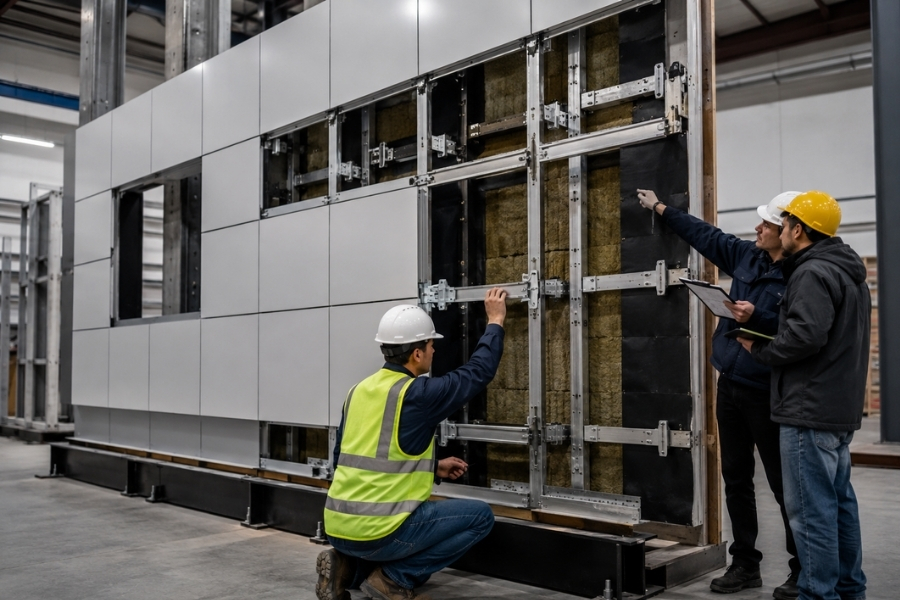
Mock-up reviews may help identify:
movement joint conflicts
panel alignment issues
perimeter sealing problems
cavity barrier continuity
attachment tolerances
drainage performance
For code-sensitive projects, mock-up validation can reduce risk before full façade installation proceeds.
Through its experience in composite panel manufacturing, CNC fabrication, and modularized façade support, Aluwell® assists project teams with coordinated composite panel solutions for complex architectural envelope systems.
Where Fire-Rated ACM Systems Are Commonly Used
Fire-rated aluminum composite material systems are widely used in:
commercial office towers
healthcare facilities
airports
educational campuses
hospitality developments
transportation hubs
mixed-use high-rise projects
These applications often require a balance between:
architectural flexibility
lightweight construction
façade flatness
weather resistance
thermal efficiency
fire compliance
installation efficiency
As exterior wall systems become more sophisticated, assembly-level fire engineering continues to play a larger role in façade design, specification, and procurement.
Conclusion
NFPA 285 exists because exterior wall fire performance depends on the interaction between the cladding panel, cavity design, insulation, air barriers, joints, attachment systems, and perimeter detailing throughout the entire façade assembly.
A fire-rated ACM panel alone cannot predict how a complete exterior wall system will behave during a real fire event. For architects, façade consultants, contractors, and developers, understanding assembly-level behavior is increasingly important as high-rise building envelopes become more complex and code requirements continue to evolve.
Rather than evaluating panels in isolation, modern façade fire safety requires coordinated system engineering, tested assembly validation, and careful integration between design, fabrication, and installation teams.
With decades of composite material manufacturing experience and project-oriented façade support capabilities, Aluwell® provides engineered aluminum composite panel solutions, customized fabrication support, and assembly coordination services for architects, contractors, and developers working on code-sensitive architectural envelope projects.
FAQ
Does using an FR core ACM panel automatically guarantee NFPA 285 compliance?
No. NFPA 285 evaluates the performance of the entire exterior wall assembly rather than the ACM panel alone. Insulation type, cavity depth, WRBs, attachment systems, and joint detailing may all influence whether the final façade system satisfies code requirements.
Why are ventilated cavities important in ACM façade fire performance?
Ventilated cavities improve drainage and airflow, but they may also accelerate vertical flame propagation during fire exposure if cavity barriers are missing or improperly installed. Cavity geometry and fire-stopping continuity are critical parts of assembly-level fire design.
What is the difference between FR core and A2 core ACM panels?
FR core ACM panels typically contain mineral-filled fire-retardant materials that reduce combustibility compared with polyethylene cores. A2 core systems generally contain even lower combustible content and are often specified for projects requiring stricter fire performance standards.
Can changing insulation or WRB products affect NFPA 285 approvals?
Yes. Many NFPA 285 approvals apply only to specific tested assembly configurations. Substituting insulation, WRBs, sealants, or fastening systems may alter fire behavior and potentially invalidate the original tested assembly pathway.
Why do façade joints influence fire spread in ACM systems?
Façade joints create openings that accommodate thermal movement and installation tolerances. During fire exposure, poorly protected joints or exposed panel edges may allow flames and hot gases to enter concealed cavity spaces and accelerate vertical fire spread.
Are open-joint ACM façade systems more difficult to design for fire compliance?
Open-joint systems may require additional engineering attention because exposed cavity openings can increase airflow behind the façade. Proper cavity barrier placement, edge detailing, and tested assembly coordination become especially important in these systems.
Why does NFPA 285 focus on full wall assemblies instead of individual materials?
Real façade fires involve interaction between multiple components including cladding panels, insulation, WRBs, cavities, and attachment systems. NFPA 285 evaluates how these components behave together under fire conditions rather than testing isolated products separately.
What should architects and contractors review before selecting fire-rated ACM systems?
Project teams should review tested assembly documentation, insulation compatibility, cavity dimensions, movement joint design, perimeter fire containment details, and approved component combinations before finalizing specifications or procurement decisions.