

01 Jun
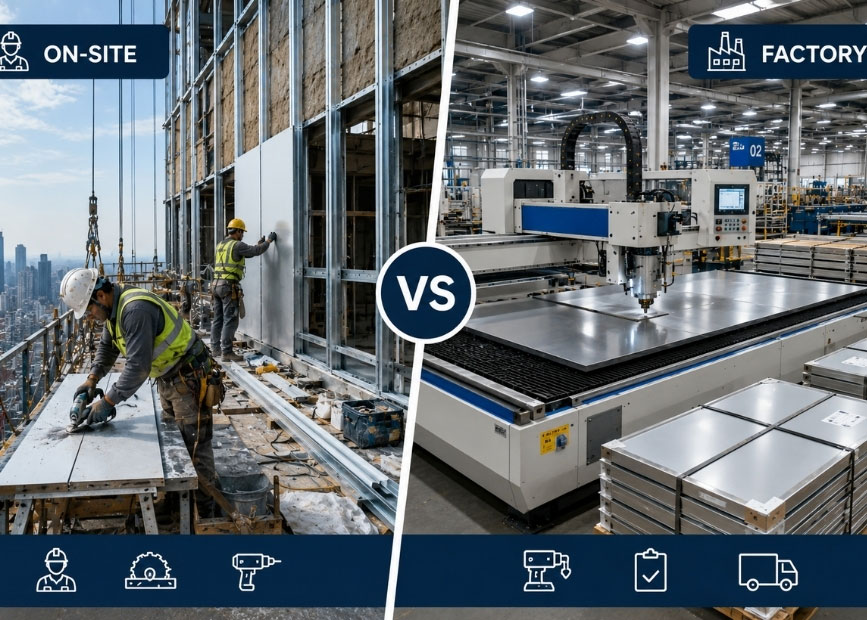
On-Site Fabrication vs Factory Prefabrication - How Aluminum Composite Panels Simplify Construction Workflows
Construction schedules are becoming tighter across commercial, institutional, healthcare, and high-rise building projects. At the same time, contractors face increasing pressure to improve installation efficiency, maintain consistent quality, and reduce labor requirements on increasingly complex job sites.
For aluminum composite panel systems, fabrication strategy plays a major role in determining project outcomes. While on-site fabrication remains common for certain applications, many architects, façade consultants, and contractors are shifting toward prefabricated aluminum composite panels to improve construction workflows and reduce field-related risks.
The discussion is no longer simply about how ACM panels are installed. The more important question is how fabrication decisions affect schedule certainty, installation quality, labor productivity, and long-term project performance.
Why Traditional On-Site ACM Fabrication Creates Scheduling Risks
Many construction teams underestimate the number of tasks required before an aluminum composite panel can be permanently installed.
A typical field-fabricated façade workflow often includes:
Layout verification
Establishing control lines
Drilling anchor locations
Installing expansion anchors
Bracket positioning
Subframe alignment
Panel trimming and modification
Joint preparation
Sealant application
Final inspection
Each activity introduces opportunities for delays.
From a manufacturer’s perspective, installation challenges rarely originate from the panel itself. More often, problems arise from substrate tolerances, alignment inconsistencies, and unexpected site conditions.
On large commercial projects, installers frequently discover that slab edges, wall framing, or window openings vary slightly from design dimensions. These deviations often require repeated bracket adjustments and rail realignment before panel installation can begin.
As project size increases, these small corrections accumulate into significant labor costs and schedule impacts.
What Factory Prefabrication Includes Before Panels Arrive on Site
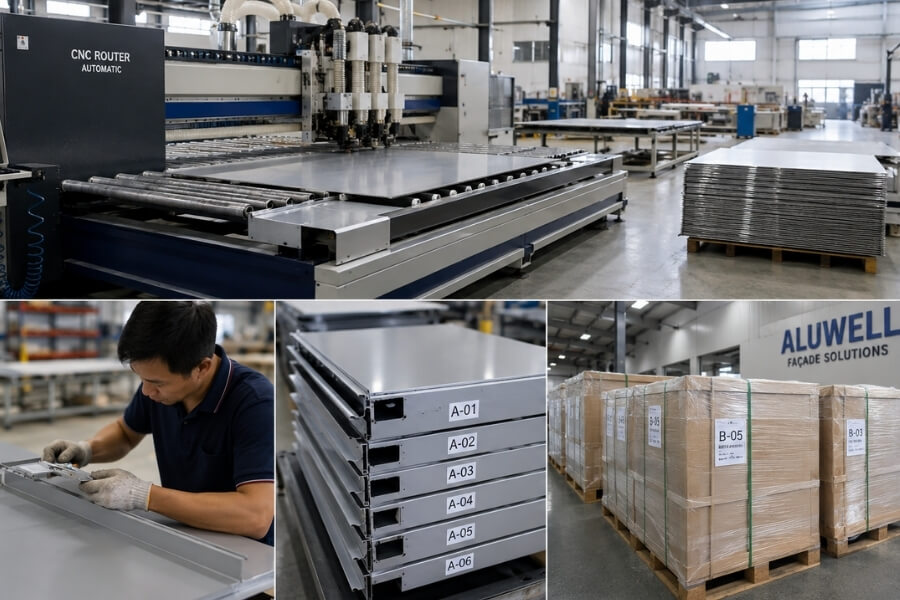
Many people assume factory prefabrication simply means cutting panels before shipment.
In reality, modern prefabricated aluminum composite panels undergo multiple fabrication and quality-control processes before reaching the project site.
Typical manufacturing operations include:
CNC cutting
Routing and grooving
Edge folding
Cassette fabrication
Attachment preparation
Hardware integration
Panel labeling
Protective packaging
Quality inspection
These processes are completed using controlled equipment and repeatable manufacturing procedures.
By transferring fabrication activities into a factory environment, contractors can focus on installation rather than production.
This distinction becomes particularly valuable on projects with aggressive schedules or limited site access.
CNC Cutting and Dimensional Accuracy
Factory CNC equipment allows panels to be manufactured according to approved shop drawings with a high degree of repeatability.
Dimensional consistency improves:
Joint alignment
Reveal consistency
Corner accuracy
Installation efficiency
Field cutting can achieve acceptable results, but maintaining identical dimensions across hundreds or thousands of panels is significantly more difficult.
Panel Identification and Sequencing
One often-overlooked advantage of factory fabrication is panel sequencing.
Each panel can be labeled according to its exact location within the façade system.
Installation crews receive components in a predefined order, reducing confusion and improving workflow efficiency.
On large projects, organized panel sequencing can significantly reduce handling time and installation errors.
How Routing and Folding Reduce Field Labor
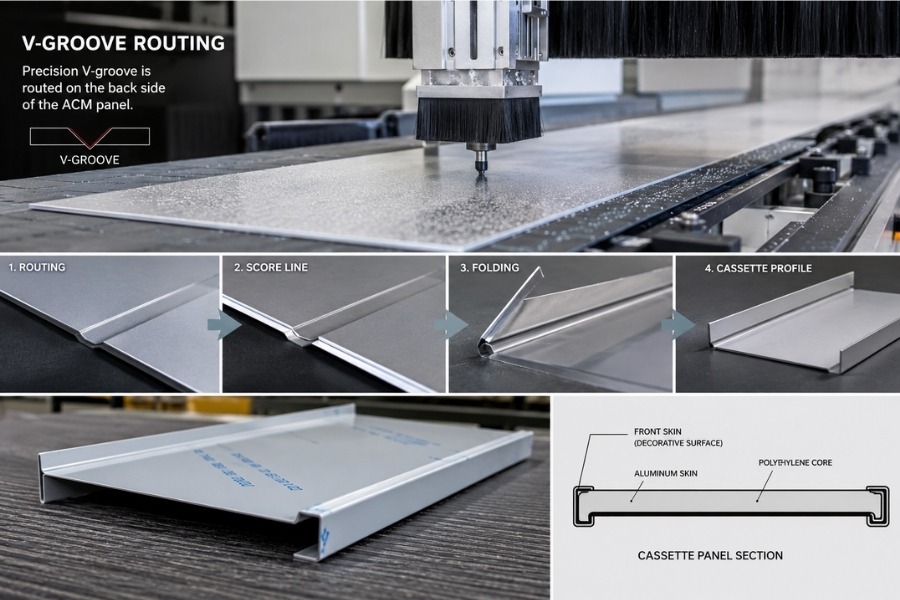
Routing and folding are among the most important processes used in the production of factory-fabricated ACM systems.
A controlled groove is machined into the rear side of the panel, allowing the material to fold without damaging the finished face.
This process creates:
Return flanges
Cassette edges
Corner details
Window return components
Soffit assemblies
The advantage of factory routing is consistency.
Routing depth must be carefully controlled. Excessive routing can weaken the fold area, while insufficient routing may prevent accurate bending.
In manufacturing environments, routing depth, fold geometry, and panel dimensions can be monitored throughout production.
This level of control is difficult to replicate consistently in field conditions.
For complex projects, prefabricated aluminum composite panels often arrive ready for installation with minimal modification required on-site.
Comparing On-Site Fabrication and Factory Prefabrication
| Factor | On-Site Fabrication | Factory Prefabrication |
|---|---|---|
| Labor Requirements | Higher | Lower |
| Installation Speed | Slower | Faster |
| Quality Consistency | Variable | Controlled |
| Weather Dependency | High | Reduced |
| Material Waste | Higher | Lower |
| Rework Risk | Higher | Lower |
| Site Safety Exposure | Greater | Reduced |
| Installation Predictability | Lower | Higher |
| Panel Traceability | Limited | Excellent |
For small projects, these differences may be relatively minor.
For large façade systems covering thousands of square feet, the advantages become much more significant.
Hidden Construction Tasks Often Overlooked During Field Fabrication
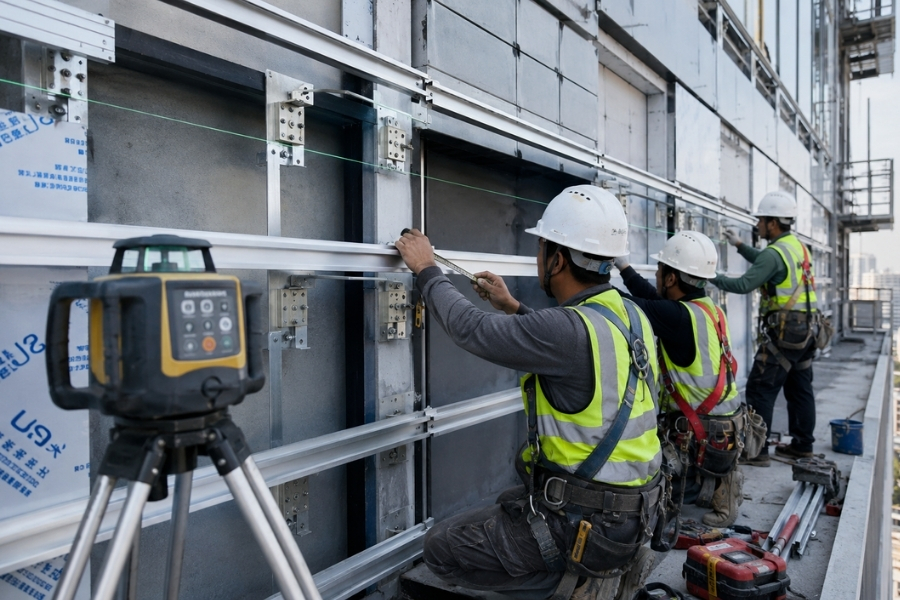
Panel installation is often perceived as the primary activity in façade construction.
In practice, many supporting tasks consume more time than expected.
Bracket and Rail Alignment
Support brackets must remain within a consistent plane.
Even minor positioning variations can affect:
Panel flatness
Reveal alignment
Visual consistency
Adjusting brackets and rails often requires multiple rounds of measurement and correction.
Joint Treatment and Sealant Work
Joint treatment is another labor-intensive process.
Many ACM systems require:
Backer rod installation
Weather-resistant sealants
Joint finishing
Visual inspection
Typical reveal widths may range from approximately 15 mm to 20 mm depending on project requirements and system design.
Maintaining consistent joint dimensions across a large façade requires careful coordination.
Weather-Related Delays
Field fabrication is highly dependent on weather conditions.
Rain, high winds, and temperature fluctuations can affect:
Sealant performance
Material handling
Worker productivity
Installation safety
Factory fabrication significantly reduces the amount of work exposed to these variables.
Why Complex Façade Geometry Benefits Most from Prefabrication
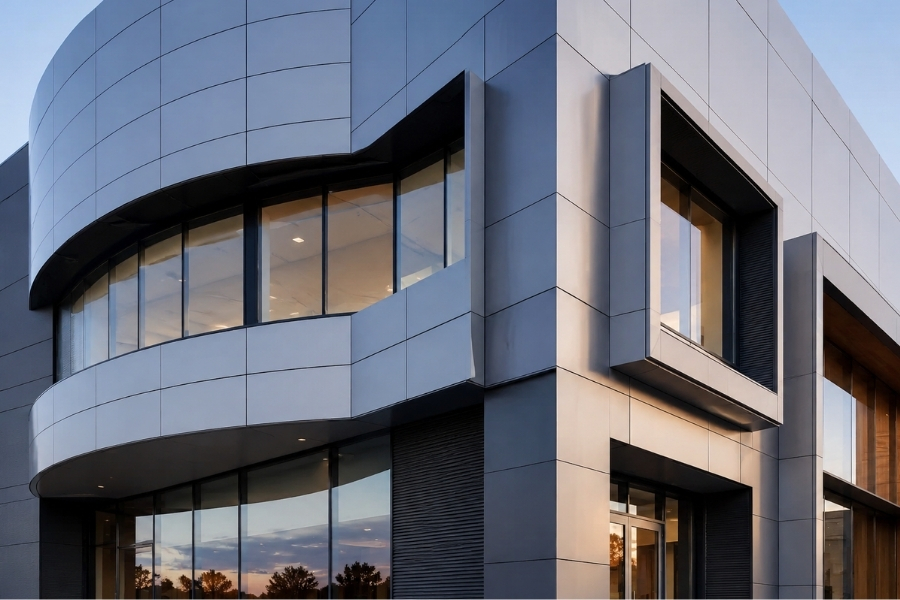
As architectural complexity increases, the value of factory fabrication becomes more apparent.
Projects involving corners, curves, transitions, and custom detailing typically benefit the most from prefabricated aluminum composite panels.
External Corners
Corner conditions require accurate fold angles and consistent dimensions.
Small fabrication errors can create visible alignment issues that become noticeable across the building envelope.
Factory-produced corner assemblies improve consistency and reduce installation adjustments.
Curved Façades
Curved wall sections introduce additional fabrication challenges.
Radius accuracy, attachment spacing, and panel segmentation must all be carefully controlled.
Manufacturing these components in a factory environment improves repeatability and reduces field fabrication risks.
Window Returns and Soffits
Window surrounds often contain numerous small components and complex transitions.
These areas frequently require multiple folds, precise dimensions, and tight alignment tolerances.
Factory fabrication simplifies installation while improving visual consistency.
When Factory Prefabrication Delivers the Greatest Value
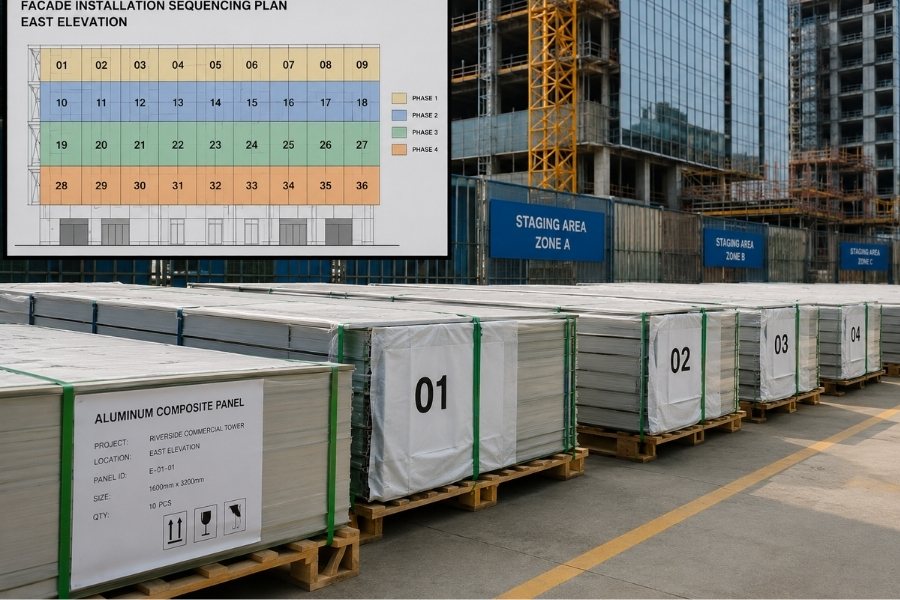
Prefabricated aluminum composite panels provide the greatest benefits when project schedules, quality requirements, and coordination demands are high.
Typical applications include:
High-rise office towers
Airports
Hospitals
Universities
Government facilities
Large façade renovation projects
In these environments, reducing field labor can improve productivity and help maintain predictable schedules.
Another advantage is improved coordination with rainscreen wall assemblies.
Many modern ACM systems function as drained and back-ventilated rainscreen systems. Behind the cladding, a weather-resistant barrier (WRB) serves as the primary moisture defense layer, while the ventilated cavity allows drainage and airflow.
Because the WRB and rainscreen cavity remain critical performance components, accurate panel installation and consistent attachment locations become increasingly important.
Factory fabrication helps support these objectives.
When On-Site Fabrication Still Makes Sense
Despite the benefits of prefabrication, on-site fabrication continues to serve a role in certain projects.
Examples include:
Small-scale renovations
Projects with limited panel quantities
Remote construction locations
Frequent design revisions
Conditions requiring extensive field verification
In these situations, the flexibility of site fabrication may outweigh the efficiency advantages of factory production.
The decision should be based on project complexity, logistics, budget, and schedule priorities rather than a one-size-fits-all approach.
Key Takeaways for Architects, Contractors, and Developers
The growing use of prefabricated aluminum composite panels reflects broader trends throughout the construction industry.
As projects become more schedule-driven and labor resources become increasingly constrained, transferring fabrication activities from the job site to the factory creates measurable advantages.
The most significant benefit is not simply faster installation. It is the reduction of field fabrication, adjustment, rework, and uncertainty throughout the construction process.
For projects involving complex geometry, large façade areas, demanding schedules, or high-performance rainscreen systems, factory-prefabricated ACM panels often provide a more predictable and efficient path to project completion.
Aluwell® supports custom aluminum composite panel manufacturing, including CNC routing, cassette fabrication, project-specific panel sequencing, and engineered packaging solutions designed to help contractors simplify installation workflows while maintaining high standards of quality and consistency.
FAQ
Are prefabricated aluminum composite panels more expensive than field-fabricated panels?
Manufacturing costs may be higher initially, but reduced labor requirements, faster installation, lower waste, and fewer field adjustments often improve overall project economics.
What is the difference between flat ACM panels and cassette panels?
Flat panels are cut to size and attached directly to a support structure. Cassette panels include folded edges that improve rigidity, conceal attachment systems, and support more efficient installation.
Can aluminum composite panels still be modified on-site?
Yes. Panels can be cut, drilled, and adjusted when necessary. However, extensive field fabrication can increase labor costs and reduce installation efficiency.
Which projects benefit most from prefabricated ACM systems?
Large commercial buildings, healthcare facilities, transportation projects, educational campuses, and complex architectural façades typically gain the greatest advantages from prefabrication.
What project information should be finalized before prefabrication begins?
Approved shop drawings, attachment locations, panel dimensions, corner details, window conditions, and subframe layouts should be confirmed before manufacturing begins to minimize the need for field modifications.