

24 Mar
How Rainscreen Systems Withstand Hurricane Wind and Impact Loads
Aluminium composite panels used within a properly engineered rainscreen system can withstand hurricane wind loads, debris impact, and moisture intrusion when designed to meet high-velocity hurricane zone requirements.
In coastal and hurricane-prone regions, façade systems are no longer defined by appearance alone. They must perform under extreme pressure cycles, resist water penetration, and maintain long-term structural stability.
This article explains how rainscreen systems with aluminium composite panels deliver reliable performance in hurricane conditions, and how system design determines real-world results.
Why Facade Systems Fail Under Hurricane Wind and Pressure
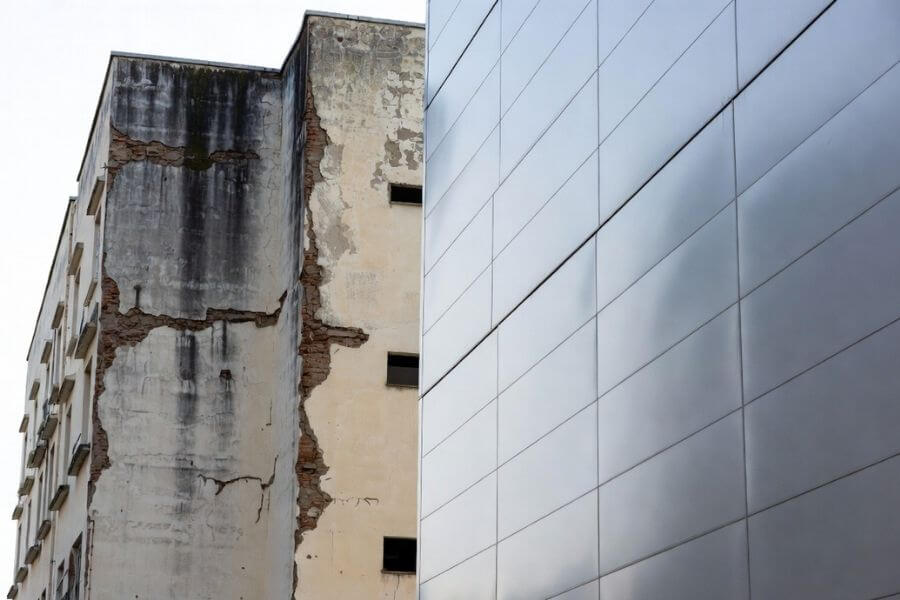
Façade failure in hurricane conditions is rarely caused by a single factor. It is typically the result of combined stresses acting on the building envelope.
Wind pressure can exceed 150–180 psf, causing panel deformation and fastener fatigue
Wind-driven rain penetrates joints under pressure differentials
Debris impact compromises the outer cladding layer
Moisture accumulation accelerates material degradation
Traditional face-sealed systems rely heavily on sealants. Under repeated pressure cycles, these systems tend to fail as joints open and water penetrates deeper into the wall assembly.
In contrast, high-performance façade systems must be designed to manage these forces rather than attempt to resist them entirely.
What Makes a Rainscreen System Work in Hurricane Zones
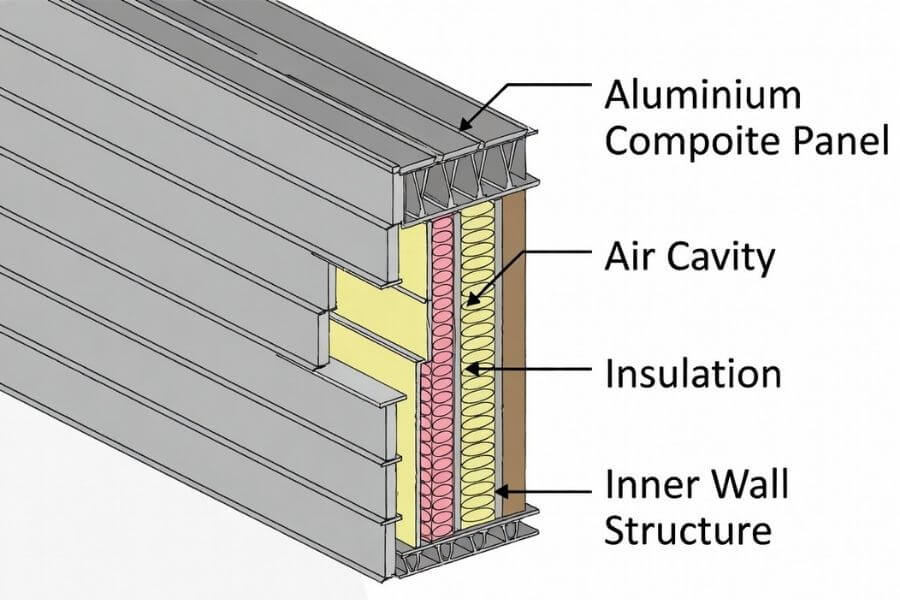
A rainscreen system improves façade performance by introducing a controlled cavity behind the cladding layer.
This design enables:
Drainage – water that penetrates the outer layer is redirected outward
Ventilation – airflow reduces moisture buildup and drying time
Pressure equalization – minimizes pressure differences that drive water into joints
Instead of relying on a single barrier, the system distributes performance across multiple layers.
In hurricane conditions, pressure equalization becomes particularly important. By reducing pressure differentials, the system lowers the force pushing water through façade joints during high wind events.
This approach transforms the façade from a sealed surface into a controlled environmental system.
Rainscreen vs Traditional Cladding in Hurricane Zones
Understanding the difference between systems helps clarify why rainscreens are more effective in extreme environments.
Traditional Cladding Systems
Depend on sealants as the primary water barrier
Limited ability to manage pressure-driven rain
Higher risk of failure under repeated wind cycles
Rainscreen Systems
Manage water through drainage and ventilation
Reduce pressure differentials across the façade
Provide layered protection rather than a single defense
In hurricane zones, where pressure and moisture act simultaneously, this difference becomes critical. Systems that manage water and pressure perform more reliably over time.
How Aluminium Composite Panels Improve Hurricane Resistance
Within a rainscreen assembly, the cladding material must maintain structural integrity under dynamic loading conditions. This is where aluminium composite panels provide measurable advantages.
Structural Performance Under Wind Load
Aluminium composite panels offer a high stiffness-to-weight ratio, which supports performance under high wind pressure.
In a typical mid-rise façade system:
Panel thickness is commonly 4mm, with adjustments based on project requirements
Subframe spacing and fastener configuration are designed to meet wind loads ranging from 130 to 180 psf
Lightweight panels reduce stress on anchors and structural supports
Panel consistency becomes critical in these assemblies. Systems built with Aluwell® aluminium composite panels maintain tight dimensional tolerances, which improves fastening stability and reduces movement under pressure.
Impact Resistance
In hurricane zones, façade systems must withstand debris impact.
Test standards such as ASTM E1996 simulate high-speed projectiles, including timber sections. Properly engineered composite panel systems can:
Absorb and distribute impact energy
Limit localized deformation
Maintain enclosure integrity after impact
Coating Durability and Surface Stability
Coating systems influence long-term performance under environmental exposure.
PVDF coatings resist UV degradation and chemical exposure
Surface stability ensures consistent color over time
Reduced maintenance supports lifecycle efficiency
In façade applications where visual consistency is important, coating performance directly affects long-term building appearance.
How Rainscreen Systems Are Tested for Wind, Impact, and Fire
Performance in hurricane zones must be validated through standardized testing of the entire wall assembly.
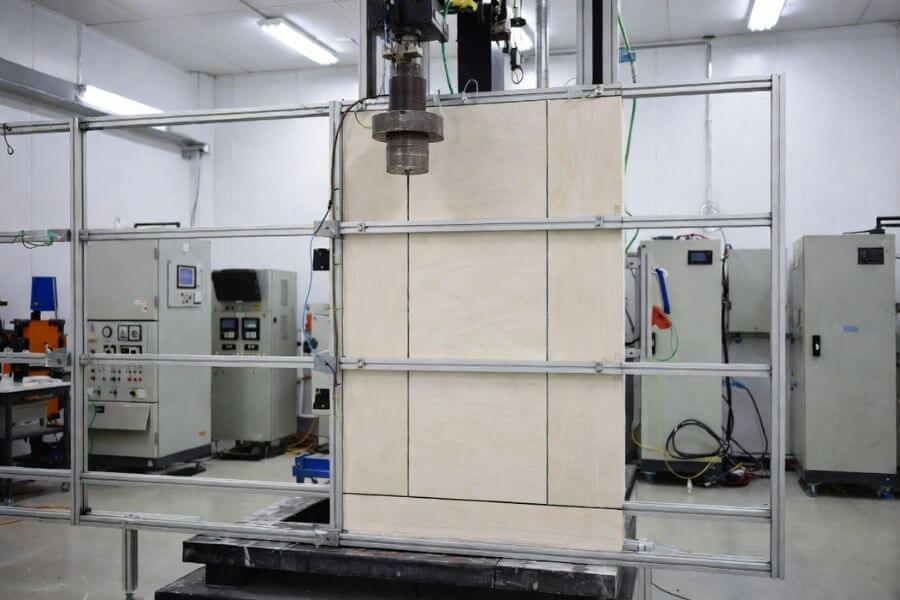
Wind Pressure Testing
Assemblies are subjected to cyclic positive and negative pressure.
Design loads may reach 180 psf in high-velocity hurricane zones
Testing evaluates deflection, fastener performance, and structural stability
Impact Resistance Testing
Standards such as ASTM E1886/E1996 and TAS 201–203 simulate debris impact.
Projectiles such as 2x4 timber sections are launched at high velocity
Systems must resist penetration and maintain integrity
Post-impact pressure cycles confirm continued performance
Fire Performance Testing
For multistory buildings, NFPA 285 evaluates vertical fire spread within wall assemblies.
Flame propagation is monitored across façade surfaces
Temperature rise is measured within system layers
Assemblies must prevent fire from spreading beyond defined limits
System coordination is essential in these tests. In assemblies incorporating Aluwell® panels, material consistency, fastening strategy, and substructure design are aligned to achieve stable performance under combined test conditions.
Example of a Hurricane-Resistant Facade System
In a coastal commercial project, more than 12,000 square feet of aluminium composite panels were installed as part of a pressure-equalized rainscreen system.
The façade assembly included:
4mm aluminium composite panels
Aluminum subframe with engineered fastener spacing
Continuous insulation layer integrated with an air and water barrier
The system was designed to withstand wind loads up to 150 psf and passed impact resistance testing based on ASTM E1996 requirements.
During installation, a full-scale mock-up was constructed to verify panel alignment, fastening performance, and joint detailing. This process reduced on-site adjustments and improved construction efficiency.
This example highlights a key principle. Performance is achieved through system design, not material selection alone.
Why System Design and Installation Matter in Hurricane Zones
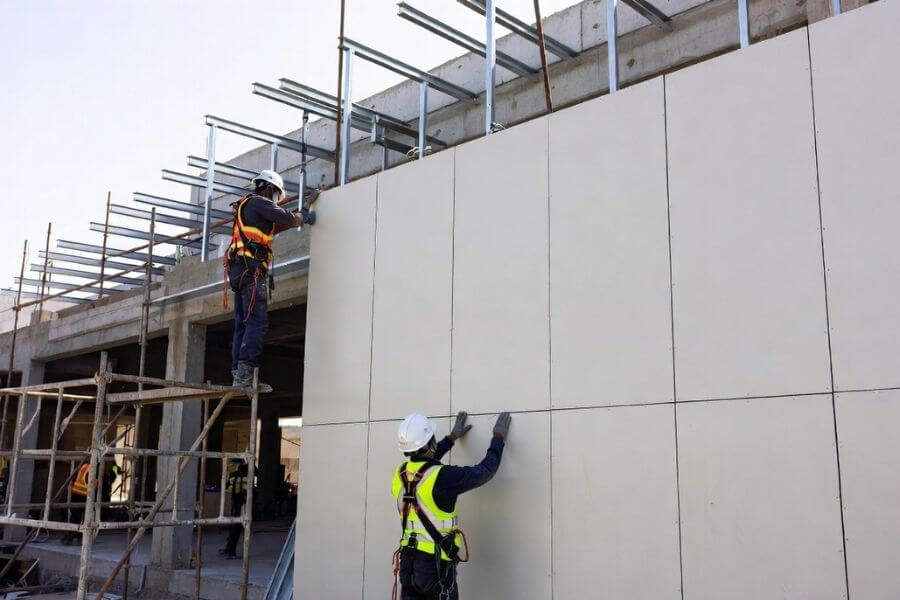
Even high-performance materials cannot compensate for poor system execution. Façade reliability depends on coordination between design, engineering, and installation.
Design Coordination
Architectural intent must align with engineering requirements.
Through integrated design support, project teams can:
Optimize panel layout and joint design
Balance aesthetics with structural performance
Reduce unnecessary system complexity
Engineering and Customization
Each project has unique exposure conditions.
Wind load requirements vary by location and building height
Fastener spacing and subframe design must be adjusted accordingly
Material selection must align with performance targets
With more than four decades of composite material expertise, ALUMAX supports project-specific solutions that address these variables through engineering and manufacturing integration.
Fabrication and Installation Control
Precision fabrication improves installation outcomes.
CNC processing ensures dimensional accuracy
Pre-assembly and mock-up validation reduce construction risk
Modular approaches improve installation speed and consistency
This integrated workflow supports reliable façade performance, especially in demanding environments.
Long-Term Performance of Facades in Harsh Weather Conditions
In hurricane zones, performance must be maintained over extended service life.
Durability
Resistance to UV exposure and corrosion
Stability under repeated wind and pressure cycles
Protection against moisture-related deterioration
Aesthetic Stability
Consistent color retention over time
Compatibility with architectural design intent
Ability to support large-scale façade composition
Lifecycle Efficiency
Reduced maintenance requirements
Long-term structural reliability
Predictable performance across environmental conditions
Systems incorporating aluminium composite panels provide a balance between performance, durability, and design flexibility in these conditions.
Designing Facades That Perform in Hurricane Conditions
Façade design in hurricane zones requires a shift from material selection to system thinking.
A properly engineered rainscreen system with aluminium composite panels can manage wind pressure, control moisture, and resist impact when tested against recognized standards.
By integrating design, engineering, and fabrication, project teams can create building envelopes that perform reliably under extreme conditions while maintaining long-term architectural value.
FAQ
What is a pressure-equalized rainscreen system
A pressure-equalized rainscreen system reduces air pressure differences across the façade cavity. By balancing external and internal pressure, it limits water penetration at joints and improves moisture drainage. This design is especially effective in high-wind environments where pressure-driven rain can compromise traditional sealed cladding systems.
Are aluminium composite panels suitable for hurricane zones
Yes. When used within a properly engineered rainscreen assembly, aluminium composite panels can withstand high wind pressure, debris impact, and environmental exposure. Their lightweight structure reduces structural load while maintaining stiffness and surface stability under dynamic conditions common in hurricane-prone regions.
What standards are required for hurricane-resistant façade systems
Hurricane-resistant façade systems are typically tested under ASTM E1886 and E1996 for impact resistance, TAS 201–203 for windborne debris, and NFPA 285 for fire performance. These standards evaluate the full wall assembly to ensure it can withstand wind pressure, impact forces, and fire exposure.
Do all rainscreen systems perform equally in high-wind conditions
No. Performance varies depending on system design, material quality, and testing validation. Only rainscreen systems engineered for high wind pressure and impact resistance, with verified test data, can perform reliably in hurricane zones. Design details such as fastening and subframe configuration are critical.
How does coating affect façade durability
Coating systems such as PVDF protect the panel surface from UV radiation, moisture, and airborne pollutants. This helps maintain color consistency and surface integrity over time. In harsh environments, coating performance directly affects long-term durability, maintenance requirements, and the overall appearance of the façade.
How does Aluwell® support façade projects in extreme environments
Aluwell® supports façade projects through consistent panel quality, engineering collaboration, and integrated manufacturing capabilities. By aligning material performance with system design and fabrication precision, it helps ensure façade assemblies meet wind, impact, and durability requirements while improving construction efficiency.