

24 Mar
Standard Stock vs Custom Production in MCM - What Architects Need to Know
Standard stock refers to pre-manufactured MCM panels available in fixed combinations of size, core, coating, and color.
Custom production refers to any panel configuration that deviates from those predefined combinations.
In façade projects, the choice is not only about availability. It determines how well the panel system aligns with design intent, code requirements, and installation efficiency.
Why Stock vs Custom Directly Impacts Your Façade Performance
In a façade system, panels are part of a coordinated assembly that includes substructure, joints, fixings, and drainage layers.
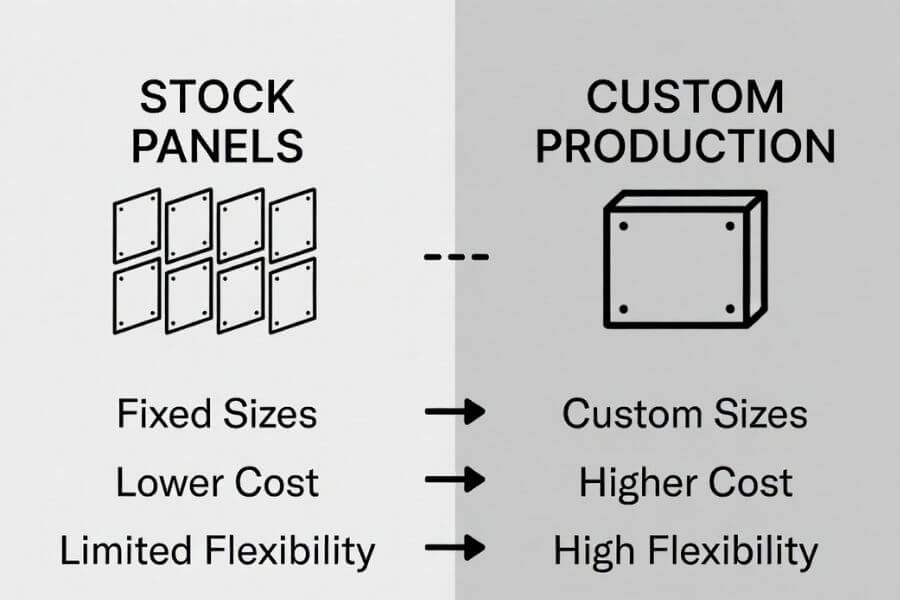
The selection between standard stock and custom production affects:
Panel module alignment and material yield
Compatibility with rainscreen systems
Fire compliance requirements in mid-rise and high-rise buildings
On-site installation efficiency and tolerance control
For example, when panel sizes exceed typical module widths, additional joints or field cutting may be required, which increases installation complexity and potential error.
Key MCM Variables That Define Stock vs Custom Panels
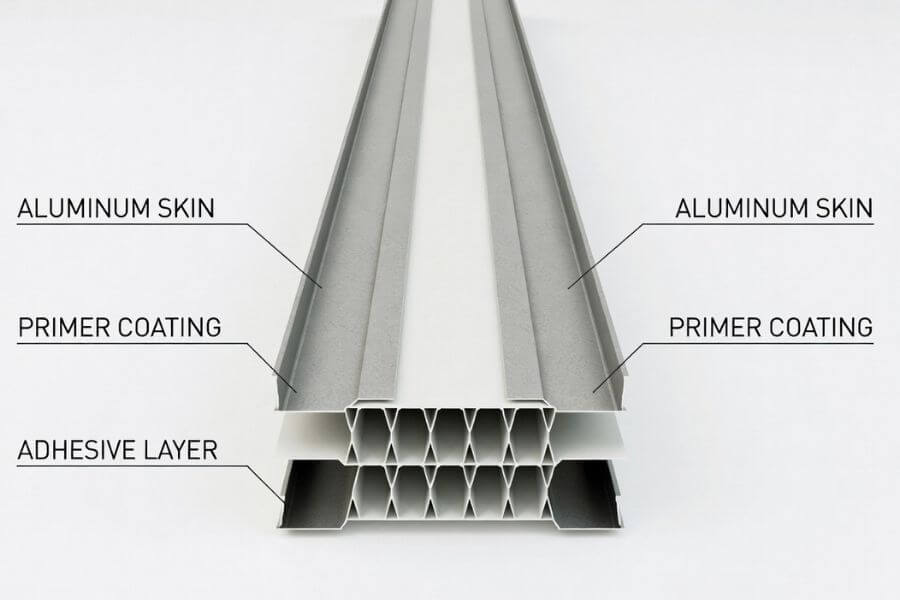
Every metal composite material (MCM) panel is defined by a combination of technical variables.
These include:
Skin material - aluminum, stainless steel, copper, or zinc
Skin thickness - typically 0.012" for signage, 0.020" for façade applications, up to 0.032" for high-load conditions
Core type - PE core or fire-resistant (FR core) required by code when building height exceeds 40 ft under IBC guidelines
Coating system - PVDF coatings or FEVE coatings for long-term weather resistance
Color and gloss level - affecting visual consistency and brand identity
Panel dimensions - standard widths such as 1220 mm, 1250 mm, 1500 mm, and project-specific lengths
For instance, ΔE color tolerance measures the difference between colors. In façade applications, maintaining ΔE < 2 is often required to ensure visual consistency across elevations.
Manufacturers with integrated material systems, such as Aluwell®, can support a wide range of these variables across aluminum composite panels, aluminum honeycomb panels, and stainless steel composite panels, enabling more precise alignment with project requirements.
When Standard Stock Panels Are the Right Choice
Standard stock panels are suitable when project requirements match predefined configurations.
Typical conditions include:
Lead time requirements under 2–3 weeks
Panel dimensions aligned with standard module grids
Non-critical façade areas with limited performance constraints
Budget-sensitive projects prioritizing predictable material costs
Advantages of standard stock:
Immediate availability
Lower upfront cost
Simplified procurement
However, stock panels are limited to fixed combinations. Even if a color exists in stock, it may not be available in all thicknesses, core types, or dimensions.
When Custom Production Becomes Necessary in Real Projects
Custom production becomes necessary when one or more parameters fall outside standard inventory.
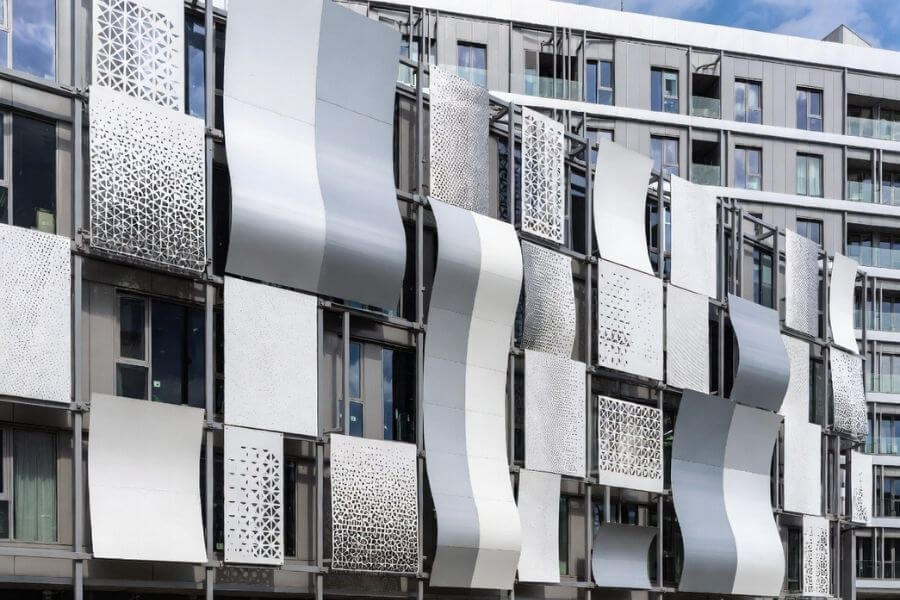
Common triggers include:
Panel width exceeding 1500 mm to reduce façade joint lines
Building height requiring FR core compliance
Brand-driven projects requiring strict ΔE color control
Non-standard gloss levels or surface finishes
Complex façade geometry or curved surfaces
In these cases, adapting the design to fit stock panels may introduce:
Additional joints
Increased installation labor
Compromised visual consistency
Custom production allows the panel system to match the design rather than forcing the design to adapt to material limitations.
Project Example - Why Standard Panels Failed and Custom Worked
In a commercial façade project in Southeast Asia, approximately 12,000 sq ft of exterior cladding was planned using 4mm aluminum composite panels.
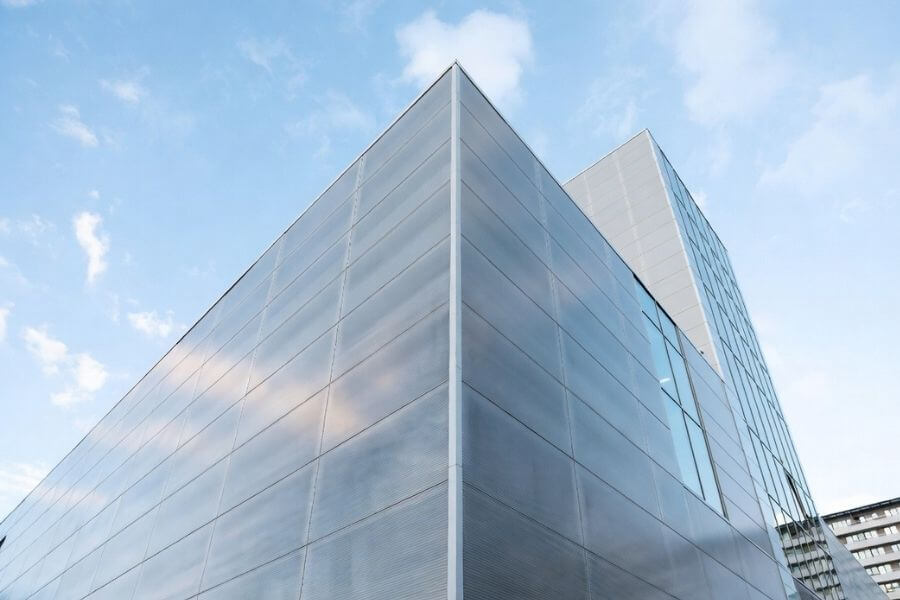
Initial specifications were based on standard stock panels:
Panel width - 1250 mm
PE core
Standard neutral color
During design development, three issues emerged:
The façade required panel widths up to 1600 mm to reduce visible joints
Local regulations required FR core panels due to building height exceeding 40 ft
The client required a brand color with ΔE < 2 consistency across batches
Standard stock could not meet all three conditions simultaneously.
The final solution involved custom production:
4mm FR core panels
Custom width panels up to 1600 mm
Controlled color formulation for batch consistency
As a result:
Panel layout aligned with the architectural grid
Installation time was reduced by minimizing joint complexity
Visual consistency across elevations was maintained
This type of outcome is typically achieved when material suppliers can support both engineering and production adjustments within the same system.
Cost vs Lead Time - What Actually Matters in MCM Projects
The assumption that custom production is always more expensive is not always accurate.
Standard stock offers:
Lower unit price
Immediate delivery
Reduced procurement complexity
Custom production involves:
Engineering and setup costs
Longer lead times
Minimum order quantities
However, custom panels often reduce:
On-site cutting and material waste
Installation errors and rework
Long-term maintenance issues
In façade projects, the total cost should be evaluated across the full lifecycle, not only the initial material price.
In practice, integrating design, fabrication, and pre-assembly processes can offset longer production lead times by improving overall project efficiency.
Standard vs Custom - A Quick Comparison
| Factor | Standard Stock | Custom Production |
|---|---|---|
| Availability | Immediate or short lead time | Requires production cycle |
| Cost | Lower upfront cost | Higher initial investment |
| Design flexibility | Limited to predefined specs | Fully adjustable |
| Panel dimensions | Fixed sizes | Project-specific |
| Performance options | Standard coatings and cores | Custom materials and systems |
| Installation efficiency | May require adaptation | Optimized for design |
| Lifecycle value | Suitable for simple projects | Better for complex or high-performance façades |
Why Early Design Collaboration Improves Custom Panel Outcomes
The value of custom production is not only in the final product but in the process.
Early-stage collaboration allows:
Optimization of panel layouts for material efficiency
Alignment between façade design and manufacturing constraints
Reduction of unnecessary complexity in fabrication
Improved coordination between architects, contractors, and suppliers
Through integrated support across design, engineering, and manufacturing, suppliers like Aluwell® help bridge gaps between concept and execution, reducing uncertainty in façade construction.
How to Decide Between Stock and Custom MCM Panels
A practical decision can be made by evaluating:
Does the design require non-standard panel dimensions
Are there fire or structural performance requirements
Is color consistency critical for brand identity
Can the project timeline accommodate production lead time
Is the project scale sufficient to justify customization
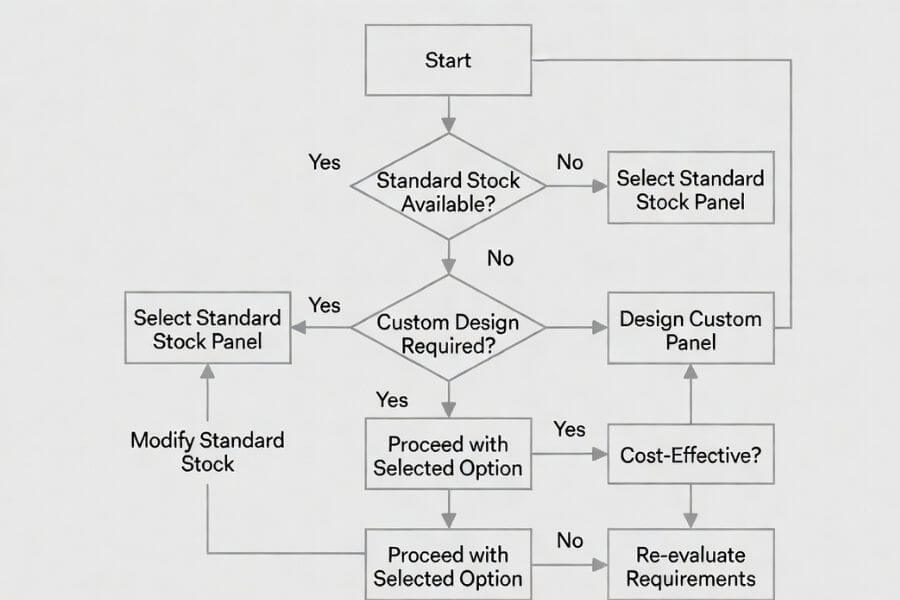
If most answers lean toward standardization, stock panels may be sufficient.
If multiple constraints are present, custom production is typically the more reliable solution.
Stock or Custom - Choosing the Right Solution for Your Project
The choice between standard stock and custom production is not a simple cost decision. It is a balance between speed, precision, and long-term performance.
Standard stock provides efficiency for straightforward applications.
Custom production enables alignment with complex architectural and engineering requirements.
For façade systems, the most effective approach is to evaluate material options within the context of the entire building system, ensuring that panel selection supports both design intent and construction performance.
By combining material expertise with engineering and manufacturing capabilities, solutions can be developed that meet both technical and architectural goals without unnecessary compromise.
FAQ
What is the main difference between standard stock and custom production in MCM?
Standard stock refers to pre-produced panels with fixed combinations of size, core, and coating. Custom production applies when any parameter changes, such as dimensions, core type, or color. In façade projects, this difference determines whether materials are readily available or must be engineered to meet specific design and performance requirements.
Does choosing a stock color mean the panel is always available?
No. A color may exist in a stock list, but it is only considered standard stock if it is available in a specific combination of thickness, core, size, and finish. If any of these variables differ from the standard configuration, the panel must be produced as a custom order.
When is custom production required for façade projects?
Custom production is typically required when projects involve non-standard panel sizes, FR core compliance, strict ΔE color control, or complex façade geometry. These conditions cannot be met using predefined stock combinations and require tailored manufacturing to ensure performance, compliance, and visual consistency.
Is custom production always more expensive than standard stock?
Not necessarily. While custom production involves higher upfront costs, it can reduce installation complexity, minimize rework, and improve long-term durability. In large-scale façade projects, these benefits often offset initial costs, resulting in better overall lifecycle value compared to standard stock solutions.
How does panel size affect the decision between stock and custom?
Panel size is a key factor. Standard stock panels are limited to predefined widths and lengths. If a façade design requires larger panels, such as widths exceeding 1500 mm, custom production becomes necessary to maintain alignment with the architectural grid and reduce excessive joint lines.
Why is early design collaboration important for custom panels?
Early collaboration allows designers and manufacturers to align panel specifications with structural, aesthetic, and fabrication requirements. This reduces design conflicts, improves material efficiency, and ensures that the final façade system can be built as intended without costly adjustments during installation.