

08 May
Understanding NFPA 285 for Aluminum Composite Panel Systems
Modern façade systems are expected to deliver far more than visual impact. Architects and developers now evaluate exterior wall materials based on fire propagation resistance, weather durability, coating stability, fabrication flexibility, and long-term code compliance.
As cities continue building taller and denser commercial structures, NFPA 285 has become one of the most influential standards shaping the specification of aluminum composite panel systems across North America. The standard plays a critical role in determining how combustible components behave within modern exterior wall assemblies during a fire event.
Global façade fires over the past two decades, including incidents in Dubai, Shanghai, and the 2017 Grenfell Tower disaster in London, accelerated industry concern surrounding combustible cladding systems. These events reshaped how architects, façade consultants, developers, and code officials evaluate exterior wall construction.
Today, fire-rated composite façade systems are no longer viewed as optional upgrades for many commercial projects. In many jurisdictions, they are a core requirement for high-rise towers, mixed-use developments, healthcare facilities, educational campuses, and hospitality projects.
Why Exterior Wall Fire Compliance Has Become Critical for Modern Façade Systems
Exterior wall design has changed dramatically since the 1980s. Modern rainscreen façades now combine multiple performance layers including insulation, air barriers, cavity systems, attachment rails, and decorative cladding panels.
This evolution improved energy efficiency and architectural flexibility, but it also introduced additional combustible materials into the building envelope.
Unlike traditional masonry construction, contemporary façade assemblies often include:
Combustible insulation
Water-resistive barriers
Ventilated cavity systems
Composite cladding materials
Polymer-based core components
As a result, façade fire behavior became significantly more complex.
Rather than evaluating individual materials in isolation, modern exterior wall fire testing was developed to assess how the entire wall assembly behaves under realistic fire conditions. This system-based approach is especially important for architects designing large-format façades where cavity geometry, attachment systems, and material combinations directly influence flame propagation behavior.
In modern commercial architecture, this is particularly relevant for:
Mixed-use towers
Hospitality developments
Airports and transit hubs
Healthcare buildings
Educational facilities
Corporate headquarters
These projects often rely on lightweight rainscreen systems that combine architectural freedom with strict performance requirements.
How the Full-Scale Façade Fire Test Works in Real Wall Assemblies
The official title of NFPA 285 is:
Standard Fire Test Method for Evaluation of Fire Propagation Characteristics of Exterior Wall Assemblies Containing Combustible Components
Although highly technical, the purpose of the test is straightforward — to determine whether fire can rapidly spread vertically or laterally through an exterior wall system.
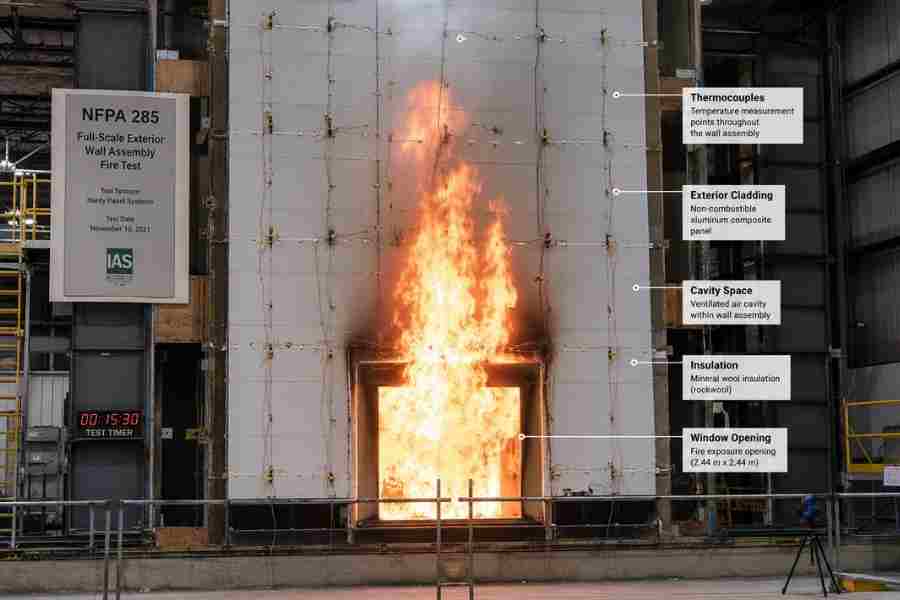
The test simulates an interior flashover fire inside a two-story test structure. Flames exit through a window opening and impinge directly onto the exterior façade assembly.
The wall system is then evaluated for:
Vertical flame propagation
Horizontal flame spread
Cavity fire development
Internal temperature rise
Fire penetration into upper floors
The standard fire exposure duration is 30 minutes.
Unlike smaller laboratory material tests, this is a full-scale assembly evaluation. The tested wall system commonly includes:
Exterior cladding panels
Insulation layers
Water-resistive barriers
Air barriers
Attachment systems
Fasteners
Subframing components
Joint configurations
This distinction is critical because fire behavior inside a ventilated rainscreen cavity is heavily influenced by system interaction rather than by a single material alone.
This is why façade consultants often emphasize a key industry principle:
There is no such thing as a certified fire-rated panel by itself. Only complete wall assemblies pass the test.
What Determines a Passing Exterior Wall Assembly
The evaluation includes strict limitations on flame propagation and temperature development throughout the wall system.
Typical acceptance requirements include:
Vertical flame spread less than 10 feet above the window opening
Lateral flame spread less than 5 feet from the window centerline
Temperatures below 1000°F at designated thermocouple locations
No flame penetration into the second-story interior room
No uncontrolled horizontal fire spread beyond the test assembly
Thermocouples positioned throughout the cavity measure heat transfer behavior during the test. These sensors help determine whether combustible components inside the assembly contribute to hidden flame spread within the façade cavity.
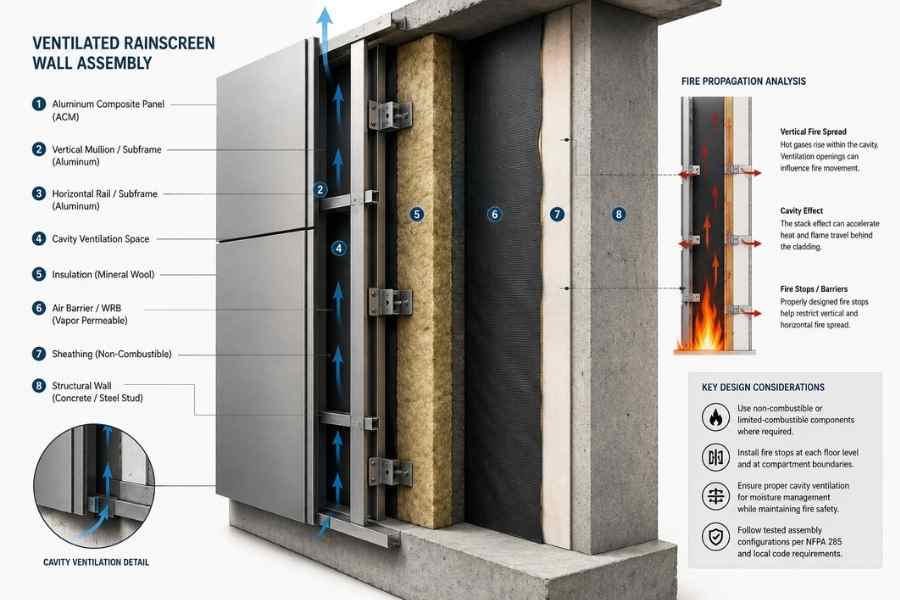
For façade engineers, cavity behavior is often as important as visible exterior flames because concealed fire propagation can rapidly compromise upper levels of the building envelope.
Joint placement also plays an important role. The 2019 edition introduced more specific joint configuration requirements because façade joints can influence flame movement and heat transfer patterns across large wall surfaces.
This is particularly relevant for contemporary architectural façades using:
Large-format composite panels
Vertical rainscreen joints
Open-joint systems
Ventilated cavity assemblies
Modular façade construction
Why Composite Façade Systems Are Evaluated as Complete Assemblies
Aluminum composite panels, also referred to as ACM or MCM products, consist of two metal skins bonded to a core material.
In traditional polyethylene-core systems, the core can become a major fuel source during a façade fire event.
Although aluminum itself is non-combustible, it is highly conductive. During a fire, heat transfers rapidly through the metal skins into the core material.
This is one reason why modern façade specifications increasingly favor FR aluminum composite panels with mineral-filled core technology.
Beyond fire performance, these composite façade systems remain highly attractive to architects because they provide:
Lightweight construction
High surface flatness
Precise panel geometry
Flexible fabrication
Large-format façade capability
Clean visual continuity across elevations
Compared with heavier solid aluminum systems, metal composite cladding simplifies transportation and installation while reducing structural dead load on the building envelope.
For large commercial projects, these characteristics support more efficient fabrication and installation sequencing while maintaining contemporary façade aesthetics.
Architects also value these systems for their ability to support:
Consistent façade rhythm
Sharp corner detailing
Integrated signage concepts
Brand-driven architectural color schemes
Complex curved or folded geometries
This combination of performance and design flexibility explains why composite rainscreen systems remain widely used despite increasingly strict façade fire regulations.
How FR Core Technology Changes Fire Behavior in Composite Cladding
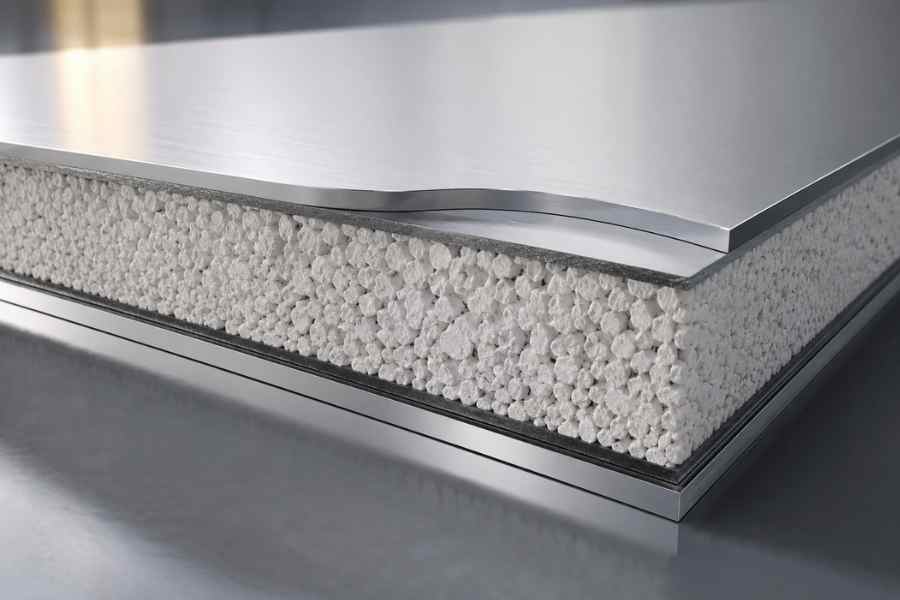
The evolution from standard PE cores to FR core ACM panels significantly changed façade fire behavior.
Modern FR cores typically contain high concentrations of mineral fillers such as:
Alumina trihydrate
Magnesium hydroxide
Other non-combustible mineral compounds
These materials improve fire performance through an endothermic reaction.
When exposed to extreme heat, the minerals absorb thermal energy and release water vapor. This process slows temperature rise within the panel and reduces the potential for sustained combustion.
The aluminum skins also contribute to delayed ignition during the early stages of fire exposure by temporarily reflecting heat away from the core.
Once the external flame source is removed, properly engineered fire-rated cladding systems can demonstrate self-extinguishing behavior due to the reduced combustible content within the core.
In practical façade applications, this improved fire behavior allows architects to continue using lightweight composite systems in projects where large continuous elevations and efficient installation remain important.
At Aluwell®, façade system development focuses not only on core formulation but also on long-term assembly performance. Coordination between core technology, coating systems, fabrication tolerances, and attachment methods is increasingly important in code-compliant façade engineering.
FR vs. A2 Composite Panels — What Architects Should Know
Not all fire-rated cladding systems perform at the same level.
Two common classifications include FR and A2 systems.
FR Core Panels
FR systems contain high mineral content while still retaining limited polymer material for fabrication flexibility and weight reduction.
These systems are commonly used in:
Commercial office towers
Mixed-use developments
Educational buildings
Hotels and hospitality projects
Retail and entertainment complexes
Most tested code-compliant façade assemblies use FR core technology.
A2 Core Panels
A2 systems contain significantly lower combustible content and provide higher levels of fire resistance.
These panels are often specified for:
Super high-rise towers
Transportation infrastructure
Healthcare facilities
Critical public buildings
Projects with elevated life-safety requirements
Although A2 systems improve fire resistance, they may also increase fabrication complexity and project cost.
The final specification is usually determined by:
Local building code
Occupancy classification
Building height
Fire consultant recommendations
Insurance requirements
Authority Having Jurisdiction (AHJ)
Understanding the Difference Between ASTM E84, ASTM E119, and Exterior Wall Fire Testing
One of the most common specification mistakes in façade projects is assuming these fire tests are interchangeable.
They are not.
Full-Scale Exterior Wall Testing
Evaluates fire propagation behavior of the complete exterior wall assembly under realistic fire conditions.
ASTM E84 / UL 723
Measures surface flame spread and smoke development on individual materials inside a controlled tunnel environment.
This test does not evaluate cavity fire propagation or multi-story façade behavior.
ASTM E119
Measures fire-resistance ratings for wall assemblies, focusing on structural integrity and heat transmission over time.
A wall assembly may achieve a 2-hour fire-resistance rating under ASTM E119 while still failing façade fire propagation evaluation due to cavity flame spread.
For architects and façade consultants, understanding these distinctions is essential during specification development.
The confusion often occurs during early-stage material review when individual product performance is mistaken for complete wall system performance.
When Exterior Wall Assemblies Require Fire Propagation Testing
Under the International Building Code (IBC), exterior wall fire testing is commonly triggered when combustible materials are used within wall assemblies on Type I, II, III, or IV buildings.
Typical triggers include:
Buildings exceeding 40 feet in height
Metal composite material systems
Combustible water-resistive barriers
Foam plastic insulation
Certain high-pressure laminate systems
Requirements may vary depending on:
Fire separation distance
Building occupancy
Sprinkler protection
Local code amendments
AHJ interpretation
This is one reason why façade compliance planning should begin early during schematic design rather than after material selection.
Acceptance of Engineering Judgements (EJs) also varies significantly between jurisdictions. Some AHJs accept limited substitutions within tested assemblies, while others require strict compliance with the original tested configuration.
Early coordination between architects, façade consultants, fire engineers, contractors, and manufacturers often helps reduce specification conflicts later in construction.
Why Wall System Coordination Matters in Composite Cladding Projects
In real-world façade construction, the greatest compliance challenges often occur during coordination rather than specification.
Even small substitutions may affect assembly performance, including:
Insulation density changes
Alternate WRB products
Different cavity depths
Modified joint spacing
Attachment system revisions
This becomes especially important on large-scale projects where multiple trades influence façade installation sequencing.
For this reason, many architects and contractors prefer manufacturers capable of supporting broader system coordination rather than supplying panels alone.
At Aluwell®, collaborative design support helps bridge the gap between architectural intent, fabrication practicality, and code-compliant façade construction.

The company’s experience in composite panel manufacturing, CNC processing, and modularized assembly support allows project teams to coordinate:
Panel fabrication requirements
Installation tolerances
Attachment configurations
Façade detailing
System integration workflows
For large commercial façades, this type of coordination can improve installation efficiency while reducing project delays and specification conflicts.
In projects involving customized façade geometry or modularized panel systems, early fabrication coordination often becomes just as important as the material specification itself.
How Architects Verify Code-Compliant Wall Assemblies
As the 2019 edition introduced more rigorous testing requirements, the façade industry increasingly shifted toward verified system documentation.
Architects and contractors commonly rely on:
UL FWFO-listed assemblies
ICC-ES evaluation reports
Manufacturer testing documentation
Third-party engineering analysis
However, reliance on generalized Engineering Judgements remains debated within the façade industry.
A tested assembly provides the highest level of confidence because real fire behavior inside façade cavities can be difficult to predict through theoretical analysis alone.
This is particularly important for:
High-rise façades
Ventilated rainscreen systems
Large cavity configurations
Complex attachment systems
Modular façade construction
As façade systems become more sophisticated, architects increasingly prioritize manufacturers capable of supporting both technical documentation and practical project coordination throughout the specification process.
Long-term façade performance also extends beyond fire testing alone. In exterior applications, PVDF coating systems remain equally important.
High-performance PVDF coatings help composite façade panels maintain color consistency, UV resistance, and surface stability under prolonged environmental exposure. This becomes especially important for large commercial elevations where visual consistency directly affects architectural quality and brand presentation.
FAQ
Can a Class A cladding material still fail a full-scale façade fire test?
Yes. ASTM E84 evaluates surface flame spread on individual materials, while full-scale exterior wall testing evaluates fire propagation across the entire assembly. A Class A material may still contribute to cavity flame spread within a multi-layer façade system under real fire conditions.
Why are FR core panels commonly used in high-rise façades?
FR aluminum composite panels contain mineral-filled cores that reduce combustible content and slow heat transfer. This helps improve façade fire performance while maintaining lightweight fabrication advantages, making them widely used in commercial towers, hospitality buildings, and large mixed-use developments.
What is the difference between FR core and A2 core systems?
FR systems contain mineral-filled cores with limited polymer content for fabrication flexibility. A2 systems contain significantly lower combustible material and provide higher fire resistance levels. The final specification usually depends on building height, occupancy classification, and local code requirements.
Can components inside a tested wall assembly be substituted?
In most cases, substitutions should not be made without technical review. Even small changes involving insulation type, cavity depth, or attachment systems may alter fire behavior. Some jurisdictions accept Engineering Judgements, while others require strict compliance with tested assembly configurations.
Where can architects verify compliant exterior wall assemblies?
Architects commonly reference UL FWFO-listed assemblies, ICC-ES evaluation reports, and manufacturer testing documentation. These resources help project teams identify tested wall systems that comply with exterior wall fire propagation requirements under specific installation conditions.
Final Thoughts on Modern Fire-Rated Façade Systems
As exterior wall systems continue evolving, NFPA 285 remains a central part of modern façade engineering and code compliance.
For architects, contractors, and developers, the standard is not simply about selecting a fire-rated panel. It is about understanding how the entire wall assembly behaves during a real fire event.
Modern aluminum composite panel systems continue to play a major role in commercial architecture because they provide a practical balance between:
Fire performance
Lightweight construction
Fabrication efficiency
Long-term durability
Architectural flexibility
When combined with properly engineered FR core technology and tested wall assemblies, composite façade systems remain one of the most effective solutions for contemporary commercial construction.
As façade regulations continue to evolve, manufacturers capable of supporting system coordination, technical integration, and verified assembly compatibility will become increasingly valuable partners throughout the specification process.