
12 Jun
What Causes Oil Canning in ACM Panels and How Can It Be Reduced?
Oil canning is one of the most common appearance concerns in aluminum composite panel façades. It appears as visible waviness, ripples, or surface distortion on otherwise flat panel surfaces. While many building owners initially assume oil canning indicates a product defect, the reality is more complex.
In most cases, oil canning is not caused by a single manufacturing issue. It is typically the result of multiple factors including panel design, fabrication methods, support structure alignment, thermal movement, panel dimensions, and installation practices. Understanding these factors can help architects, façade consultants, contractors, and project teams reduce risk and achieve better visual results.
What Is Oil Canning in ACM Panels?
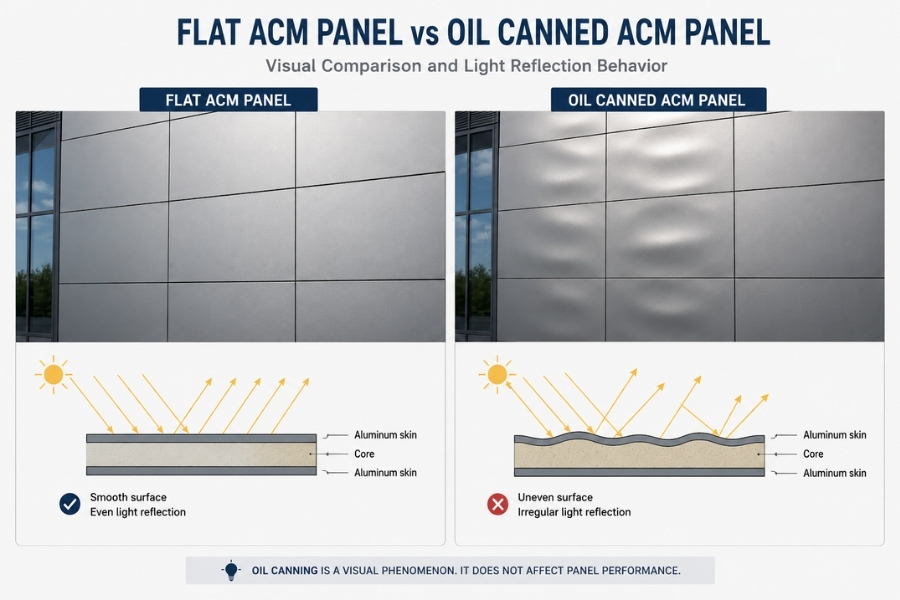
Oil canning refers to visible waviness or distortion that develops on flat metal surfaces. In ACM façade systems, the phenomenon becomes noticeable when light reflects unevenly across the aluminum face sheets.
The effect may appear as:
Surface ripples
Slight panel waviness
Visual distortion
Uneven reflections
Shadow lines across flat surfaces
Oil canning can occur in many architectural cladding materials, including aluminum, steel, zinc, copper, metal composite material (MCM), and aluminum composite panel systems.
Most importantly, oil canning is generally considered a visual phenomenon rather than a structural failure.
Does Oil Canning Mean an ACM Panel Is Defective?
Not necessarily.
One of the most common misconceptions in façade construction is that oil canning automatically indicates poor product quality. In reality, an ACM panel may fully comply with manufacturing tolerances and project specifications while still exhibiting some degree of visible waviness.
Industry quality inspections typically focus on measurable criteria such as:
Panel thickness
Panel dimensions
Edge straightness
Surface finish quality
Bond integrity
Coating performance
Flatness tolerances
A panel that meets these requirements may still display oil canning under certain lighting and viewing conditions.
For this reason, many industry organizations classify oil canning as an inherent characteristic of flat metal-faced architectural panels rather than a manufacturing defect.
Why Oil Canning Occurs in ACM Façade Systems
Oil canning rarely has a single cause. Most cases result from multiple factors acting together throughout manufacturing, fabrication, transportation, and installation.
Residual Stress in Aluminum Coil Production
The aluminum skins used in ACM production originate from rolled aluminum coils.
During rolling, leveling, slitting, and recoiling operations, small residual stresses can remain within the metal. These stresses are often invisible during manufacturing but may become more noticeable after fabrication and installation.
Large flat architectural cladding panels can amplify the visual effect of these internal stresses.
Stress Introduced During Routing and Folding
Many ACM façade systems use routed-and-returned cassette construction.
Routing removes material from the back of the panel to allow folding and edge formation. If routing depth varies or folding accuracy is inconsistent, stress concentrations may develop within the finished panel.
Over time, these stresses can contribute to visible surface distortion.
Thermal Expansion and Contraction
Aluminum naturally expands and contracts as temperatures change.
Exterior ACM façade systems may experience significant temperature variation between daytime and nighttime conditions. Dark-colored panels can experience even greater surface temperatures.
If movement is restricted by fasteners, support systems, or insufficient expansion allowances, internal stress can accumulate and increase the likelihood of oil canning.
Uneven Support Structures
A façade panel can only be as flat as the structure supporting it.
Misaligned support rails, improperly positioned brackets, twisted framing members, or out-of-plane substructures can force panels into stressed positions.
Even minor deviations in the support system may become visible across large panel surfaces.
Installation-Induced Stress
Installation practices have a direct impact on final appearance.
Common installation issues include:
Over-tightened fasteners
Uneven fixing sequences
Forced panel alignment
Improper cassette attachment
Inconsistent support conditions
These conditions may introduce localized stress that becomes visible once the façade is exposed to changing environmental conditions.
Why Large ACM Panels Are More Susceptible to Oil Canning
Panel size is one of the most important variables affecting oil canning visibility.
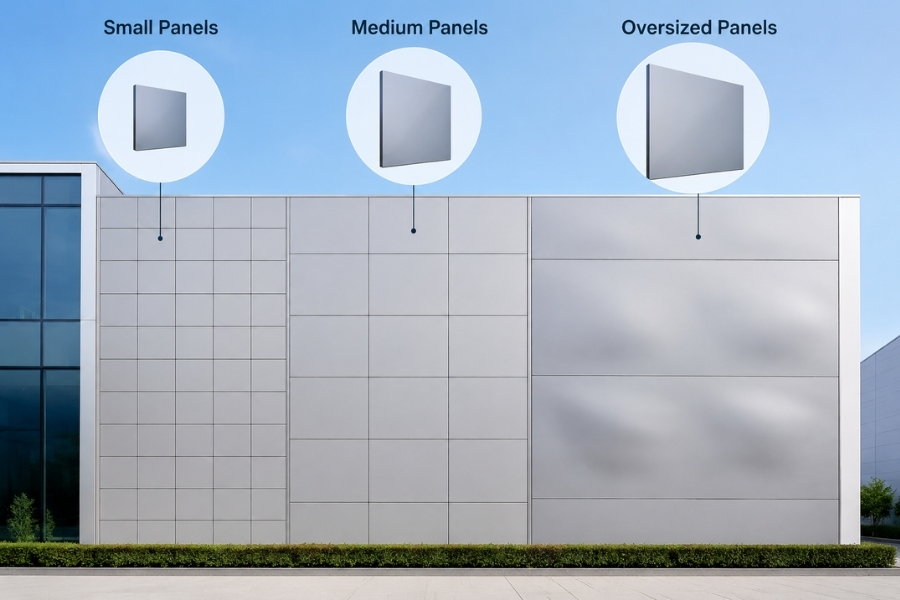
Modern architecture increasingly favors large-format aluminum façade panels to create clean and uninterrupted building elevations. However, larger panels also create larger reflective surfaces.
As panel dimensions increase:
Surface stiffness decreases
Unsupported areas increase
Thermal movement becomes more significant
Reflections become more continuous
Small distortions become easier to detect
Common ACM panel widths include approximately 1220 mm, 1250 mm, and 1500 mm. Panel lengths may exceed 3000 mm or even 5000 mm depending on project requirements.
The larger the panel, the more critical proper fabrication, support design, and installation become.
| Panel Size | Relative Oil Canning Risk |
|---|---|
| Small Modules | Low |
| Medium Modules | Moderate |
| Large Format Panels | Higher |
| Oversized Architectural Panels | Highest |
This does not mean large panels should be avoided. It simply means they require greater engineering attention during design and installation.
Why Oil Canning Is More Visible on Certain Buildings
Two projects using identical ACM panels may display different levels of visible oil canning.
In many cases, perception is influenced by architectural and environmental conditions.
Dark Colors
Dark finishes absorb more solar heat and create stronger visual contrast.
This makes surface irregularities easier to detect.
Metallic Finishes
Metallic coatings reflect light differently than solid colors.
The reflective particles within the finish often increase the visibility of subtle surface variations.
Glossy PVDF Coatings
High-gloss PVDF coating systems produce sharper reflections than matte finishes.
While these finishes are popular for premium architectural applications, they may also reveal oil canning more readily.
Low-Angle Sunlight
Early morning and late afternoon sunlight frequently highlight surface irregularities.
A façade that appears perfectly flat at midday may reveal oil canning when viewed under low-angle lighting conditions.
Long Viewing Distances
Large commercial buildings, airports, shopping centers, and office towers often feature expansive wall surfaces.
Long uninterrupted elevations make subtle panel distortions easier to identify.
How Panel Design Influences Oil Canning Risk
Many oil canning issues can be reduced during the design phase before fabrication begins.
Panel Thickness Selection
Panel stiffness increases as thickness increases.
| ACM Configuration | Relative Oil Canning Risk |
|---|---|
| 3 mm ACM | Higher |
| 4 mm ACM | Moderate |
| 6 mm ACM | Lower |
For many exterior rainscreen panel systems, 4 mm ACM remains the most common specification. Larger panels may benefit from increased thickness or additional reinforcement.
Joint Layout and Module Design
Proper joint placement can break up large reflective surfaces and reduce the visual impact of oil canning.
Well-designed module layouts often improve both appearance and installation efficiency.
Cassette Fabrication Quality
Accurate routing, folding, and cassette assembly help distribute loads more evenly across the panel surface.
Poor fabrication practices can introduce unnecessary stress before the panel even reaches the jobsite.
Manufacturing Factors That Influence Panel Flatness
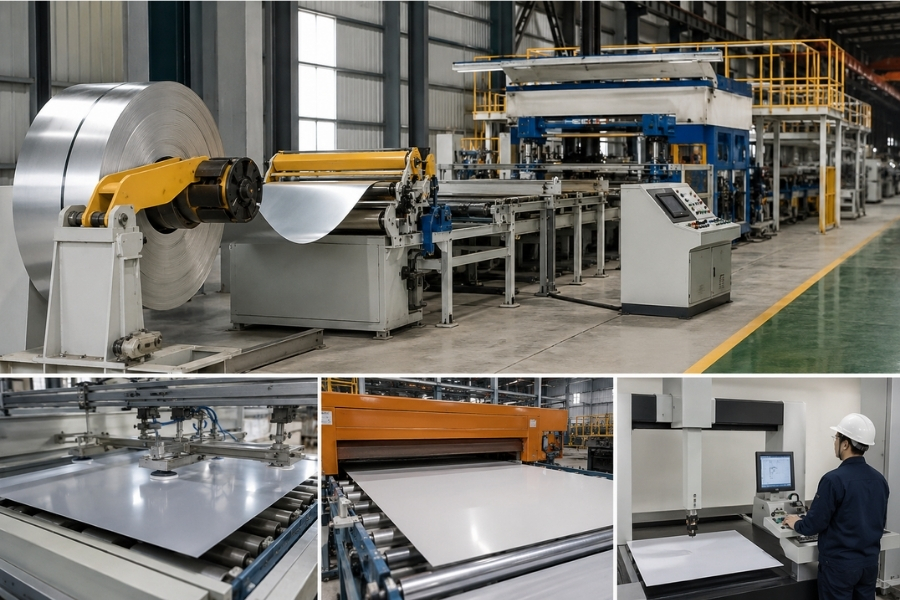
From a manufacturer's perspective, panel flatness begins long before installation.
Several production variables influence the visual performance of finished ACM panels.
Coil Leveling Quality
Proper leveling helps reduce residual stress within aluminum coils before lamination.
Lamination Consistency
Uniform bonding between aluminum skins and the core material helps maintain dimensional stability.
Fabrication Accuracy
Precise routing and folding operations reduce the introduction of unnecessary stress.
Quality Inspection Procedures
Manufacturers commonly inspect:
Panel dimensions
Surface quality
Flatness characteristics
Edge straightness
Coating appearance
Consistent production controls help improve overall panel uniformity across large façade projects.
Installation Factors That Commonly Trigger Oil Canning
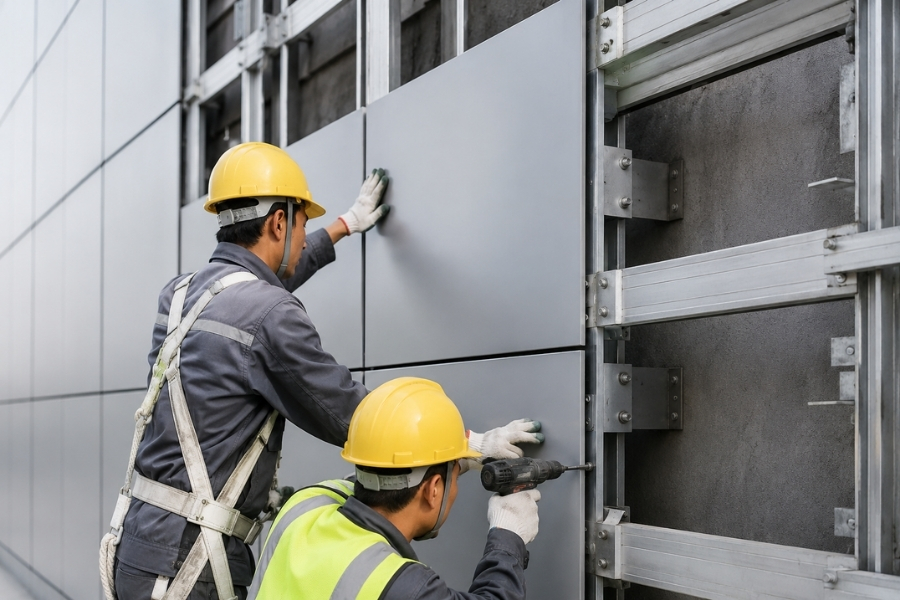
Many oil canning complaints originate from installation conditions rather than panel manufacturing.
Subframe Alignment Issues
Support structures should be inspected before panel installation begins.
Out-of-plane framing can transfer distortion directly to the façade surface.
Improper Fastener Tightening
Fasteners should secure panels without restricting intended movement.
Excessive tightening can create localized stress points.
Insufficient Expansion Allowance
Expansion joints and movement clearances are essential in ventilated façade systems and rainscreen panel assemblies.
Ignoring thermal movement requirements can increase the risk of visible distortion.
Inconsistent Joint Gaps
Uneven joints may create visual inconsistencies and indicate installation inaccuracies.
Consistent spacing improves both aesthetics and system performance.
Practical Strategies to Reduce Oil Canning in ACM Projects
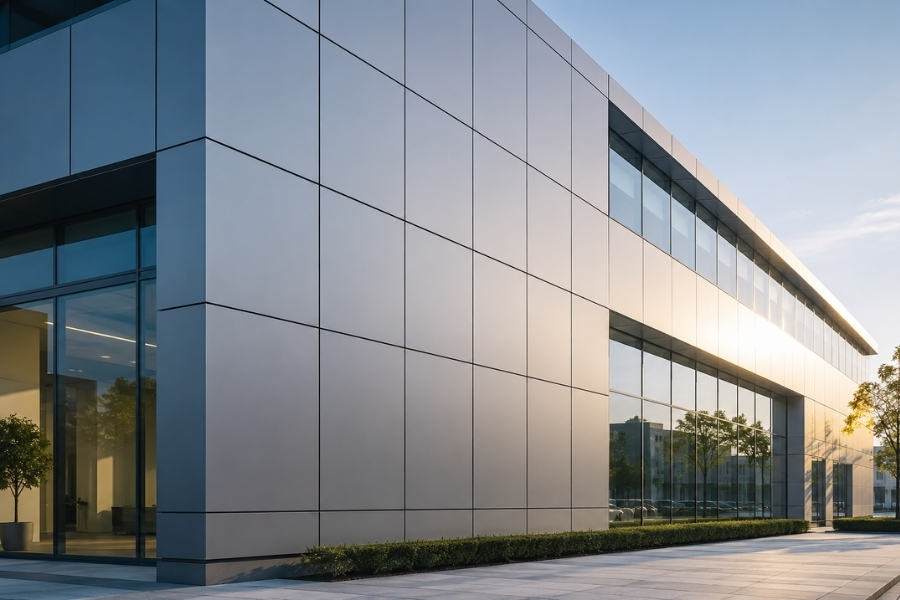
While oil canning cannot always be completely eliminated, several measures can significantly reduce its visibility.
During Design
Avoid unnecessarily oversized panels
Select appropriate panel thickness
Consider lighting conditions
Optimize panel module layouts
During Manufacturing
Maintain accurate coil leveling
Control lamination consistency
Verify fabrication tolerances
Conduct flatness inspections
During Installation
Ensure subframe alignment
Allow for thermal movement
Avoid over-tightening fasteners
Maintain consistent joint spacing
During Material Selection
Evaluate finish reflectivity
Consider matte finishes when appearance is critical
Select suitable ACM or MCM configurations
Review project-specific environmental conditions
Project Example – Oil Canning on a Commercial Office Façade
A commercial office project utilized metallic silver ACM façade panels measuring approximately 1500 mm wide and 3200 mm high.
Following installation, visible waviness appeared on portions of the south-facing elevation during afternoon sunlight.
A project review identified several contributing factors:
Large-format panel dimensions
High-reflectivity metallic finish
Minor subframe alignment deviations
Limited movement accommodation in several panel zones
The panels remained structurally sound and compliant with project requirements.
For future phases, the design team reduced panel widths, tightened subframe tolerances, and enhanced installation quality control procedures. These modifications significantly improved visual consistency across the remaining elevations.
Conclusion
Oil canning in ACM panels is typically the result of multiple interacting factors rather than a single manufacturing defect. Material stress, panel dimensions, fabrication methods, support structure alignment, thermal movement, finish selection, and installation practices can all influence the final appearance of an ACM façade system.
For architects, contractors, developers, and façade consultants, the most effective strategy is to address oil canning risk early in the project lifecycle. Careful panel sizing, precise fabrication, properly aligned support structures, and appropriate installation methods can significantly improve visual consistency and help deliver a high-quality architectural façade.
As an ACM manufacturer serving commercial, institutional, and architectural cladding projects worldwide, Aluwell® works closely with architects, façade consultants, fabricators, and contractors to help optimize panel specifications, fabrication details, and installation performance. Through consistent production quality, precise panel processing, and project-specific engineering support, Aluwell® helps reduce appearance-related risks and supports the long-term visual performance of ACM façade systems.
FAQ
Is oil canning acceptable in ACM panels?
In many architectural projects, a certain degree of oil canning is considered acceptable because it is an inherent characteristic of flat metal-faced panels. Acceptance criteria often depend on project specifications, viewing conditions, and owner expectations.
Can oil canning be completely eliminated?
Not always. Proper engineering, fabrication, and installation can significantly reduce oil canning, but complete elimination cannot always be guaranteed.
Does ACM panel thickness affect oil canning?
Yes. Thicker panels generally provide greater stiffness and may reduce the visibility of surface waviness.
Can oil canning be repaired after installation?
Minor improvements may be possible in some situations, but correcting oil canning after installation is often more difficult than preventing it during design and construction.
Are dark ACM panels more likely to show oil canning?
Dark-colored panels do not necessarily experience more oil canning, but they often make the phenomenon easier to see because of increased visual contrast and heat absorption.
Does PVDF coating cause oil canning?
No. PVDF coatings do not cause oil canning. However, certain gloss levels and reflective finishes may make surface distortions more noticeable.