

01 Jun
Why ACM Panels Are Widely Used in Modern Rainscreen Systems
Modern building envelopes must withstand rain, wind, UV exposure, thermal movement, and moisture accumulation over decades of service. Traditional face-sealed façades attempt to stop water entirely at the exterior surface. Modern rainscreen systems follow a different engineering approach by managing water, air pressure, and moisture within the wall assembly.
This shift in façade design philosophy is one of the main reasons aluminum composite panels have become widely used in rainscreen applications. When properly designed, an ACM rainscreen system can improve durability, reduce maintenance requirements, and support long-term building envelope performance.
Why Modern Façades No Longer Depend Solely on Face-Sealed Systems
Traditional cladding systems often rely heavily on sealants and exterior joints to prevent water penetration.
While this approach can perform well initially, no sealant lasts forever. Exposure to UV radiation, temperature fluctuations, building movement, and weathering gradually reduces sealing effectiveness.
Once water bypasses the exterior seal, moisture can become trapped within the wall assembly, increasing the risk of corrosion, insulation degradation, and long-term maintenance costs.
Modern rainscreen design addresses this challenge differently. Rather than relying on a single waterproof layer, it uses multiple layers of protection to control water movement and reduce moisture-related risks.
The Core Engineering Principle Behind a Rainscreen System
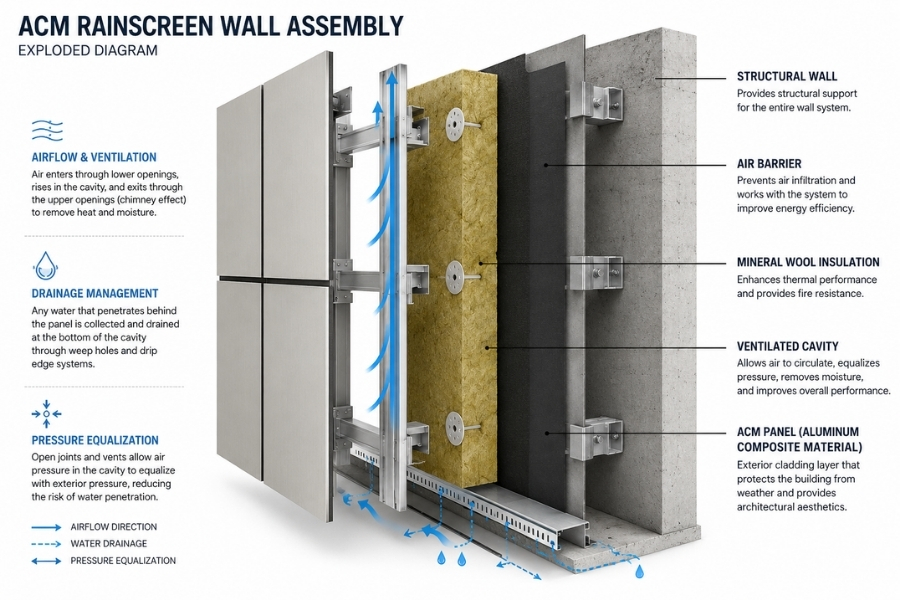
A rainscreen system is designed around the concept of moisture management rather than complete water exclusion.
Most rainscreen assemblies consist of three primary layers:
Outer cladding layer
Ventilated cavity
Inner wall assembly
Each component performs a specific role within the building envelope.
The Outer Cladding Layer
The outer ACM panel acts as the first line of defense against weather exposure.
Its primary functions include:
Shedding rainwater
Protecting against UV exposure
Resisting wind-driven weather
Protecting underlying building components
Providing architectural appearance
Although the panel blocks most environmental exposure, it is not intended to function as the sole waterproofing layer.
The Ventilated Cavity
The cavity between the ACM panel and the backup wall is what transforms conventional cladding into a true rainscreen system.
The cavity supports:
Pressure equalization
Drainage
Moisture evaporation
Thermal moderation
Without this air space, the wall assembly loses many of the performance advantages associated with rainscreen design.
The Inner Wall Assembly
The inner wall assembly serves as the building's primary protective barrier.
Depending on the project, it may function as:
Air barrier
Water barrier
Thermal barrier
Structural support system
Together, the outer ACM skin and the inner wall assembly create a layered defense against environmental exposure.
How Pressure Equalization Reduces Water Penetration
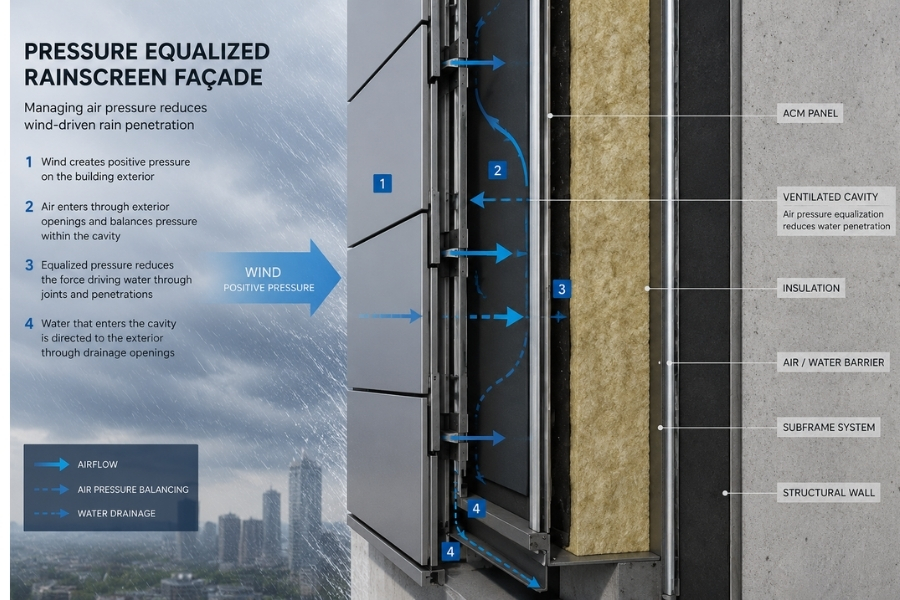
One of the most important but least understood principles in rainscreen engineering is pressure equalization.
Water does not enter façades solely because of gravity. Wind pressure often drives moisture through joints, openings, and façade interfaces.
When exterior pressure is significantly higher than cavity pressure, water can be forced through small gaps within the cladding system.
A properly designed pressure-equalized rainscreen minimizes this pressure difference.
By allowing exterior air to enter the cavity through controlled openings, cavity pressure gradually approaches exterior pressure. As the pressure differential decreases, the force pushing water into the wall assembly is dramatically reduced.
This principle is especially valuable for high-rise buildings and projects exposed to severe wind-driven rain conditions.
Why the Ventilated Air Cavity Is the Most Important Component
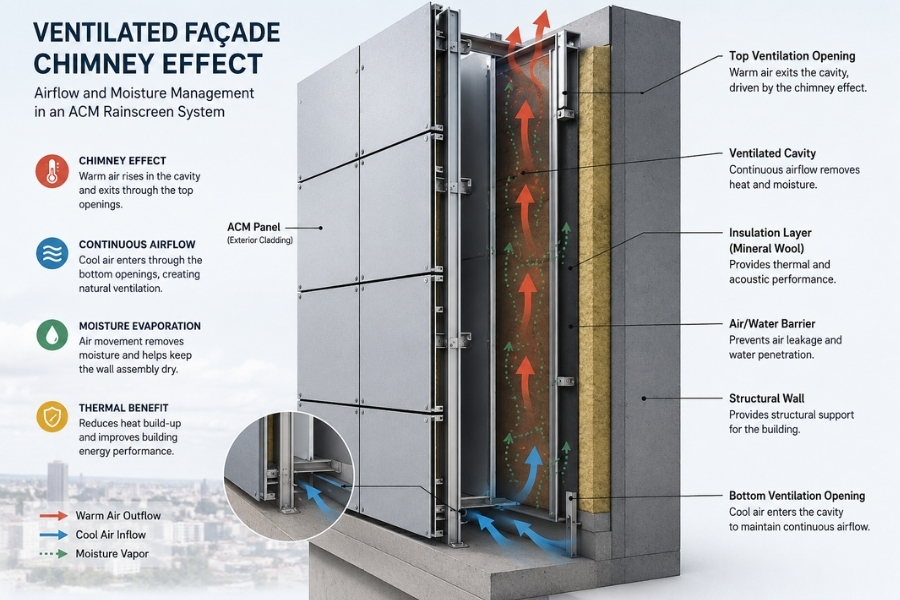
Many discussions focus on panel materials, yet the ventilated cavity often contributes more to long-term façade performance than the cladding itself.
The cavity performs several critical functions simultaneously.
Drainage Function
Even the best-designed façade can experience limited water penetration during extreme weather events.
The cavity provides a controlled drainage path that allows water to exit the wall assembly before it reaches sensitive building components.
Moisture Evaporation
Small amounts of moisture vapor can migrate through building assemblies over time.
Ventilation within the cavity helps remove this moisture before it accumulates and causes deterioration.
Chimney Effect
The cavity naturally supports airflow through what is commonly known as the chimney effect.
During warm weather, air within the cavity heats up and rises. Cooler air enters from lower openings, creating continuous airflow.
This natural ventilation helps remove heat and moisture while improving overall façade performance.
Condensation Control
Condensation can develop when warm humid air contacts cooler surfaces within the wall assembly.
A ventilated cavity helps reduce moisture accumulation and lowers the risk of:
Mold growth
Corrosion
Material degradation
Reduced insulation performance
For this reason, cavity design is often considered one of the most important aspects of rainscreen engineering.
How ACM Panels Support Rainscreen Performance
Aluminum composite panels have become one of the most widely specified rainscreen materials because they combine performance, fabrication flexibility, and aesthetic versatility.
Lightweight Construction
Compared with many traditional façade materials, ACM panels offer a favorable strength-to-weight ratio.
Lower panel weight can reduce structural demand while simplifying transportation and installation.
Fabrication Flexibility
Modern architectural projects frequently incorporate:
Curved surfaces
Folded geometries
Large-format panels
Custom façade details
ACM panels can be routed, folded, and fabricated into complex shapes while maintaining visual consistency across the façade.
Durability in Exterior Exposure
When combined with high-performance coating systems such as PVDF finishes, ACM panels provide excellent resistance to:
UV exposure
Rainfall
Wind
Temperature fluctuations
Atmospheric pollutants
Compatibility With Modern Attachment Systems
ACM panels can be integrated into a variety of rainscreen support systems, including aluminum rail systems, bracket-supported assemblies, and pressure-equalized façade systems.
This flexibility makes them suitable for commercial, institutional, transportation, and high-rise projects.
ACM Rainscreen Systems vs Face-Sealed Façades
The difference between these two façade approaches is often misunderstood.
| Performance Factor | ACM Rainscreen System | Face-Sealed Façade |
|---|---|---|
| Water Management | Drainage based | Sealant dependent |
| Moisture Control | Excellent | Limited |
| Pressure Equalization | Yes | No |
| Maintenance Demand | Lower | Higher |
| Thermal Performance | Better | Moderate |
| Long-Term Durability | Higher | Joint dependent |
| Risk of Hidden Moisture | Lower | Higher |
This comparison helps explain why rainscreen systems are increasingly preferred for modern building envelopes.
Common Design Mistakes in ACM Rainscreen Projects
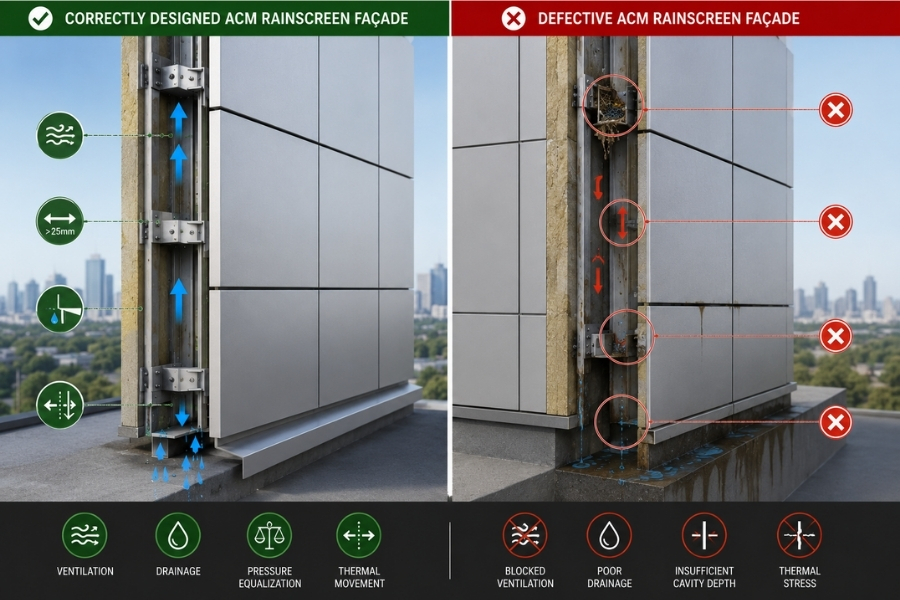
Many façade failures are caused by detailing issues rather than panel defects.
Insufficient Cavity Depth
A shallow cavity can restrict airflow and reduce drainage efficiency, limiting the effectiveness of pressure equalization.
Blocked Ventilation Openings
Improper flashing details, debris accumulation, or poorly designed insect screens can restrict airflow and reduce system performance.
Poor Drainage Design
Water entering the cavity must have a clear path to exit. Inadequate drainage details can lead to moisture accumulation behind the façade.
Ignoring Thermal Expansion
Aluminum expands and contracts as temperatures change.
Failure to incorporate movement joints and expansion allowances can create visible distortion and stress within the façade system.
Incorrect Fire Barrier Placement
Cavity barriers must balance fire safety requirements with ventilation performance. Improper placement can negatively affect both.
Fire Performance Must Be Evaluated as a Complete System
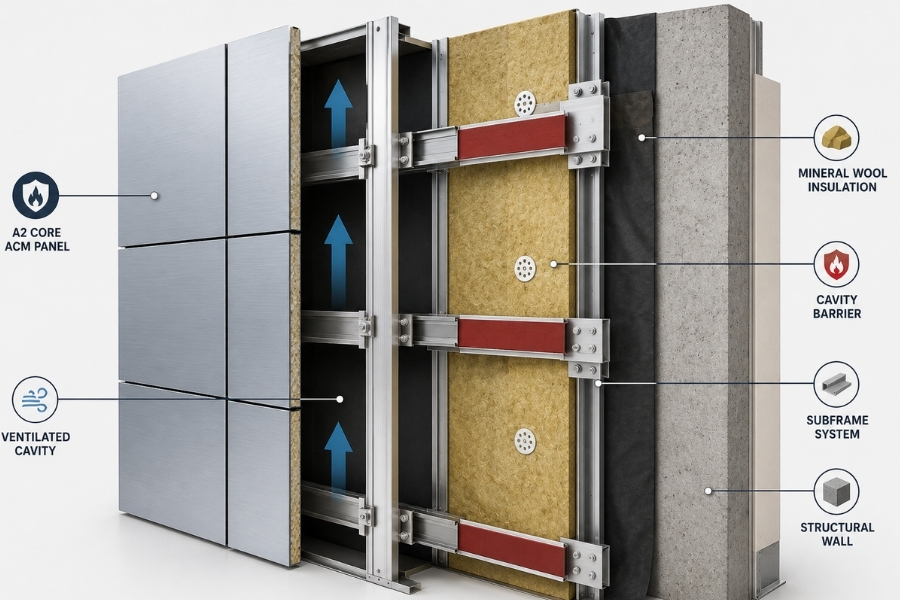
One of the most common specification mistakes is evaluating only the ACM panel itself.
Fire performance should always be assessed at the system level.
A complete rainscreen assembly includes:
ACM panels
Insulation
Subframe components
Cavity barriers
Air and water barriers
Attachment systems
The interaction between these elements determines overall fire behavior.
Depending on project requirements, design teams may evaluate compliance using standards such as:
EN 13501
ASTM E84
NFPA 285
Material selection should always align with building height, occupancy type, project location, and applicable code requirements.
What Architects and Contractors Should Evaluate Before Specifying an ACM Rainscreen System
Successful rainscreen performance depends on more than panel appearance.
Project teams should evaluate:
Panel Configuration
Panel thickness
Core type
Fire classification
Surface finish
Coating System
PVDF performance
UV resistance
Color retention
Weather durability
Insulation Strategy
Many ACM rainscreen systems utilize mineral wool insulation due to its non-combustibility, thermal performance, and moisture resistance.
Subframe Design
Support systems should address:
Structural loading
Thermal movement
Corrosion resistance
Installation tolerances
Manufacturing Capability
The selected supplier should demonstrate:
Fabrication accuracy
Panel flatness control
Quality assurance procedures
Project engineering support
Conclusion
The effectiveness of an ACM rainscreen system is not based solely on the exterior panel. Its performance depends on the interaction between the cladding, ventilated cavity, insulation, air barrier, and structural wall assembly.
By combining pressure equalization, drainage, ventilation, and durable exterior protection, rainscreen systems provide a practical solution for managing moisture and improving long-term building envelope performance.
For architects, façade consultants, contractors, and developers, understanding these engineering principles is essential when designing durable and code-compliant exterior wall systems.
Aluwell® provides FR and A2 aluminum composite panel solutions engineered for modern rainscreen applications, helping project teams balance aesthetics, weather resistance, durability, and regulatory compliance across a wide range of façade projects.
FAQ
What is the difference between an ACM rainscreen and a curtain wall?
An ACM rainscreen is installed over a structural backup wall and manages water through drainage and ventilation. A curtain wall forms the primary exterior envelope and typically functions as a sealed façade system.
How much cavity depth is required for a rainscreen system?
Required cavity depth depends on project conditions, building height, and ventilation strategy. Many systems utilize cavity depths ranging from approximately 20 mm to 50 mm or greater.
Can ACM rainscreen systems improve energy efficiency?
Yes. When combined with continuous insulation and proper cavity design, ACM rainscreen systems can reduce thermal bridging and improve overall building energy performance.
Why is pressure equalization important in rainscreen design?
Pressure equalization reduces the pressure differential across the exterior cladding. This minimizes the force that drives water through façade joints during wind-driven rain events.