

22 May
Why Aluminum Cladding Systems Continue to Dominate Modern Architectural Projects
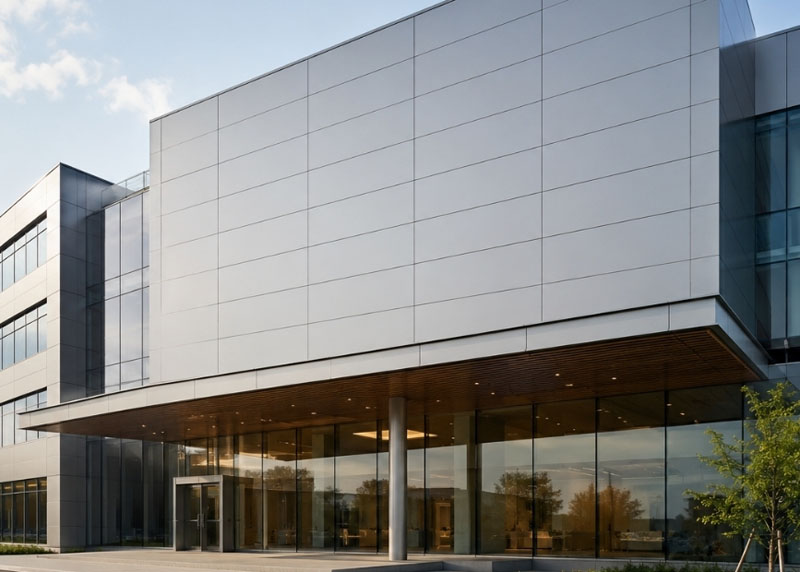
Modern façade systems are expected to do far more than create visual impact. Architects, façade consultants, and developers now evaluate exterior materials based on lifecycle durability, installation coordination, thermal movement behavior, maintenance accessibility, and long-term envelope reliability.
This shift has significantly changed how aluminum cladding is specified in contemporary construction.
In many commercial and institutional projects, aluminum cladding is no longer selected simply because it looks modern. It is increasingly chosen because it supports the technical and operational demands of large-scale façade systems while maintaining architectural flexibility across complex building envelopes.
For high-rise towers, transportation infrastructure, educational facilities, healthcare buildings, and mixed-use developments, aluminum cladding systems have become closely associated with modern rainscreen engineering and long-term façade performance.
Why Modern Façade Design Prioritizes System Performance Instead of Material Appearance Alone
Modern façade engineering focuses on how the entire exterior assembly performs over decades of environmental exposure.
A façade system may need to manage:
thermal expansion and contraction
moisture drainage
wind-load resistance
installation tolerances
coating weatherability
fire compliance
maintenance access
structural movement
long-term visual consistency
Because of this, façade materials are increasingly evaluated as part of a complete building envelope system rather than as standalone decorative finishes.
This is one reason aluminum cladding systems continue to gain specification preference across contemporary architectural projects.
Compared with heavier façade materials, aluminum panels can support lightweight construction strategies while remaining compatible with ventilated rainscreen assemblies, prefabricated installation methods, and large-format panel layouts.
The result is a façade system that balances engineering practicality with architectural control.
Why Lightweight Façade Systems Improve High-Rise Construction Efficiency
Façade weight has a direct impact on structural loading, transportation logistics, installation sequencing, and long-term building performance.
Compared with precast concrete, natural stone, or steel-based façade systems, aluminum cladding assemblies typically place lower dead loads on the primary structure. This becomes particularly important in high-rise projects where cumulative façade weight may significantly affect structural engineering requirements.
Reduced façade weight may improve:
anchor load management
transportation efficiency
lifting coordination
crane utilization
installation safety
installation speed
secondary support structure demands
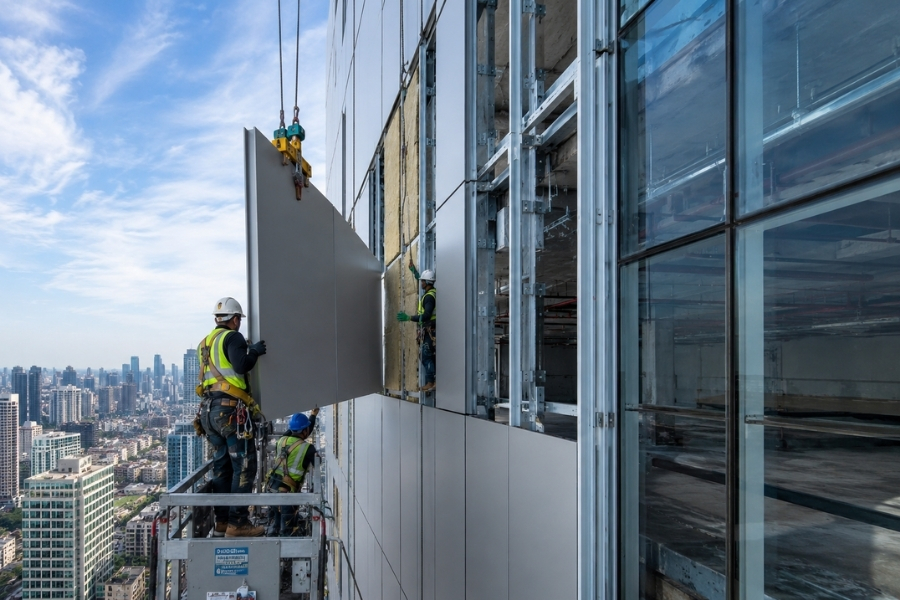
For retrofit projects, lightweight aluminum cladding systems can also reduce structural reinforcement requirements compared with heavier exterior replacement materials.
This does not mean aluminum panels lack rigidity.
Modern façade systems frequently integrate stiffeners, reinforced folds, carrier rails, and engineered support brackets to maintain panel stability under wind pressure and thermal movement conditions.
Large-format aluminum façade panels may appear visually flat during fabrication, but insufficient support spacing or improper fixing strategies can increase the risk of oil-canning after installation. This is one reason façade engineers closely evaluate panel dimensions, support geometry, and fixing flexibility during system design.
In practice, aluminum cladding performs best when lightweight construction is balanced with movement accommodation and controlled fabrication tolerances.
Why Fabrication Precision Matters in Architectural Cladding Systems
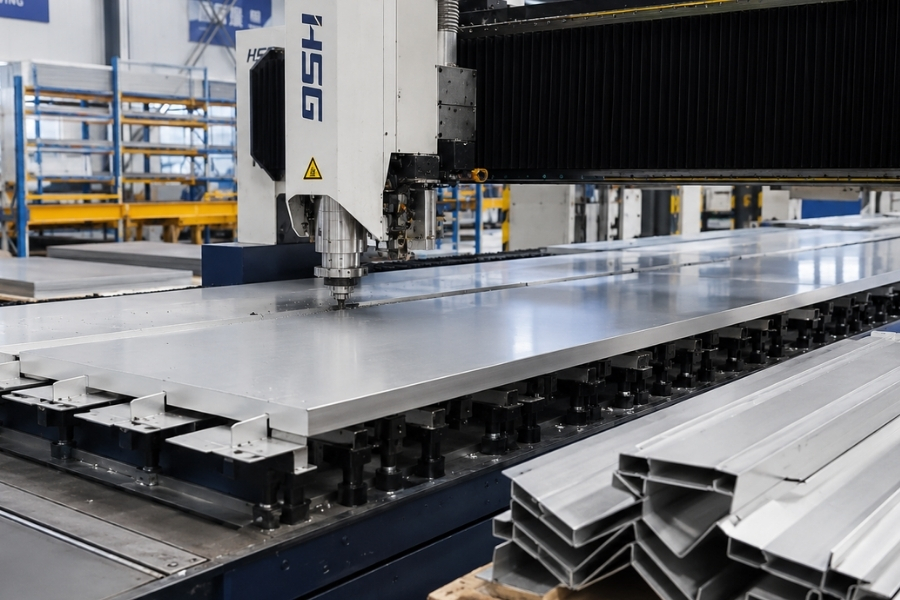
Contemporary architecture increasingly relies on large panel modules, folded geometry, perforated screens, and custom façade transitions that require precise fabrication consistency.
Aluminum cladding systems support these design requirements because the material can be routed, folded, perforated, curved, and CNC-machined with relatively high dimensional control.
This fabrication flexibility allows architects to achieve:
sharp edge detailing
continuous façade rhythm
custom perforation patterns
curved façade geometry
integrated ventilation designs
folded corner systems
large-format visual alignment
However, fabrication precision directly affects façade appearance and long-term system performance.
Minor inconsistencies in routing depth, fold geometry, or panel flatness may become highly visible across reflective metallic surfaces or continuous horizontal elevations.
Improper routing depth can also create stress concentration near folded edges, particularly in corners exposed to repeated thermal cycling. Over time, these stress areas may contribute to coating instability, edge distortion, or localized deformation.
For curved façade systems, fabrication coordination becomes even more critical.
Curved aluminum cladding often requires customized support structures, segmented forming sequences, and carefully controlled bending tolerances to maintain smooth visual continuity without introducing excessive panel stress.
This is one reason large architectural projects increasingly rely on digitally coordinated fabrication workflows between architects, façade consultants, and panel manufacturers.
Why Thermal Movement Must Be Considered in Aluminum Façade Design
Thermal movement is one of the most important engineering considerations in aluminum cladding systems.
Aluminum naturally expands and contracts as surface temperatures fluctuate throughout the day. Large façade elevations exposed to direct sunlight may experience significant temperature variation between shaded and exposed surfaces.
If thermal movement is not properly accommodated, the façade system may experience:
panel distortion
oil-canning
fastener stress
sealant fatigue
joint failure
alignment irregularities
localized surface deformation
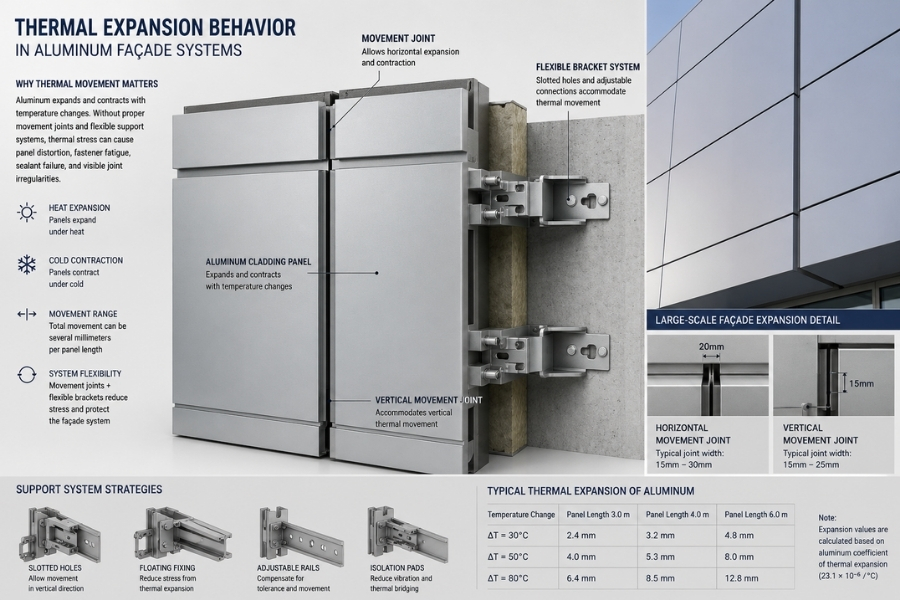
Modern rainscreen systems address these risks through movement-aware design strategies.
These may include:
expansion joints
floating fixing systems
slotted attachment points
flexible bracket assemblies
controlled joint spacing
ventilated cavity design
Joint design is particularly important.
Undersized movement joints may restrict natural expansion behavior, while inconsistent joint geometry can create visual irregularities across the façade. In large commercial projects, façade consultants often coordinate movement joint layouts together with panel module dimensions to balance visual consistency and thermal accommodation.
Thermal expansion behavior also influences fabrication decisions.
Oversized panel spans may improve visual simplicity but can increase thermal stress and surface movement under changing environmental conditions. Smaller modular layouts may improve movement control while increasing fabrication and installation complexity.
These trade-offs are a normal part of façade engineering.
Why Rainscreen Design Improves Long-Term Weather Protection
Modern aluminum cladding systems are commonly installed as part of ventilated rainscreen assemblies.
Rather than relying entirely on exterior sealants to block water penetration, rainscreen systems manage moisture through layered drainage and ventilation strategies.
A typical rainscreen façade assembly may include:
exterior cladding panels
ventilation cavities
waterproof membranes
air barriers
cavity drainage paths
insulation layers
support rails
movement joints
cavity barriers
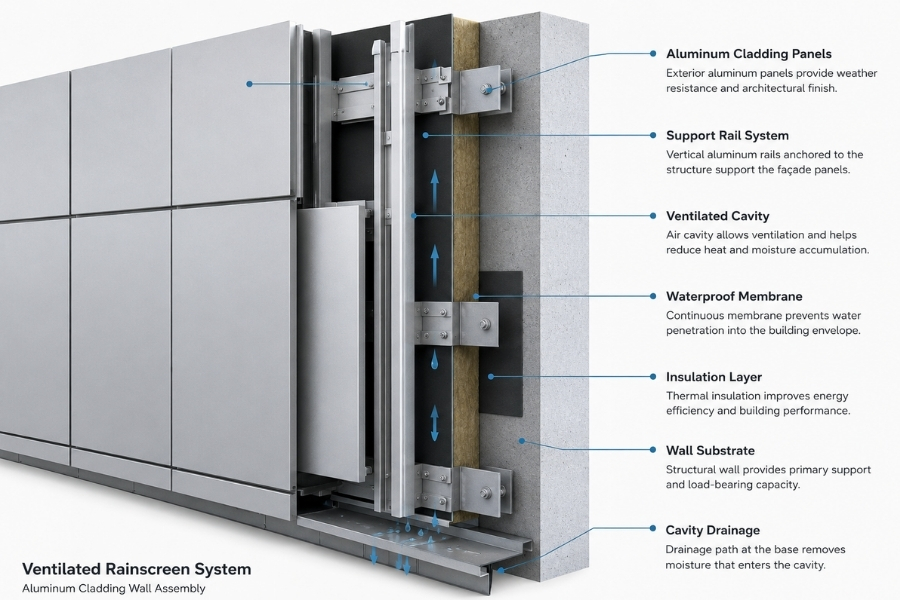
This layered approach improves long-term envelope durability by reducing trapped moisture behind the façade surface.
Water management logic becomes especially important around:
panel joints
window transitions
façade corners
floor slab intersections
movement joints
parapet terminations
Improper detailing in these areas may increase leakage risk even when high-quality panel materials are used.
Sealant performance alone cannot compensate for poor drainage design.
This is why modern façade engineering increasingly prioritizes pressure equalization, cavity ventilation, and drainage hierarchy instead of depending exclusively on exposed sealant lines.
In coastal and high-humidity environments, these considerations become even more critical because continuous moisture cycling and salt exposure place additional stress on the building envelope.
Why Coating Performance Often Determines Façade Lifecycle Durability
The long-term appearance of aluminum cladding depends heavily on coating quality and environmental exposure conditions.
Modern architectural cladding systems commonly use PVDF or FEVE coating technologies because of their resistance to:
UV degradation
chalking
gloss reduction
fading
environmental contamination
color instability
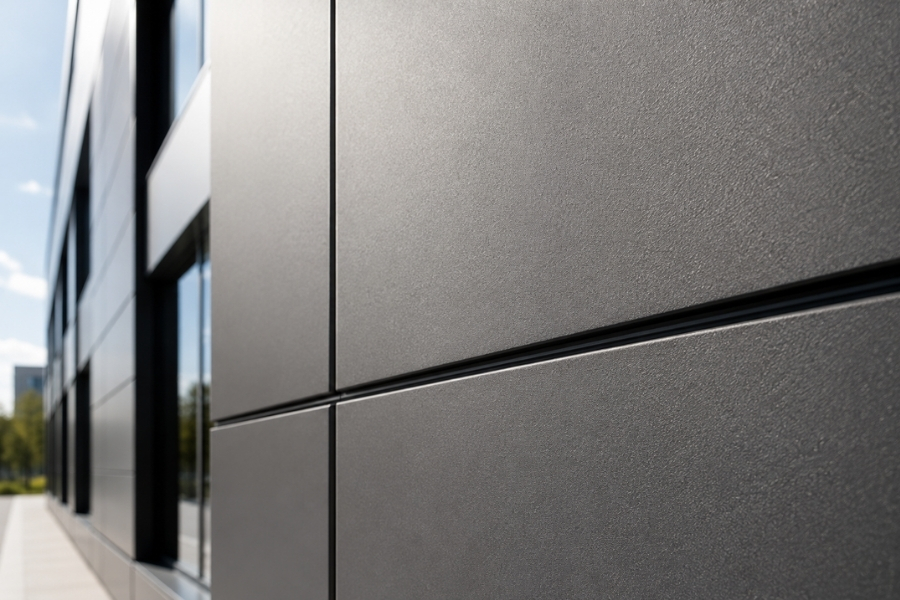
For large façade elevations, coating consistency is often just as important as structural performance.
Even small color variation differences between production batches may become visually noticeable under changing daylight conditions. This is one reason many façade projects evaluate Delta E color consistency during coating approval and production quality control.
Coating thickness also affects long-term weather resistance.
Insufficient coating thickness may reduce UV durability and accelerate finish degradation in aggressive climates with strong solar exposure, airborne pollution, or coastal salt conditions.
High-performance architectural coating systems frequently comply with standards such as AAMA 2605 for exterior durability requirements.
Surface finish selection also influences façade behavior.
Metallic coatings, matte finishes, brushed textures, anodized-look surfaces, and wood-look architectural finishes each interact differently with sunlight reflection, panel geometry, and viewing angles.
Large reflective surfaces may visually amplify panel waviness or substrate irregularities, which is why panel flatness control becomes increasingly important on high-visibility architectural projects.
Why Installation Coordination Often Determines Façade Quality
Even well-designed aluminum cladding systems can encounter long-term performance problems if installation sequencing and field coordination are poorly managed.
Façade installation quality depends on factors such as:
bracket alignment
support rail leveling
fixing accuracy
movement joint consistency
waterproofing coordination
panel handling conditions
field adjustment tolerances
Tolerance accumulation is a common challenge in large-scale façade projects.
Small deviations in support rail alignment can gradually affect panel positioning across long elevations, eventually creating inconsistent joints, uneven shadow lines, or visible façade distortion.
This becomes particularly noticeable on metallic finishes or continuous curtain wall interfaces where visual precision is critical.
Modern prefabricated aluminum cladding systems help reduce some of these risks because much of the fabrication work occurs under controlled manufacturing conditions before arriving on site.
However, successful installation still requires coordination between:
façade consultants
structural engineers
waterproofing teams
cladding installers
fabrication suppliers
project managers
On complex projects, façade quality is often determined as much by installation sequencing and coordination discipline as by material quality itself.
Why Fire Compliance Must Be Evaluated as a Complete Façade Assembly
Fire performance remains one of the most critical considerations in façade specification.
Aluminum cladding should never be evaluated as an isolated material without considering the complete wall assembly.
Real façade fire behavior depends on the interaction between:
cladding panels
insulation systems
cavity barriers
ventilation cavities
fixing methods
air barriers
structural support systems
This is why modern façade regulations increasingly focus on assembly-level testing rather than individual panel performance alone.
Depending on project location and building type, façade systems may require evaluation against standards such as:
EN 13501-1
NFPA 285
ASTM E84
BS 8414
Early coordination between architects, façade consultants, fire engineers, and manufacturers is often necessary to balance compliance requirements with architectural goals and installation practicality.
For high-rise and public infrastructure projects, façade specification decisions increasingly prioritize complete system performance rather than isolated material marketing claims.
Why Aluminum Cladding Continues to Shape Contemporary Architecture
Modern architectural design increasingly emphasizes clean geometry, façade continuity, lightweight construction, and long-term operational efficiency.
Aluminum cladding systems support these objectives because they combine:
fabrication flexibility
lightweight construction
coating durability
large-format visual consistency
rainscreen compatibility
installation efficiency
long-term maintainability
Unlike many traditional façade materials, aluminum cladding can adapt to both highly engineered building envelopes and architecturally expressive exterior forms without creating excessive structural complexity.
This balance between engineering performance and architectural flexibility is one reason aluminum cladding continues to dominate modern façade design across commercial, institutional, transportation, and mixed-use construction sectors.
As building envelopes become increasingly performance-driven, aluminum cladding is evolving beyond a simple exterior finish into a highly coordinated façade engineering system.
Aluwell® supports modern architectural projects with custom aluminum cladding fabrication, architectural coating solutions, large-format façade panel manufacturing, and project-oriented exterior wall system support designed for contemporary commercial construction and engineered building envelopes.
FAQ
Is aluminum cladding suitable for high-rise façade systems?
Yes, aluminum cladding is widely used in high-rise construction because of its lightweight structure, fabrication flexibility, and compatibility with ventilated rainscreen assemblies. However, panel dimensions, support spacing, movement joints, and fire compliance requirements must all be carefully engineered to ensure long-term façade stability and safety.
Why do aluminum façade panels sometimes develop oil-canning?
Oil-canning is usually caused by thermal expansion stress, insufficient panel stiffness, improper fixing methods, or inconsistent support alignment. Large reflective panels can make minor surface waviness more visible. Proper panel geometry, controlled fabrication tolerances, and movement-accommodating fixing systems help reduce this risk.
What coating system is commonly used for architectural aluminum cladding?
PVDF and FEVE coating systems are commonly specified for exterior architectural cladding because they provide strong UV resistance, long-term color retention, and weather durability. Many high-performance projects also require coating systems that comply with standards such as AAMA 2605 for exterior exposure performance.
Why are movement joints important in aluminum cladding systems?
Aluminum naturally expands and contracts with temperature fluctuations. Without properly designed movement joints, thermal stress may lead to panel distortion, sealant fatigue, fastener stress, or joint failure. Expansion joints and flexible fixing systems help maintain long-term façade stability under changing environmental conditions.
Is aluminum cladding considered a fire-resistant façade material?
Fire performance depends on the complete façade assembly rather than the aluminum panel alone. Cladding panels, insulation, cavity barriers, fixing systems, and ventilation cavities all influence fire behavior. Project teams typically evaluate systems against standards such as NFPA 285, EN 13501-1, ASTM E84, or BS 8414 depending on local code requirements.
What factors affect the long-term durability of aluminum cladding?
Long-term performance depends on several factors, including coating quality, panel fabrication precision, drainage design, thermal movement accommodation, environmental exposure, and installation accuracy. Coastal climates, UV intensity, pollution levels, and poor waterproofing coordination can all affect façade lifespan if not properly addressed during design and construction.