

13 May
Why Lightweight ACM Panels Have Become a Popular Choice for Commercial Facades
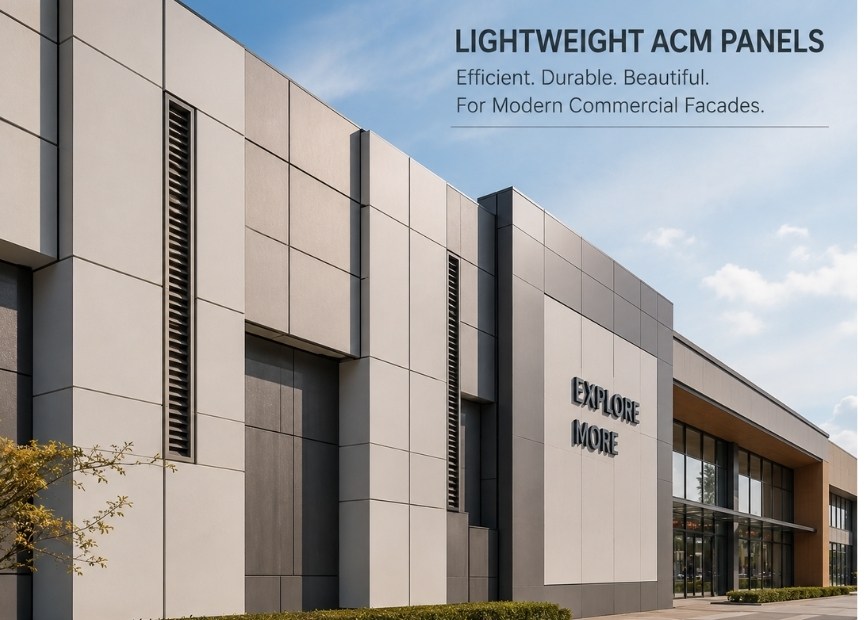
Modern commercial architecture places enormous pressure on façade systems. Exterior materials are expected to deliver long-term durability, precise aesthetics, weather resistance, efficient installation, and lower lifecycle costs — often within increasingly complex building geometries and compressed construction schedules.
This is one reason lightweight metal facade systems based on ACM technology have become increasingly common across office towers, transportation hubs, mixed-use developments, and retail architecture. Architects and façade consultants are not simply looking for attractive exterior materials anymore. They are looking for systems that improve construction efficiency while maintaining long-term building envelope stability.
Unlike many traditional cladding materials, these systems help simplify large-scale façade construction while maintaining clean visual consistency across complex exterior elevations.
What Are ACM Panels?
Aluminum Composite Material panels, commonly called ACM panels, are manufactured by bonding two thin aluminum sheets to a lightweight non-aluminum core. Depending on project requirements, the core may consist of polyethylene (PE) or a mineral-filled fire-resistant (FR) material.
This composite structure creates a panel that is both lightweight and rigid.
The aluminum surfaces provide structural stability, corrosion resistance, flatness, and smooth architectural finishes, while the internal core increases stiffness without significantly increasing overall weight.
Compared with solid aluminum sheets or steel cladding systems, composite facade panels may reduce material weight by more than 60 percent while still maintaining strong façade performance.
Modern commercial projects commonly use these systems for:
Curtain wall cladding
Ventilated rainscreen assemblies
Soffits and parapets
Entrance canopies
Corporate branding façades
Interior architectural wall systems
Why Lightweight Panels Matter in Commercial Buildings
Weight affects nearly every aspect of façade engineering.
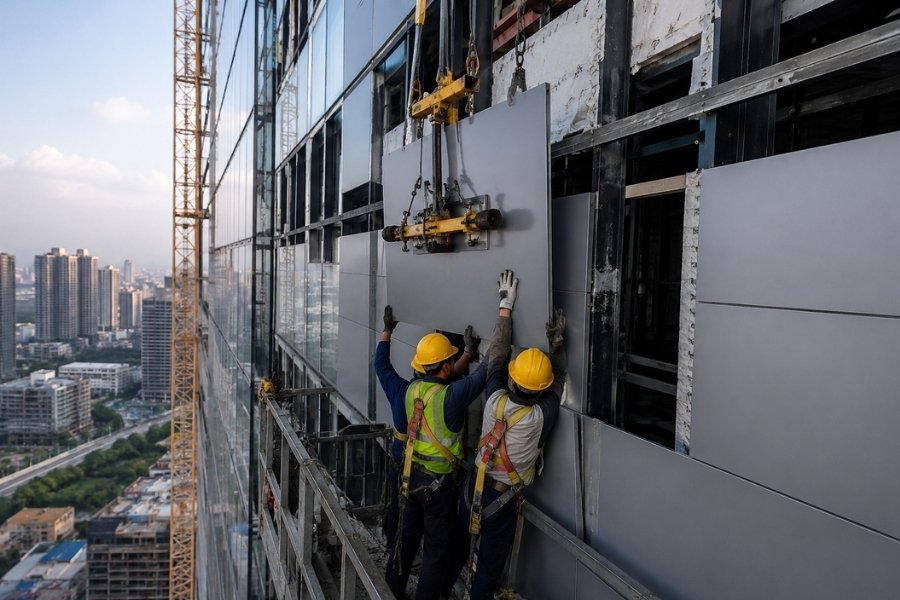
As commercial buildings become taller and more geometrically ambitious, reducing exterior dead load directly influences structural requirements, crane logistics, anchoring systems, installation speed, and long-term building movement behavior.
Heavier exterior wall systems typically require:
Larger support structures
Increased slab edge reinforcement
Stronger anchoring assemblies
Higher transportation costs
More installation labor
This is one reason lightweight architectural cladding has become increasingly attractive in both new construction and retrofit projects.
In older commercial buildings, existing structural capacity may already be close to its design limit. Adding heavy recladding systems often requires additional reinforcement work, which can significantly increase project cost and schedule complexity.
A recent commercial podium renovation in Southeast Asia used more than 14,000 square feet of large-format aluminum composite panels across the exterior envelope. Because the project involved an aging reinforced concrete structure, reducing façade weight became a major engineering priority during the early design phase.
The lower panel weight simplified transportation, reduced crane dependency, and helped minimize structural modifications to the original building frame.
Lightweight Panels With Strong Structural Performance
Lightweight materials are often incorrectly associated with reduced structural strength.
In reality, properly engineered composite cladding systems provide excellent rigidity relative to their weight because the panel structure distributes stress efficiently across the surface.
This helps improve resistance against:
Wind pressure
Panel vibration
Thermal movement stress
Localized impact loading
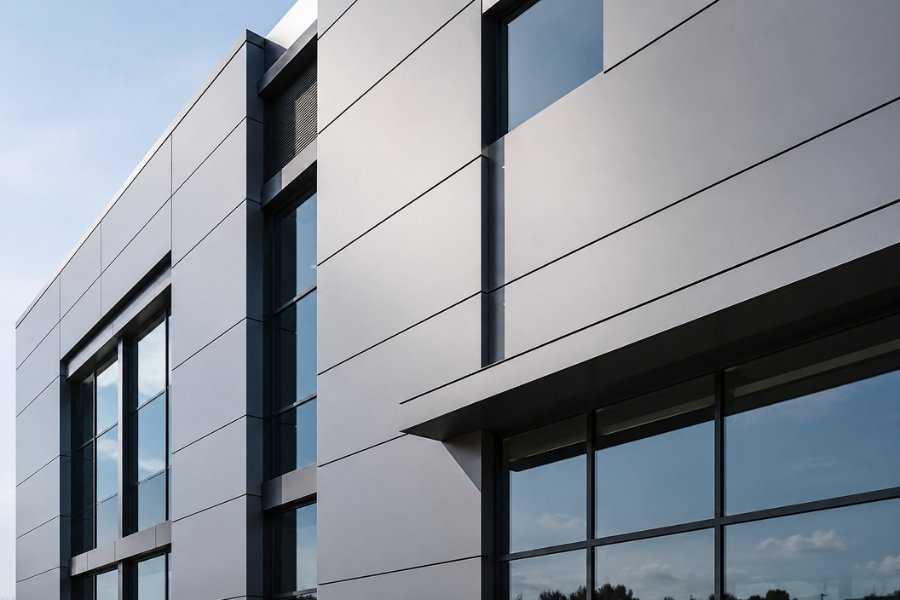
As façade dimensions increase, maintaining visual flatness becomes more difficult. Uneven support tolerances, improper fastening pressure, or thermal expansion stress may contribute to visible waviness, sometimes called oil canning.
This becomes increasingly important in projects featuring:
Long horizontal elevations
Reflective metallic finishes
Large uninterrupted panel layouts
High-visibility corporate façades
Modern commercial architecture increasingly emphasizes clean geometry, shadow depth, and uninterrupted transitions between glass curtain walls and solid cladding zones.
Faster Fabrication and Easier Installation
Construction speed has become a major priority in commercial façade projects.
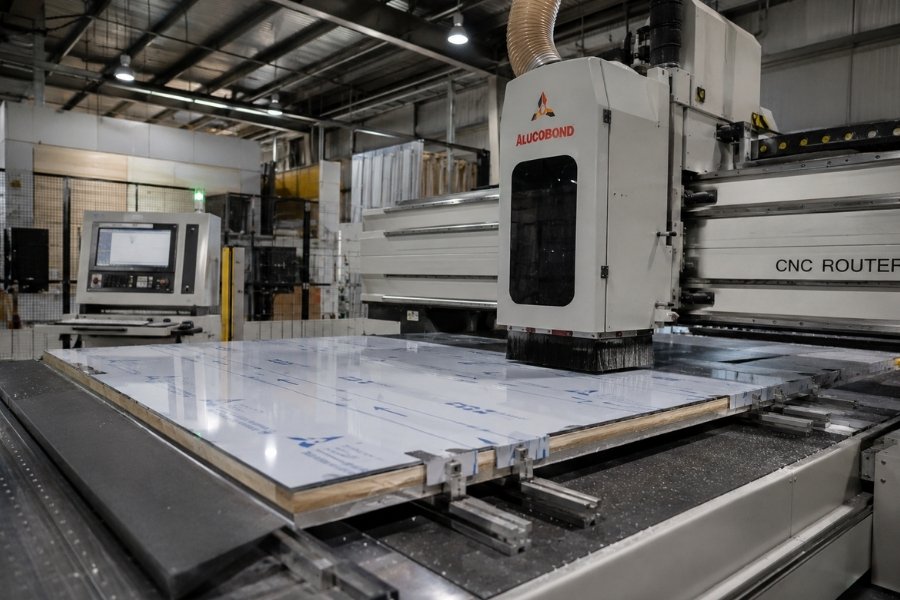
Because these architectural exterior systems are lightweight and easy to machine, they support faster off-site production and more efficient on-site assembly.
Panels can be:
Routed
Folded
Curved
CNC-machined
Fabricated into cassette systems
Pre-assembled into modular façade sections
Some manufacturers now use CNC-routed cassette fabrication combined with off-site mock-up calibration to reduce alignment problems during installation. This approach becomes especially valuable on large commercial elevations where small dimensional inconsistencies may become visually amplified across long façade spans.
Collaborative design workflows supported by Aluwell® help integrate fabrication, engineering, and site coordination during earlier project stages, reducing uncertainty between architectural intent and on-site execution.
Typical façade assembly systems may include:
Hook-and-rail concealed fastening
Routed-and-returned cassette systems
Ventilated rainscreen cladding assemblies
Adjustable aluminum subframes
These solutions help improve installation efficiency while reducing visible fasteners across the finished façade surface.
More Design Freedom for Modern Facades
Modern façades are expected to do more than protect the building envelope.
They also contribute to architectural identity, visual rhythm, branding integration, and perceived building scale.
This is one reason modern facade materials increasingly prioritize fabrication flexibility alongside structural performance.
Aluminum composite facades support:
Sharp edges
Controlled joint spacing
Curved geometry
Seamless surface transitions
Large-format cladding layouts
Alternating panel widths, recessed joints, metallic finishes, and shadow lines can reduce the perceived mass of large commercial buildings while creating more dynamic exterior elevations.
In many mixed-use developments, façade designers also use composite panels to create smoother transitions between glazing systems, signage zones, soffits, and solid wall areas.
High-quality architectural composite systems are available in a wide range of finishes, including:
Matte surfaces
Metallic finishes
Brushed textures
Stone-look finishes
Woodgrain patterns
Mirror effects
Weathered steel appearances
For branding-oriented commercial projects, maintaining color consistency across large production batches is especially important.
Delta E values are often used to evaluate color variation between panels. Lower Delta E values indicate greater consistency between production runs, helping maintain uniform façade appearance across large elevations.
Built for Long-Term Exterior Performance
Commercial façades operate under constant environmental exposure.
UV radiation, moisture, freeze-thaw cycling, airborne pollutants, humidity, and thermal expansion all affect long-term material behavior.
High-quality aluminum cladding panels are designed to resist these conditions while maintaining surface stability and finish consistency over extended service periods.
PVDF coating systems are commonly specified because they provide strong resistance against:
UV degradation
Chalking
Color fading
Chemical contamination
Moisture exposure
In coastal and humid environments, rear ventilation behind the façade also becomes increasingly important.
Without proper airflow and moisture drainage, trapped humidity may gradually affect insulation performance, fastening systems, and wall durability.
How ACM Panels Improve Rainscreen Facade Systems
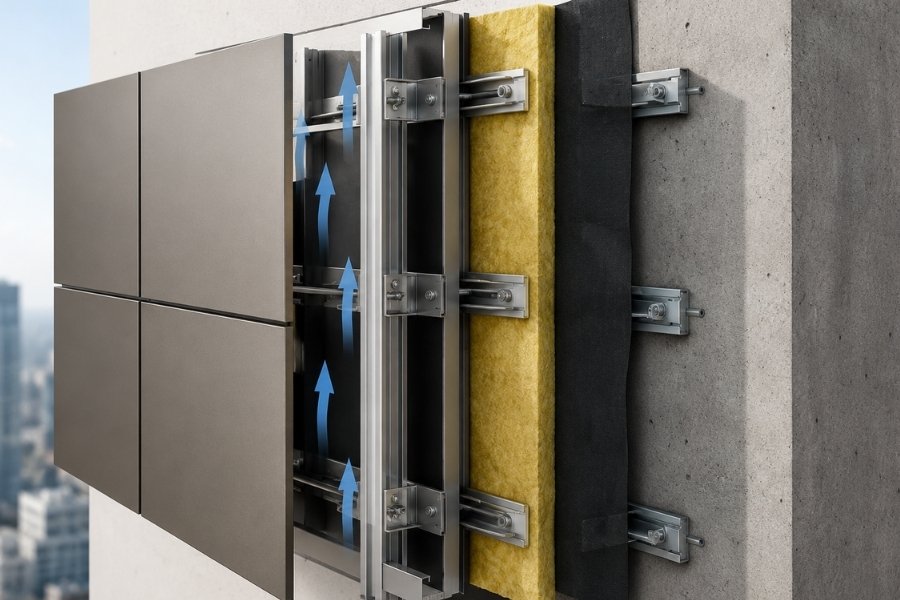
Most modern aluminum composite facades are installed as ventilated rainscreen systems rather than fully sealed exterior walls.
Instead of attempting to block all moisture at the outer surface, rainscreen systems manage water penetration through drainage, cavity ventilation, and pressure equalization.
A typical rainscreen assembly may include:
Exterior composite panels
Ventilated cavity
Insulation layers
Air and moisture barriers
Adjustable subframe systems
Commercial rainscreen cavities commonly range between 25 mm and 50 mm depending on climate conditions, airflow requirements, and façade design.
The cavity allows:
Rear ventilation airflow
Moisture drainage
Pressure equalization
Reduced condensation risk
Improved thermal performance
In humid climates, this ventilation path becomes especially important for long-term wall durability.
Poorly ventilated wall assemblies may trap moisture behind the cladding surface, increasing the risk of insulation deterioration and corrosion around fastening systems.
Proper drainage detailing, cavity continuity, and expansion joint placement all contribute to long-term façade performance.
Why Fire-Resistant ACM Panels Matter
Fire safety has become one of the most important considerations in commercial façade specification.
Not all aluminum composite systems are designed for the same building applications.
For high-rise developments and public buildings, fire-resistant panels with mineral-filled cores are often required to comply with local code requirements and wall assembly standards.
FR-grade systems help reduce flame spread and improve overall façade safety performance.
Fire performance also depends on:
Joint detailing
Cavity barrier placement
Insulation compatibility
Subframe configuration
Full wall assembly design
Proper expansion joint design is also critical because aluminum naturally expands and contracts under temperature variation.
Lightweight ACM Panels and Sustainable Building Design
Sustainability increasingly influences façade material selection across commercial architecture.
Aluminum is highly recyclable, and many manufacturers now incorporate recycled content into production processes.
Compared with heavier cladding materials, large-format cladding systems based on composite panel technology may also reduce transportation energy and structural material requirements.
Additional sustainability advantages include:
Lower transportation loads
Reduced structural steel demand
Faster installation
Long service life
Reduced maintenance frequency
Because these systems maintain finish performance for decades with relatively limited maintenance, they also contribute to lower lifecycle replacement demand.
Where Lightweight ACM Panels Are Commonly Used
Today, these metal building envelope systems are widely used across many commercial sectors, including:
Office towers
Retail storefronts
Shopping centers
Hotels
Airports
Hospitals
Educational buildings
Transportation terminals
Commercial renovation projects
They are also commonly used for:
Signage systems
Entrance canopies
Column covers
Ceiling systems
Interior wall cladding
In recent years, aluminum composite systems have also become increasingly common in façade retrofit projects where architects want to modernize older commercial buildings without introducing excessive structural load.
FAQ
Can lightweight ACM panels still handle high wind loads in tall buildings?
Yes. Properly engineered composite facade systems can maintain excellent rigidity and wind resistance despite their lower weight. Structural performance depends on panel thickness, fastening design, subframe engineering, and overall wall assembly configuration rather than panel weight alone.
Why are ventilated rainscreen systems commonly used with ACM facades?
Ventilated rainscreen systems help manage moisture through rear airflow, drainage, and pressure equalization. The cavity behind the panels reduces condensation risk, improves thermal stability, and helps extend the long-term durability of commercial wall assemblies.
What causes visible waviness or oil canning in metal facade panels?
Oil canning is a visual distortion sometimes seen on reflective metal surfaces. It may result from thermal movement, uneven subframes, excessive fastening pressure, or installation tolerances. Proper panel fabrication and support alignment help minimize this effect.
Are ACM panels suitable for commercial facade retrofit projects?
Yes. Lightweight architectural cladding systems are widely used in renovation and recladding projects because they add less structural load to existing buildings. This helps simplify upgrades while reducing the need for major reinforcement work.
How do PVDF coatings improve long-term facade performance?
PVDF coating systems provide strong resistance against UV exposure, color fading, chalking, moisture, and environmental pollutants. These coatings help commercial façades maintain long-term surface stability and consistent appearance under demanding exterior conditions.
Can ACM panels be fabricated into curved or complex facade shapes?
Yes. Aluminum composite panels can be routed, folded, curved, and CNC-machined into customized forms. This fabrication flexibility allows architects to create curved elevations, recessed joints, sharp corners, and large-format façade compositions with precise visual alignment.
Why Architects Continue Choosing Lightweight ACM Panels
The growing popularity of ACM technology is closely tied to the changing demands of commercial façade design.
Modern building envelopes must balance:
Structural efficiency
Visual precision
Installation speed
Long-term durability
Energy performance
Construction cost control
Composite cladding systems help address these requirements through a combination of lightweight engineering, fabrication flexibility, weather resistance, and architectural versatility.
For architects, the material supports cleaner façade modulation, sharper geometry, and greater freedom across large commercial elevations.
For contractors, lighter panel systems help simplify handling, transportation, and installation coordination.
For developers, long-term durability and reduced maintenance requirements improve lifecycle value.
With more than two decades of composite panel manufacturing experience, ALUMAX Composite Material Co., Ltd. continues supporting commercial façade projects through collaborative design assistance, customized fabrication, modularized production, and advanced processing capabilities developed alongside Taiwan Alumax Industrial Co.
Today, Aluwell® systems are widely used in commercial façades, signage environments, transportation projects, and customized architectural cladding applications across global markets.