

08 May
Why Rainscreen Systems Matter in Modern ACM Facades
Modern exterior wall systems are expected to do far more than create a visually clean appearance. Today’s commercial buildings must manage moisture, improve thermal efficiency, withstand environmental exposure, and maintain long-term durability across decades of operation.
This shift has changed how architects evaluate the building envelope. In many contemporary projects, especially high-rise and large-scale commercial developments, the outer wall is no longer treated as a decorative surface alone. It functions as a performance-driven architectural system.
As a result, ventilated façade systems have become increasingly common in projects using aluminum composite material panels, particularly where long-term weather resistance and operational efficiency are critical design considerations.
For architects, developers, and façade consultants, the discussion is no longer simply about selecting cladding materials. The larger question is how the entire exterior wall assembly manages airflow, drainage, thermal movement, and environmental stress over time.
Modern ACM Facades Need More Than Surface Protection
Traditional wall assemblies often relied on the outer cladding surface as the primary defense against water penetration. In real construction environments, however, wind-driven rain, pressure differences, thermal expansion, and aging sealants make complete exterior sealing difficult to maintain throughout a building’s lifecycle.
Modern rainscreen design approaches this challenge differently.
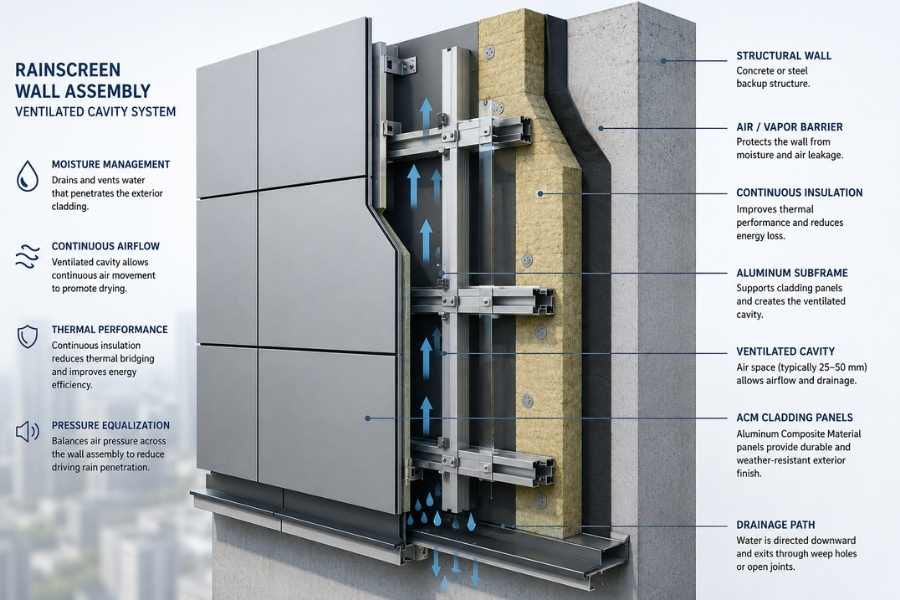
Rather than attempting to stop all moisture at the outer surface, a rainscreen assembly is designed to control and redirect water before it can damage the architectural envelope. The system allows moisture to drain and evaporate through a ventilated cavity behind the cladding panels.
A typical ventilated wall assembly may include:
Exterior composite panels
Continuous insulation
Air and vapor barrier systems
Aluminum support framing
Drainage and flashing components
Fire-stopping and cavity barrier systems
Together, these layers create a high-performance wall system capable of handling environmental exposure more effectively than conventional sealed façades.
This approach has become particularly important in regions exposed to:
Coastal humidity and salt air
Freeze-thaw cycles
Heavy seasonal rainfall
Strong wind pressure
High UV exposure
Large daily temperature swings
In these environments, long-term façade reliability depends heavily on how the wall assembly manages moisture and thermal stress behind the visible cladding surface.
How Rainscreen Systems Control Moisture and Airflow
Why Ventilated Cavities Matter
Moisture management is one of the primary reasons ventilated cladding systems are widely used in contemporary architecture.
Even high-quality exterior panels are not intended to function as completely watertight barriers. Water can still enter through joints, fastener penetrations, pressure-driven openings, or construction tolerances during severe weather conditions.
Problems begin when moisture becomes trapped inside the wall assembly.
Over time, trapped water may contribute to:
Mold growth
Corrosion
Insulation degradation
Coating deterioration
Structural damage
Reduced thermal efficiency
A ventilated cavity creates space for drainage and evaporation behind the exterior skin.
Instead of remaining trapped behind the cladding, moisture is directed downward through flashing systems while continuous airflow helps dry the assembly naturally.
In many commercial façade projects, cavity depths typically range between 25 mm and 50 mm depending on airflow strategy, façade geometry, and regional construction standards.
In humid coastal climates, insufficient cavity depth can slow drainage performance and increase condensation risks behind metal composite cladding during seasonal temperature fluctuations.
Managing Wind-Driven Rain and Water Penetration
High-rise buildings and exposed commercial structures often experience significant wind pressure across the outer wall surface.
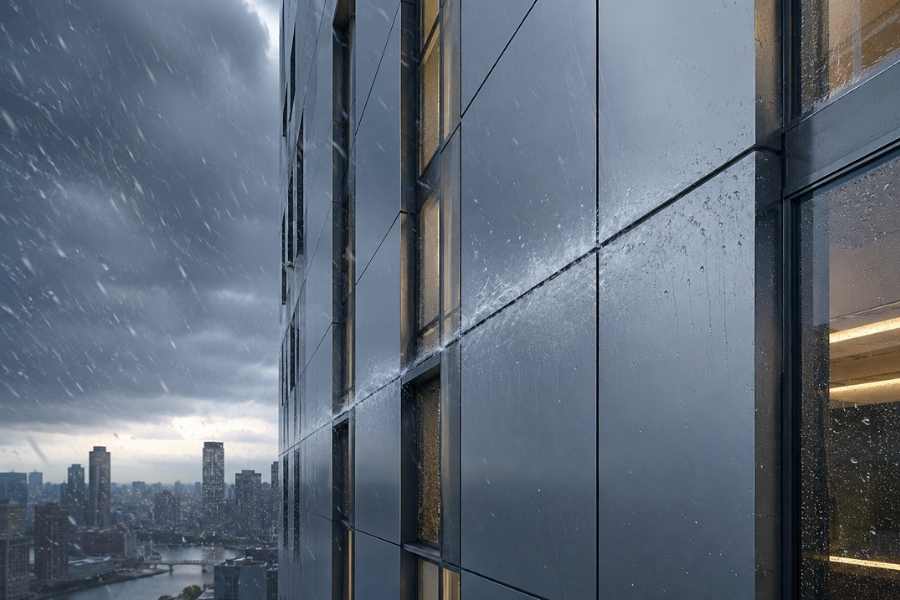
Without pressure management, wind-driven rain can be forced through joints and gaps within the exterior wall assembly. This becomes especially problematic around corners, slab edges, parapets, and window transitions.
Ventilated façade assemblies help reduce this risk through pressure equalization.
The air cavity reduces pressure differences between the outer cladding surface and the inner wall structure. As pressure becomes more balanced, the force driving water into the system decreases.
This principle becomes increasingly important in:
Coastal towers
Airport terminals
Healthcare facilities
High-rise residential buildings
Large mixed-use developments
Poorly aligned support brackets or inconsistent cavity depths can disrupt airflow and drainage performance across large wall elevations. This is one reason installation precision is critical in modern cladding construction.
How Airflow Extends Façade Lifespan
Continuous airflow inside a cavity wall assembly also improves long-term durability.
During warmer seasons, heat buildup behind dark-colored exterior panels can significantly increase surface temperatures. Ventilated cavities help release trapped heat through natural convection.
Warm air rises through the cavity and exits near the top of the façade while cooler air enters from below. This chimney effect continuously circulates air behind the cladding system without requiring mechanical energy.
Consistent airflow helps reduce:
Condensation accumulation
Heat retention behind panels
Moisture-related staining
Biological growth
Thermal stress on coatings
For PVDF-coated ACM panels, reducing excessive heat buildup may also help maintain long-term color consistency and coating stability in high-UV environments.
This becomes particularly important in regions with intense solar exposure, where exterior wall temperatures can fluctuate significantly throughout the day.
Why ACM Panels Work Well in Rainscreen Facades
Lightweight Panels Improve Installation Efficiency
Modern ventilated wall systems rely heavily on lightweight façade materials that can balance durability with installation efficiency.
Compared with solid aluminum plate or masonry cladding systems, aluminum composite panels offer a high strength-to-weight ratio that reduces structural load on the exterior wall assembly.
This creates several practical advantages during construction:
Faster installation
Easier material handling
Reduced subframe demand
Lower transportation weight
Improved installation efficiency at height
These advantages become especially valuable in large commercial developments where installation speed directly affects labor costs and construction schedules.
For retrofit projects, lighter architectural cladding systems may also reduce the need for major structural reinforcement.
Consistent Flatness Supports Modern Facade Design
Large-scale commercial buildings depend heavily on visual consistency.
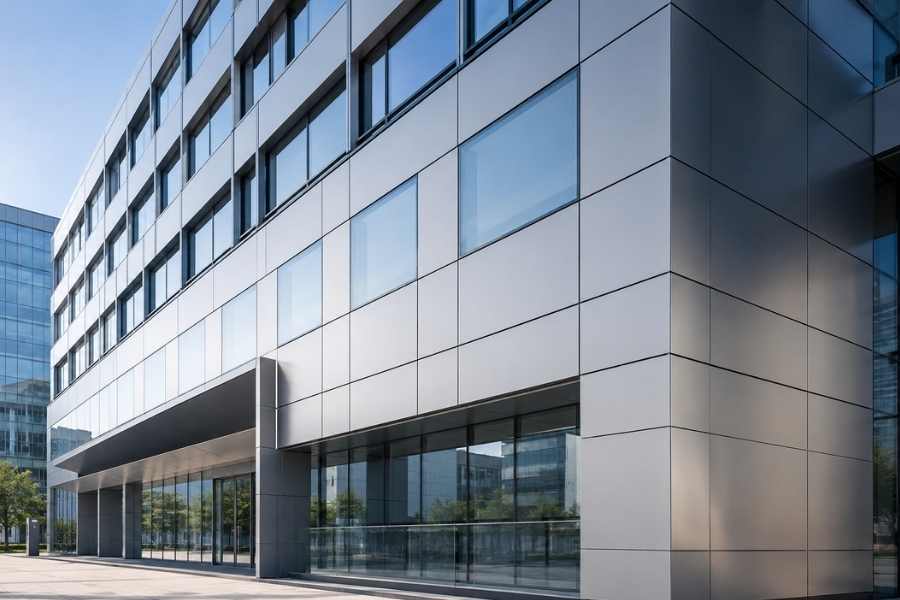
Uneven panel surfaces, inconsistent joint lines, or visible distortion can become highly noticeable across expansive exterior elevations.
One reason composite façade panels remain widely specified is their ability to maintain surface flatness across large panel dimensions while supporting precise fabrication tolerances.
This supports:
Consistent joint alignment
Clean shadow lines
Uniform façade rhythm
Minimal visual distortion
Precise geometric transitions
In many contemporary office towers and branded commercial developments, façade composition plays a major role in architectural identity.
Alternating finishes, metallic coatings, woodgrain textures, and custom color systems are often used to reduce perceived building scale while reinforcing the visual language of the project.
Flexible Fabrication for Complex Architectural Designs
Contemporary wall systems increasingly incorporate:
Curved elevations
Folded panel geometry
Deep reveals
Custom perforation patterns
Integrated signage systems
Parametric façade layouts
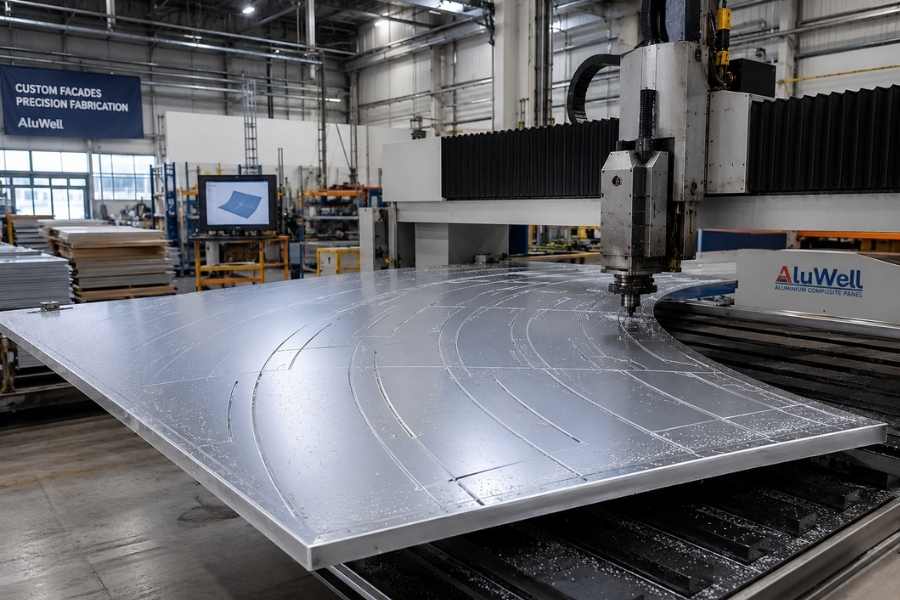
Because aluminum composite material systems can be routed, folded, cut, and machined efficiently, they remain highly compatible with complex rainscreen fabrication requirements.
At ALUMAX Composite Material Co., Ltd., the Aluwell® brand supports these applications through collaborative façade coordination, CNC machining capability, and customized fabrication support.
Rather than functioning only as a panel supplier, the company works with architects, fabricators, and contractors during early project stages to help coordinate panel dimensions, attachment strategies, installation sequencing, and façade detailing requirements.
This type of early coordination becomes increasingly important in projects involving custom geometry or large-scale modular cladding systems.
How Rainscreen Systems Improve Long-Term Building Performance
Managing Expansion and Thermal Movement
All exterior wall materials experience thermal expansion and contraction.
In large architectural assemblies, repeated movement caused by temperature changes can place stress on:
Fasteners
Sealants
Joints
Support framing
Panel edges
Without proper accommodation for movement, façade systems may eventually develop:
Joint misalignment
Oil-canning effects
Panel distortion
Sealant separation
Water penetration risks
Ventilated rainscreen assemblies help reduce these stresses by separating the outer cladding layer from the structural backup wall.
Properly engineered support systems allow the wall assembly to absorb movement more effectively while maintaining alignment and weather resistance.
This becomes particularly important on long elevations exposed to direct sunlight throughout the day.
Better Thermal Performance and Energy Efficiency
Ventilated cladding systems also contribute to operational efficiency by improving how the exterior wall assembly manages heat transfer.
The cavity helps stabilize wall temperatures while continuous insulation reduces thermal bridging through the support structure.
In many commercial buildings, this can help lower HVAC demand while improving occupant comfort during seasonal temperature changes.
The performance benefits become more noticeable in:
Buildings with large solar exposure
Glass-and-metal high-rise developments
Mixed-use commercial projects
Warm and humid climates
For projects pursuing sustainability certifications or long-term operational efficiency targets, ventilated envelope systems often play an important role within the overall building performance strategy.
Lower Maintenance Over the Building Lifecycle
Long-term maintenance requirements are heavily influenced by moisture exposure and thermal stress.
When water becomes trapped behind exterior panels, deterioration can accelerate across coatings, fasteners, insulation layers, and support systems.
Ventilated façade assemblies help reduce these risks by improving drying performance throughout the wall cavity.
As a result, building owners may experience:
Lower maintenance frequency
Reduced façade staining
Improved coating longevity
Fewer moisture-related repairs
More stable long-term appearance
High-performance coating systems also play an important role in long-term durability.
For example, 70% PVDF coating systems are commonly specified for commercial architectural cladding panels because they provide strong resistance against UV exposure, fading, chalking, and environmental pollutants.
Aluwell® composite panels are manufactured using advanced production technologies developed by Taiwan Alumax Industrial Co., which has exported hundreds of composite panel production lines globally and developed more than 20 patented technologies related to composite material equipment and processing systems.
Fire Safety in Modern ACM Rainscreen Facades
Fire safety has become one of the most important considerations in modern façade engineering following several major international façade fire incidents.
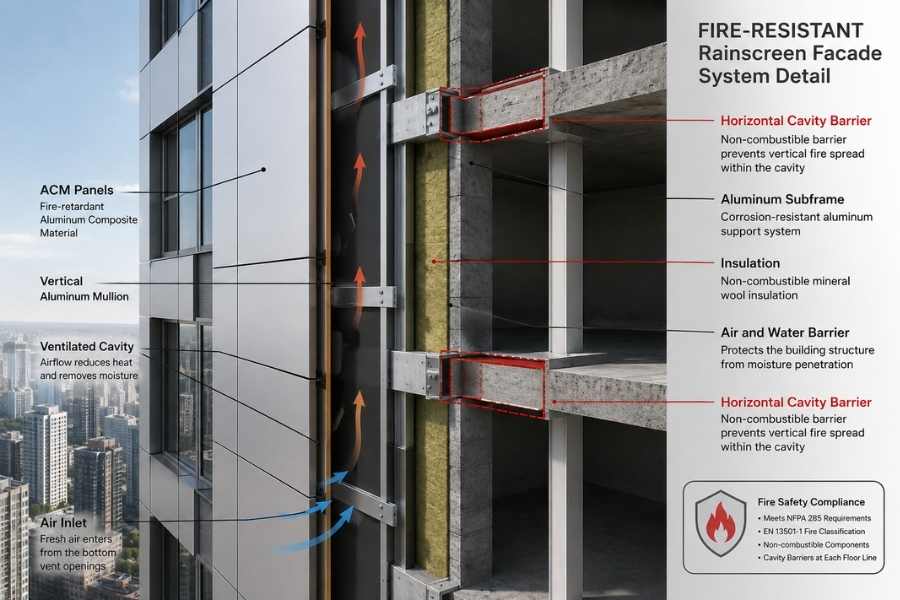
While ventilated cavities improve moisture management and thermal performance, they can also accelerate vertical fire spread if combustible materials are improperly specified.
Modern exterior wall systems therefore require careful coordination between:
Cladding materials
Insulation systems
Cavity barriers
Attachment methods
Fire compartmentation strategy
Current façade specifications increasingly prioritize:
Fire-retardant ACM materials
Non-combustible insulation
Horizontal and vertical cavity barriers
Intumescent fire-stopping systems
Compliance with regional façade regulations
Many high-rise regulations now restrict the use of standard polyethylene-core composite panels for certain building types and heights.
As a result, architects increasingly specify systems designed to comply with standards such as:
EN 13501 classifications
NFPA façade testing requirements
GB 8624 fire performance classifications
Why Early Coordination Improves Rainscreen Installation
Many façade performance failures do not originate from the panel material itself.
Instead, problems often appear during coordination and installation stages.
Common site-related issues include:
Uneven cavity depths
Misaligned support brackets
Poor drainage detailing
Incorrect flashing transitions
Improper cavity barrier installation
Inconsistent attachment tolerances
Even small dimensional inconsistencies can affect airflow and water drainage performance across large wall elevations.
This is why early coordination between architects, fabricators, engineers, and installers has become increasingly important in modern rainscreen construction.
ALUMAX supports this process through integrated technical assistance connecting:
Architecture
Engineering
Fabrication
Installation planning
Manufacturing coordination
The company also provides modularized façade support services, including full-scale mockup verification and factory-based calibration before on-site installation.
These processes help improve:
Installation accuracy
Construction efficiency
Dimensional consistency
Project scheduling reliability
Long-term façade performance
For complex architectural projects, early collaboration often reduces downstream installation risks while improving overall construction quality.
Why Rainscreen Facades Have Become Standard in Modern Architecture
Modern exterior wall systems are expected to balance aesthetics, durability, operational efficiency, safety, and long-term environmental performance simultaneously.
As buildings become more complex and environmental requirements become more demanding, ventilated rainscreen assemblies have evolved from a specialized façade strategy into a mainstream building envelope solution.
For contemporary ACM façade systems, ventilated wall assemblies help manage some of the most important long-term performance challenges in modern construction, including:
Moisture control
Thermal movement
Energy efficiency
Coating durability
Maintenance reduction
Weather resistance
When properly engineered and correctly installed, aluminum composite panels perform far beyond their role as decorative exterior surfaces alone.
For architects, developers, and façade consultants seeking durable, technically reliable, and visually refined building envelopes, rainscreen assemblies remain one of the most effective approaches in modern façade design.
FAQ
What is the purpose of a rainscreen system in ACM façades?
A rainscreen system helps manage moisture behind the exterior wall through drainage, ventilation, and pressure equalization. Instead of trapping water inside the wall assembly, the system allows moisture to dry and exit naturally, improving façade durability, reducing condensation risks, and supporting long-term building envelope performance.
What cavity depth is typically used in ventilated wall systems?
Most ventilated façade systems use cavity depths between 25 mm and 50 mm depending on airflow requirements, building height, joint design, and regional standards. Proper cavity spacing helps improve drainage, pressure equalization, ventilation performance, and moisture control throughout the exterior wall assembly.
Why are aluminum composite panels commonly used in ventilated façades?
Aluminum composite panels are lightweight, flat, durable, and easy to fabricate into custom architectural shapes. These characteristics make them well suited for ventilated façade systems used in commercial towers, institutional buildings, transportation hubs, and large-scale developments requiring efficient installation and long-term exterior performance.
Why is airflow important in a rainscreen façade system?
Continuous airflow inside the ventilated cavity helps remove trapped moisture and excess heat from the wall assembly. This improves drying performance, reduces condensation risks, limits thermal stress on coatings, and helps extend the service life of the façade system in demanding environmental conditions.
Are all composite panels suitable for high-rise façade systems?
No. High-rise buildings often require fire-retardant cladding materials that comply with local façade regulations and fire testing standards. Material selection should consider building height, occupancy type, insulation compatibility, and regional code requirements to ensure long-term façade safety and compliance.